
Tessellated Tiles in Rooty Hill
Rooty Hill has a long local history within Blacktown City, and its documented heritage places show why tile decisions should begin with the building and site rather than a pattern chosen in isolation. Authentic Heritage Tiling Co can help Rooty Hill property owners work through tessellated tile design, supply, installation and restoration, including verandah and pathway layouts and stone bullnose or edging coordination. Where older fabric remains, the right approach depends on what is present, what is damaged and how new work will meet it.
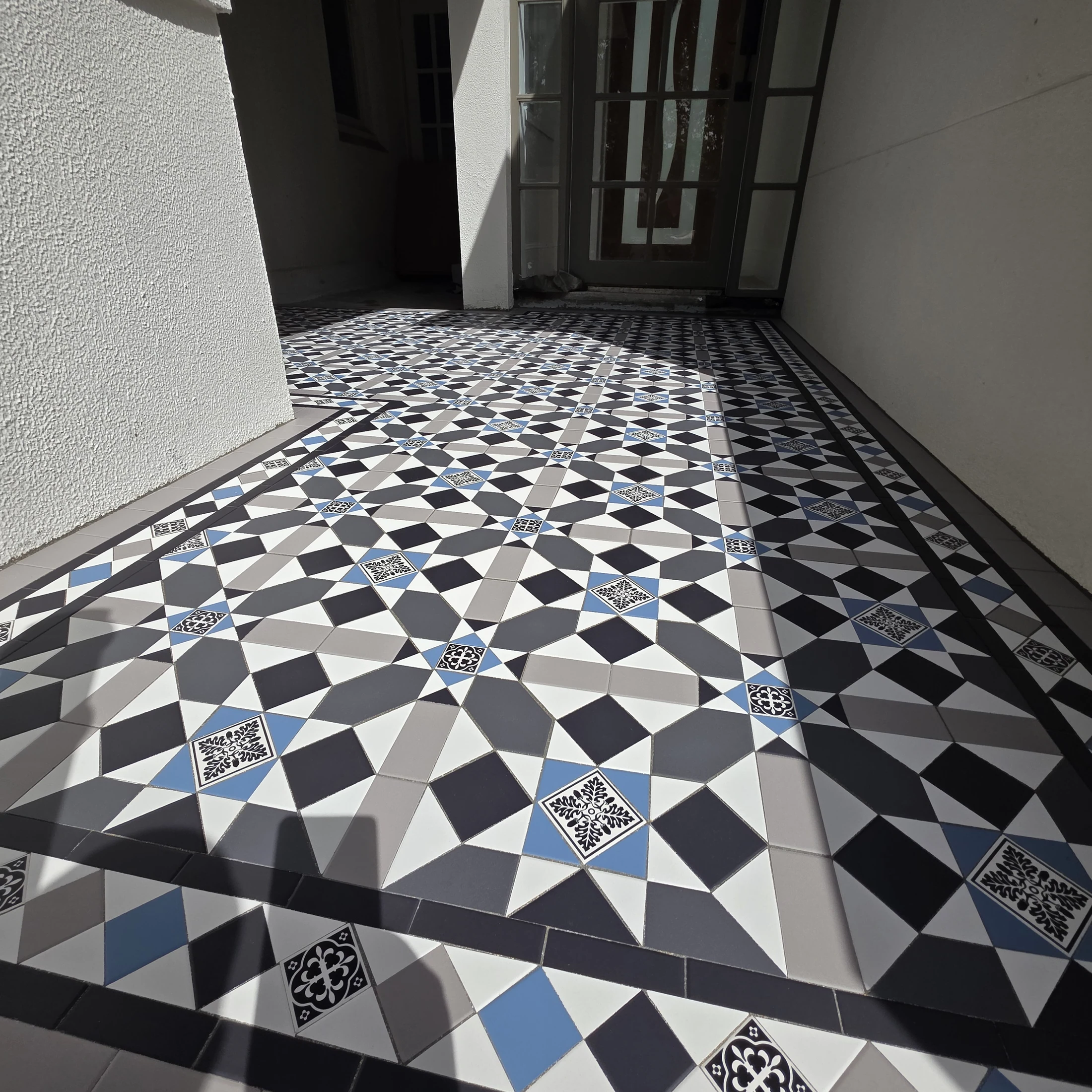
A Rooty Hill context for tile decisions
Rooty Hill has been known by its present name since 1810, and Blacktown City Council identifies it as one of the city's suburbs. That long history does not make every house historic, but it is a useful reminder to inspect the whole setting: the front approach, verandah proportions, thresholds, garden edges and any surviving original surfaces can all influence a sympathetic tile layout.
The NSW Heritage Management System records a Government Depot (Ruins) item in Rooty Hill. A separate Blacktown Council heritage impact statement documents a historic house and outbuildings whose appearance changed over time, from an earlier Victorian form to a later Inter-War Georgian Revival character. For owners of older or altered properties, matching the visible period cues may be more appropriate than assuming one historical style applies across the suburb.
Verandahs, pathways and edge details
A Rooty Hill verandah or front path needs a layout that works with its proportions and arrival sequence. Before selecting colours or borders, consider door clearances, step geometry, drainage falls, existing thresholds and the visual weight of the edge. Tessellated patterns can be planned for a compact entry, a longer path or a verandah with turning points, rather than forcing the same repeat into every space.
Stone bullnose or other edging coordination may help define a step, garden boundary or exposed transition, but the suitable profile and finish are site-specific. An assessment can separate sound original tiles from later repairs and identify where careful lifting, cleaning, selective replacement or a new adjoining section is the least disruptive option.
Check the property, not just the suburb name
A heritage record for one place does not automatically apply to neighbouring homes. If a Rooty Hill property is listed, sits near a listed place or is affected by a conservation or planning control, confirm the relevant requirements with Blacktown City Council before disturbing significant fabric. The council publishes its Development Control Plan and Local Environmental Plan as the starting point for current development controls.
For an unlisted home, a heritage-sensitive result can still be practical: document the existing surface, retain sound material where feasible, use new work that is legible without pretending to be old, and resolve junctions at doors, steps and walls with care. The final recommendation should follow an inspection and the owner's priorities.
Rooty Hill tessellated tile services
The existing Rooty Hill service page can cover design consultation, tessellated tile supply, installation and restoration in one place. It can also help coordinate stone bullnose or edging details where a verandah, path or threshold needs a considered finish. The useful starting information is the property's location, whether the work is new or restoration, the areas involved and any photographs or dimensions available.
For older surfaces, restoration advice should be based on observed condition rather than a universal method. For new work, the pattern, border, scale and transition details can be developed around the architecture and daily use of the space.
Your Heritage Tiling Questions
Does every older-looking property in Rooty Hill need heritage approval for tile work?
No. Heritage controls are property-specific. Rooty Hill contains recorded heritage places, but a suburb-wide assumption would be unreliable. Check the property's listing and applicable Blacktown planning controls before altering significant fabric.
Can a tessellated pattern be designed for a narrow Rooty Hill pathway?
Yes. A narrow path can be planned around its width, turning points, thresholds and edge treatment. The repeat and border should be set out to avoid awkward cuts and to keep the approach visually balanced.
Can existing Rooty Hill tiles be restored instead of replaced?
Often the answer depends on the condition and extent of the surviving surface. An inspection can identify sound areas, loose or damaged tiles, later repairs and the transitions that need to be protected before a restoration or replacement approach is chosen.
What should I check before tiling a verandah or front path?
Check the existing substrate and thresholds, drainage and falls, step geometry, door clearances, edge conditions and any planning or heritage controls. These details affect both the pattern layout and the long-term performance of the finished work.
Discuss Your Heritage Tiling Project
Share your location, project details and photographs using our enquiry form, or call 0433 932 711.