
Heritage tiles and heritage-sensitive tiling in Melbourne
Melbourne's heritage-tile decisions are shaped by the property, its setting and the work being considered. This guide brings together heritage-sensitive design consultation, tessellated tile supply, installation, repair and restoration pathways, then points you to the relevant Melbourne locality and service pages.
A metropolitan service area with distinct local contexts
The City of Melbourne municipality is the innermost part of a much larger metropolitan area. The council describes Greater Melbourne as extending across a broad suburban landscape, while its own municipality is about 37 km² and borders seven other councils. For tile work, that means the property's suburb and planning scheme matter as much as the broad Melbourne label.
Use the locality directory to find the existing service route for your area. The directory also retains connections to regional Victorian destinations in the current service grouping, including Geelong, Ballarat, Bendigo and Mornington Peninsula; these are useful service links, not a claim that they sit inside the City of Melbourne municipality.
Check the property's heritage setting before choosing the work
A Melbourne property may sit within a heritage precinct, have an individual heritage control, or have no identified statutory heritage protection. The City of Melbourne explains that Heritage Overlay maps and schedules identify protected places and precincts, and that precinct requirements can apply across buildings within the precinct.
Planning Victoria distinguishes local Heritage Overlay decisions by councils from state-significant places on the Victorian Heritage Register. If a property is listed on the state register, Heritage Victoria approval is required for changes. A property-specific planning and heritage check should come before committing to removal, replacement, external alterations or new work.
Heritage and planning | City of MelbourneLocal heritage protection — Planning VictoriaState heritage listing | Heritage Victoria
Let the building lead the tile design
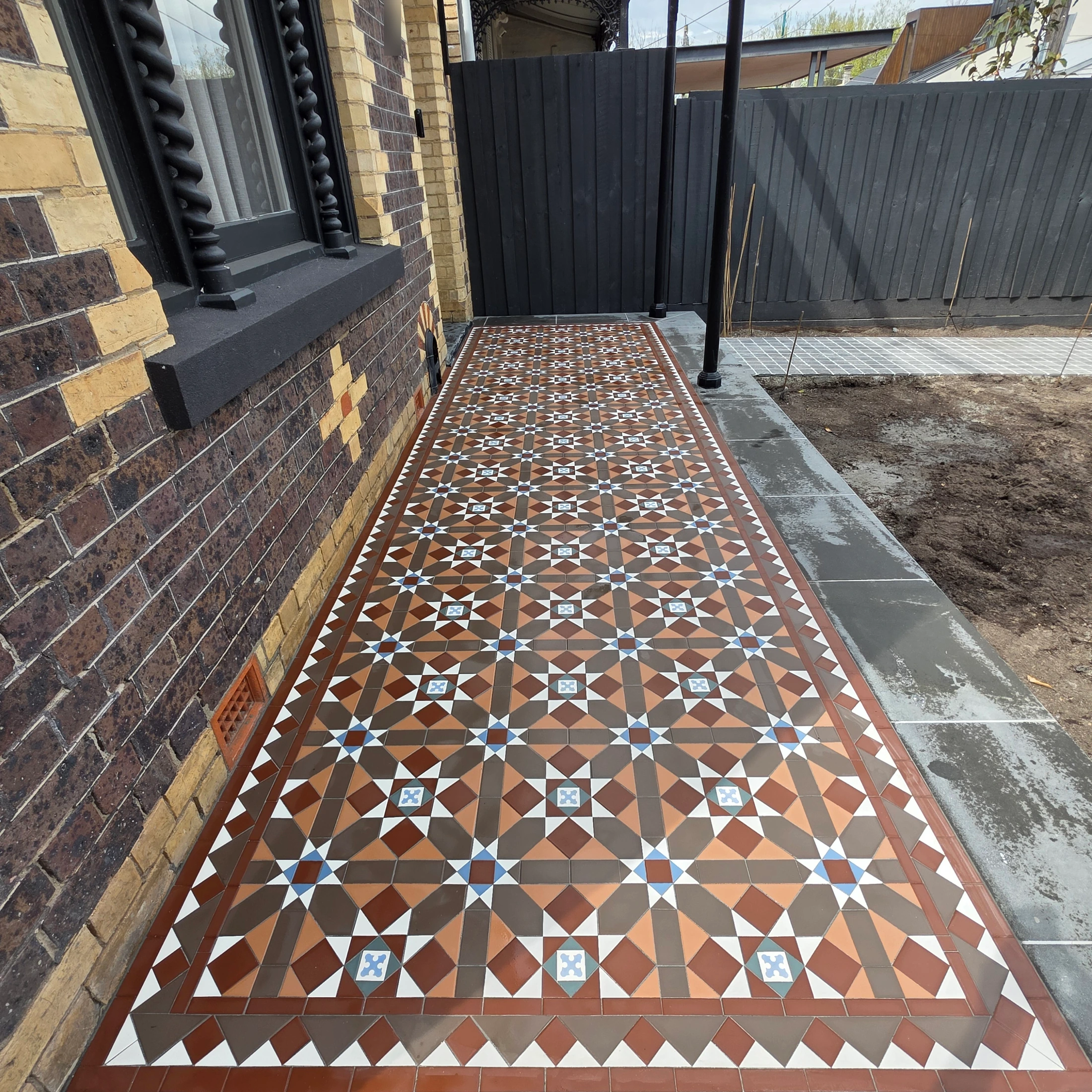
For a period home, a verandah or a front pathway, begin with what survives: the threshold, floor proportions, adjacent masonry, joinery, paint colours and any original tile fragments. A restrained border can help a small entry read clearly, while a more elaborate tessellated layout may suit a larger, legible path or verandah. The right choice depends on the building and the space rather than a period label alone.
Where existing tiles remain, matching colour, scale, geometry and wear can be more important than introducing a new pattern. A design consultation can separate retained fabric from new work and coordinate supply, installation and any stone bullnose or edging requirements around the actual site.
Craftsmanship that respects original fabric
Heritage-sensitive tiling is not only a pattern choice. It involves reading the existing surface, documenting what is worth retaining, making careful transitions between old and new work, and coordinating edges where a floor meets steps, walls or a verandah perimeter. The aim is a coherent result that belongs to the property without pretending that every Melbourne home has the same construction or heritage status.
AHTC's Melbourne service pages connect design consultation with tessellated tile supply, installation, restoration, repairs and stone bullnose or edging coordination. The appropriate sequence depends on the site's condition and the work's scope.
Melbourne metropolitan area directories
Regional service-group connections
Other retained area directories — metropolitan relationship uncertain
Your Heritage Tiling Questions
Does every Melbourne period home have heritage protection?
No. Heritage protection is property- and precinct-specific. The City of Melbourne identifies places through its Heritage Overlay and distinguishes significant, contributory and non-contributory places. Check the relevant planning scheme and council information for the property rather than relying on its age or appearance.
Will I need a permit for heritage tile work in Melbourne?
It depends on the property's controls and the proposed work. Planning Victoria says a property in a Heritage Overlay will generally need a local council planning permit for various works, including demolition, exterior alterations and new construction. State-registered places have a separate Heritage Victoria approval framework. Confirm the requirements with the relevant authority before work begins.
Can existing tessellated tiles be repaired instead of replaced?
Often that is the first question worth assessing. The condition of the surviving tiles, the extent of loss, the pattern and the surrounding floor determine whether selective repair, careful restoration or new work is the most appropriate path. A site-led assessment should establish the practical scope before a design is finalised.
Which Melbourne service page should I start with?
Use the broad tessellated tile supply and installation route for a new floor, verandah or pathway. Use the repair or restoration routes when original tiles remain and condition is the main concern. The heritage hub is the best starting point when you first need to understand the property's context and choose the right service pathway.
Discuss Your Heritage Tiling Project
Share your location, project details and photographs using our enquiry form, or call 0433 932 711.