
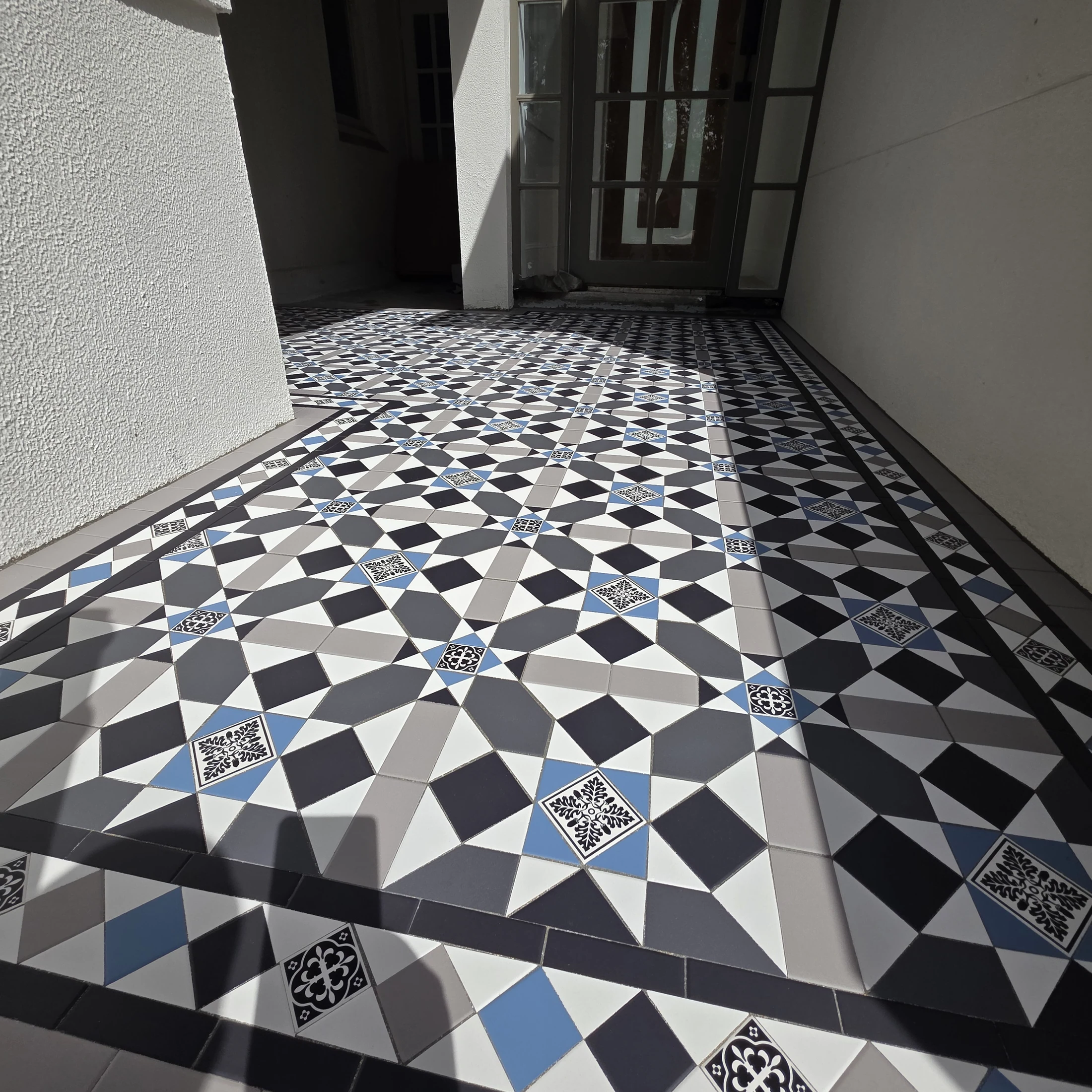
Tessellated tiles in Dawes Point
Dawes Point sits within a distinctive harbourside setting at the southern end of the Sydney Harbour Bridge, beside The Rocks. Its relationship with the Millers Point & Dawes Point Village Precinct makes the starting point for any tile work the property and its surviving fabric, not a generic period label. AHTC can discuss tessellated tile design, supply, installation and restoration for Dawes Point projects, with the scope shaped by the building, access, existing surfaces and any applicable heritage controls.
A harbourside setting with layered built character
The NSW State Heritage Inventory describes the Millers Point & Dawes Point Village Precinct as a townscape conservation area with archaeological and landscape values. Its documented character includes varied building types, steep lanes and streets, sandstone kerbing, terraces, public housing and harbour-facing views. Those qualities make proportion, transitions and the relationship between a tiled surface and its surrounding threshold important parts of design consideration.
The precinct also contains evidence from different periods, including late Colonial, Victorian, Federation and early interwar buildings. A tile pattern should therefore be selected from the property's documented context and surviving details rather than assuming that one pattern belongs across all of Dawes Point.
Millers Point & Dawes Point Village Precinct — State Heritage InventoryMillers Point & Dawes Point Village Precinct: General Design Guidelines for Adaptive Reuse of Heritage Properties
Start with the property and its existing fabric
For an older terrace, entry, verandah, stair or pathway, begin by recording what remains: tile dimensions and layout, borders, thresholds, edges, falls, adjoining masonry and any signs of movement or moisture. A design consultation can then separate repairable original fabric from areas where new work may be appropriate, while keeping the proposed finish legible alongside the building rather than treating the floor as an isolated pattern.
The heritage design guidelines emphasise retaining heritage values while adapting properties for current use. They also caution that changes to verandahs and balconies can affect individual buildings and the cumulative streetscape. For a Dawes Point property, access, visibility from the public realm and the relationship to an adjoining terrace group are useful questions to raise before selecting a layout or installation sequence.
Millers Point & Dawes Point Village Precinct: General Design Guidelines for Adaptive Reuse of Heritage PropertiesMillers Point & Dawes Point Village Precinct — State Heritage Inventory
Design inspiration and craftsmanship for Dawes Point homes
Dawes Point's documented walking-scale streets, narrow footpaths, sandstone details and harbour outlooks provide a useful design reference without prescribing a single look. Borders can help a threshold read clearly, while a restrained field pattern may sit more comfortably with a compact entry or verandah. On a sloping or stepped approach, the layout should be developed with the actual run, drainage and transitions in view.
Where existing tiles survive, careful matching is more than choosing a similar colour. It can involve comparing dimensions, geometry, border proportions, tonal variation and the way the surface meets stone, masonry or timber. New supply, installation or restoration should be scoped after an inspection or clear project information so that the proposed workmanship responds to the actual substrate and retained details.
Millers Point & Dawes Point Village Precinct — State Heritage InventoryMillers Point & Dawes Point Village Precinct: General Design Guidelines for Adaptive Reuse of Heritage PropertiesHeritage conservation areas: Repainting guidelines — City of Sydney
Check the applicable heritage requirements
The City of Sydney's repainting guidance specifically names Dawes Point and notes that repainting a heritage-listed building or a building in Millers Point or Dawes Point requires development consent or a written exemption. That guidance is not a blanket ruling on every tiling proposal, so the property's listing, the proposed work and the relevant planning pathway should be checked before work begins.
AHTC's role is to help with tile design, supply, installation and restoration decisions. It is not a heritage approval authority. Where a project affects significant fabric or a visible terrace relationship, allow time for the appropriate property-specific advice and approvals outside the tile quotation process.
Heritage conservation areas: Repainting guidelines — City of SydneyMillers Point & Dawes Point Village Precinct: General Design Guidelines for Adaptive Reuse of Heritage PropertiesMillers Point & Dawes Point Village Precinct — State Heritage Inventory
Your Heritage Tiling Questions
Does every property in Dawes Point have the same heritage controls?
No. The Millers Point & Dawes Point Village Precinct is a State Heritage Register conservation area, but the precinct listing does not establish identical controls or listing status for every individual property. Check the specific property and proposed work with the relevant planning or heritage authority before proceeding.
Can original tessellated tiles in a Dawes Point property be restored rather than replaced?
That depends on the condition and extent of the surviving surface. An assessment can consider whether tiles, borders and thresholds can be retained or matched, and where new work is needed. The decision should be based on the actual floor and adjoining fabric rather than a generic period assumption.
What should be considered for a tiled verandah or pathway in Dawes Point?
Consider the property's existing proportions, steps or slope, drainage and transitions to stone, masonry or timber. The heritage context also makes the visibility of the work and its relationship to adjoining buildings relevant, particularly where a verandah or entry contributes to a terrace group or streetscape.
Does the City of Sydney repainting guidance automatically approve or refuse tile work?
No. The guidance concerns repainting and says that repainting a heritage-listed building or a building in Millers Point or Dawes Point requires development consent or a written exemption. It does not decide every tiling proposal. Obtain property-specific advice for the proposed work.
Discuss Your Heritage Tiling Project
Share your location, project details and photographs using our enquiry form, or call 0433 932 711.