
Tessellated tiles in Kingsgrove
Kingsgrove's history reaches from King's Grove Farm and early settlement south of Cooks River to the railway-era growth of a substantial south-western Sydney residential suburb. For a tile project here, the useful starting point is the property itself: whether original tessellated work survives, what pattern and edging remain, how the entry or verandah is used, and whether current heritage information needs to be checked. AHTC can assist with design consultation, tessellated tile supply, installation, restoration and stone bullnose or edging coordination.
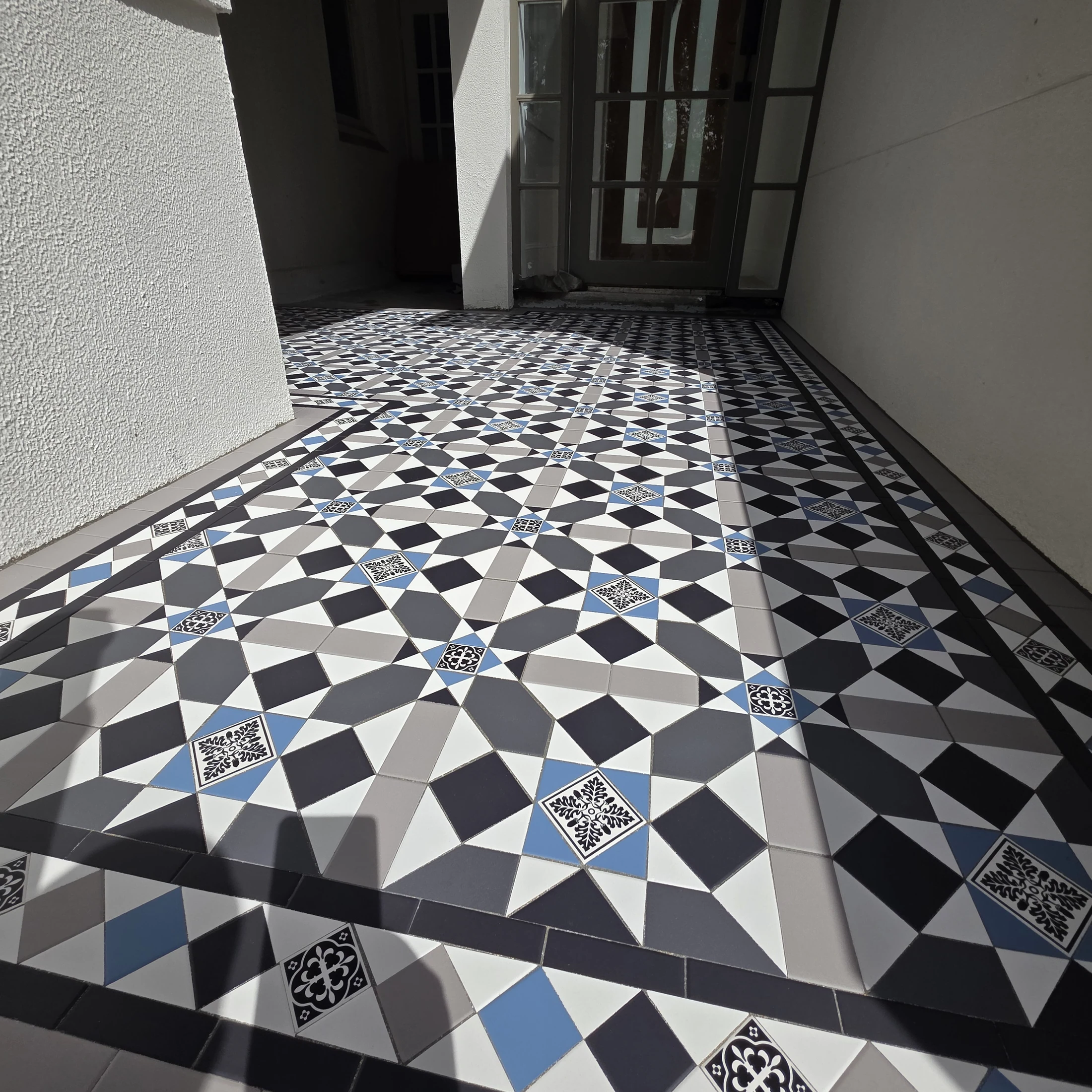
A layered Kingsgrove setting
Kingsgrove is recorded as a south-western residential suburb whose name comes from King's Grove Farm, the 1804 land grant to Hannah Laycock. Local historical material describes an earlier period of relative isolation, followed by railway-related change and later residential growth. That history is useful context, but it does not establish one uniform architectural character across every street or property.
Georges River Council publishes heritage-study material that includes Kingsgrove, and its heritage-management-plan register identifies the Mashman Site in Kingsgrove. These are reasons to research a particular property carefully, not reasons to describe every Kingsgrove home as heritage listed or automatically subject to approval.
Heritage StudiesRegister of Heritage Conservation Management Plans — Georges River Council
Designing for the property in front of you
For an older entry, verandah or pathway, begin by recording the surviving layout before choosing a replacement pattern. Note the direction of the border, the relationship between field and edge tiles, thresholds, steps and drainage paths, and any areas where tiles have already been replaced. A measured sketch and clear photographs help separate original fabric from later work.
A restrained new layout can still belong to the house without pretending to reproduce an undocumented original. Where a surviving pattern or colour relationship is clear, matching its proportions and transitions is often more useful than selecting a generic motif. Where the evidence is incomplete, design consultation can test practical access, exposure and maintenance needs alongside the visual relationship to the building.
Register of Heritage Conservation Management Plans — Georges River CouncilState Heritage Inventory — NSW Government
Restoration, repair or new tessellated work
Restoration decisions should follow a condition review. Loose or cracked tiles, failed edges, uneven transitions and moisture-related staining can have different causes, so the visible symptom should not be treated as a universal repair recipe. AHTC's restoration and installation discussion can be shaped around the evidence found on site, with supply and design choices coordinated where new tiles are needed.
For new work, the brief may be a historically sympathetic entry, a practical pathway, a verandah treatment or a contemporary tessellated composition. The important distinction is whether the work is retaining identified existing fabric or creating a new surface inspired by the setting. That distinction keeps the design honest and gives a future owner a clearer record of what was retained and what was introduced.
Register of Heritage Conservation Management Plans — Georges River CouncilState Heritage Inventory — NSW Government
Checking heritage information before work
The NSW State Heritage Inventory provides a way to search heritage-listed places and objects and explains that local councils and NSW Government agencies contribute records. Its guidance recommends checking the relevant council or agency for the most current information. Because Kingsgrove has changing and overlapping administrative history, confirm the applicable authority for the actual property rather than relying on the service-group label in this page's navigation.
A heritage reference is not the same as approval to carry out work. If a property search identifies a listing, conservation area or other planning control, obtain the current property-specific advice before finalising the scope. AHTC can keep the tile design and installation conversation separate from that statutory question.
Your Heritage Tiling Questions
Is every Kingsgrove home heritage listed?
No conclusion of that kind is supported. Kingsgrove has published heritage studies and a documented Conservation Management Plan for the Mashman Site, but the NSW State Heritage Inventory explains that listing information is checked by property, place or object. Search the actual property and confirm current information with the relevant authority.
Which council should I contact about a Kingsgrove property?
Do not infer the statutory authority from the Georges River service-group route alone. Historical and current locality records describe Kingsgrove as crossing changing council relationships. Use the actual property location and current NSW and council information to identify the relevant planning or heritage contact.
Can an existing tessellated pathway or verandah be restored?
Often the right approach depends on what survives and why it has failed. Start with a condition review of the field, borders, edges, steps and transitions, then decide whether the work is selective restoration, coordinated replacement or new installation. The scope should be based on the property evidence rather than a universal repair method.
Can a new tile pattern suit an older Kingsgrove home without copying an original?
Yes. A design can take cues from the entry proportions, surviving border lines, thresholds and the building's setting while remaining clearly new work. Record any surviving fabric first, then use design consultation to balance pattern, transitions, access and maintenance.
Discuss Your Heritage Tiling Project
Share your location, project details and photographs using our enquiry form, or call 0433 932 711.