
Tessellated Tiles Geelong West
Geelong West combines a well-known Pakington Street streetscape with timber houses, cottages and period homes. For a verandah, entrance path or interior floor, tessellated tile choices work best when the pattern, border and transition details respond to the property rather than treating every older home the same. AHTC can help with design consultation, tile supply, installation, restoration and stone bullnose or edging coordination.
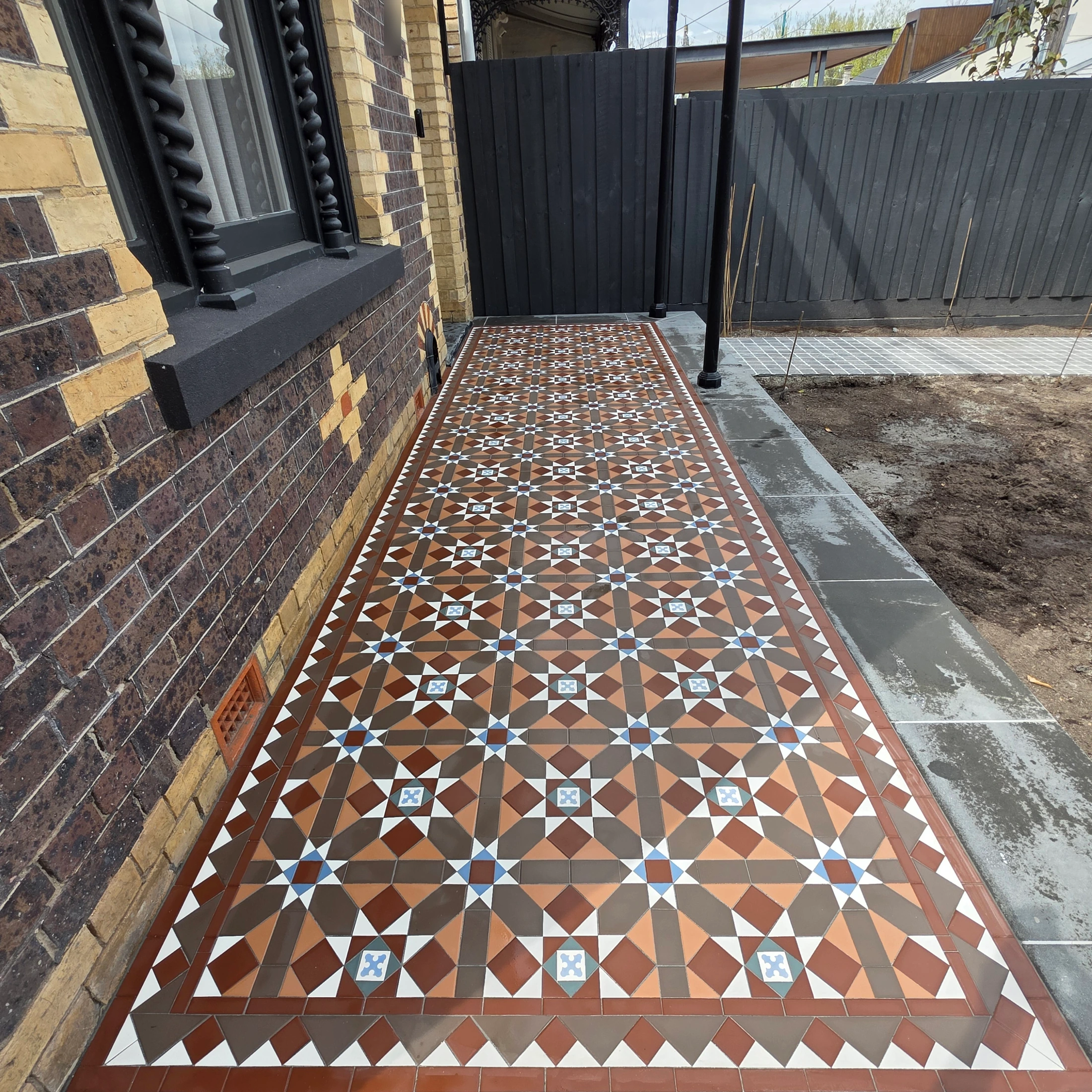
Tiling ideas for Geelong West homes
The City of Greater Geelong describes Geelong West as a suburb with renovated timber houses and cottages, period homes and an active Pakington Street strip. That mix makes proportion and restraint important: a new tessellated layout should sit comfortably with the existing entry, verandah posts, steps, brickwork and garden edges rather than compete with them.
For a front path or verandah, the useful early decisions are the route width, border treatment, thresholds and how the pattern meets steps or gates. For an internal floor, the room geometry and adjoining finishes usually matter more than selecting a pattern in isolation. Design consultation can test those relationships before supply and installation are arranged.
Heritage-aware tile planning in Greater Geelong
The Greater Geelong Planning Scheme identifies several heritage areas in Geelong West, including Pakington Street Commercial, Ballinasloe, Great Western Road, Milton, Pineville and Waterloo. An overlay is a mapped planning control, so it should be checked for the specific property rather than assumed from the suburb name alone.
Before changing an external verandah, path, steps or other visible fabric, check the property's current zoning and overlays and seek the appropriate council or heritage advice. The City notes that proposed work is assessed against the significance and character of the heritage place and nearby buildings. AHTC's role is to help consider layout, matching, restoration and new-work options; it does not provide heritage approval.
Restoration, replacement or a new layout
Existing tessellated tiles can sometimes be retained, repaired or selectively replaced. The practical starting point is a condition review: identify loose or cracked areas, previous repairs, edge movement, moisture exposure and whether enough original pattern remains to guide matching. Where a new section is needed, the relationship between old and new work should be discussed before committing to a pattern or border.
For new work, tile supply and installation can be coordinated with the intended use and the property's existing details. Stone bullnose or edging may help resolve steps and exposed edges where appropriate. The final specification should follow the site assessment and chosen design, not a universal recipe.
Your Heritage Tiling Questions
Does every Geelong West property require heritage approval for tessellated tiling?
No. Heritage controls depend on the property's zoning and mapped overlay or other applicable controls. The City of Greater Geelong recommends checking the property before development work, particularly where external appearance or heritage fabric may change.
Can tessellated tiles suit a renovated timber cottage in Geelong West?
They can, when the layout respects the cottage's scale and existing details. Border width, path proportions, thresholds and the relationship to verandah posts and steps should be considered together rather than selected as isolated pattern choices.
Can existing tessellated tiles be restored instead of replaced?
Often the first step is a condition and matching assessment. It can identify whether original tiles and patterns can be retained, repaired or selectively replaced, and whether new work should be visually quiet or clearly distinguished. The suitable approach depends on what remains on site.
What should I consider for a Geelong West verandah or front path?
Consider the path or verandah proportions, border and corner treatment, step and threshold transitions, drainage exposure and how the tilework meets existing brick, stone or garden edges. If the property is in a heritage overlay, check the relevant controls before work begins.
Discuss Your Heritage Tiling Project
Share your location, project details and photographs using our enquiry form, or call 0433 932 711.