
Tessellated Tiles in Thornleigh
Thornleigh properties can bring together suburban additions, older fabric and distinctive outdoor transitions. A considered tessellated-tile scheme starts with the building, the way a verandah or path is used, and the condition of any existing tiles. AHTC can help with design consultation, tessellated tile supply, installation, restoration and stone bullnose or edging coordination for projects in Thornleigh and the surrounding Hornsby area.
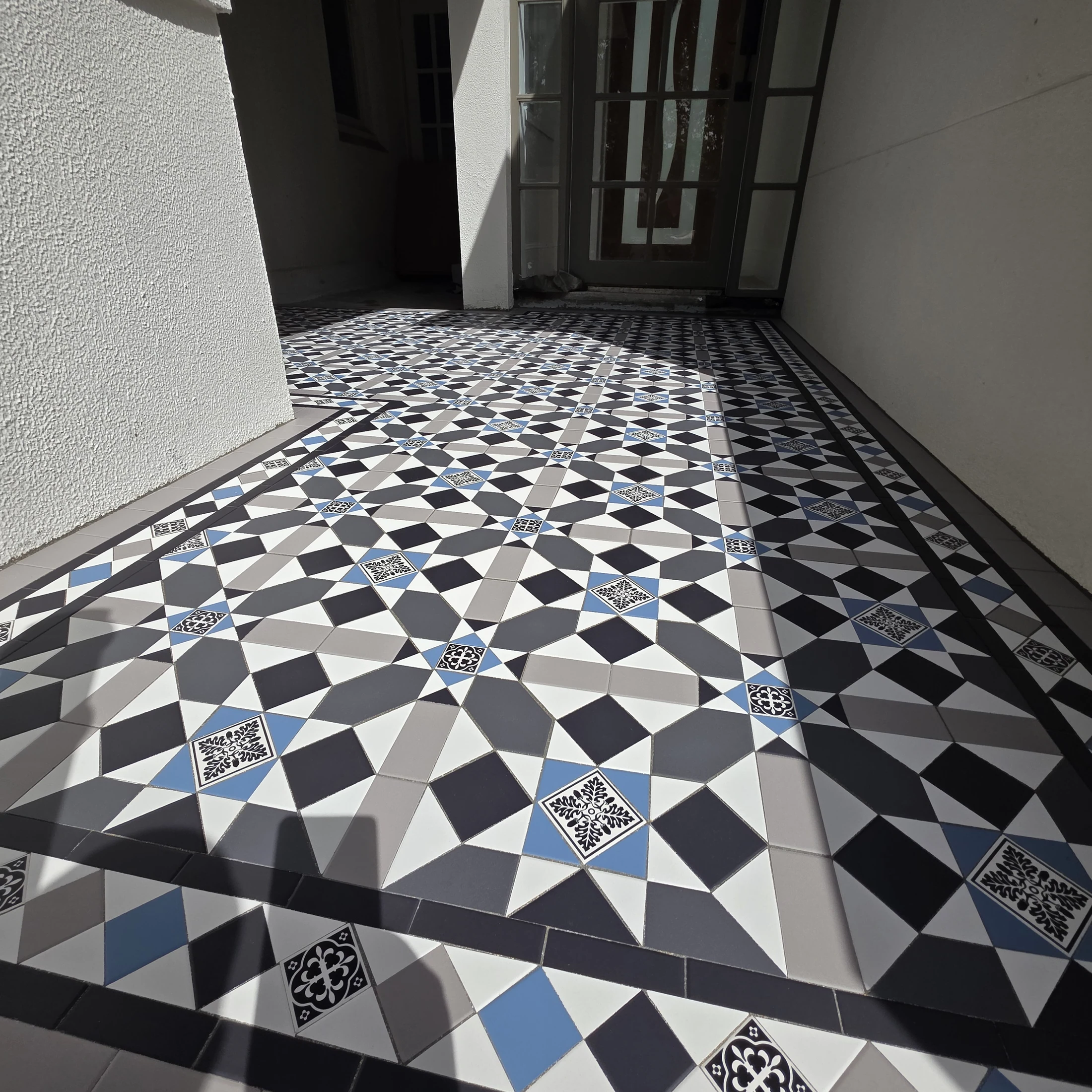
A local setting with more than one architectural story
Hornsby Council's local history places Thornleigh within a district shaped by early land grants, timber-getting, farming and orchards, followed by railway-led suburban growth. That layered history is useful context when choosing a floor or pathway treatment: a new pattern should support the proportions and materials of the particular property rather than assume one uniform Thornleigh style.
Council's draft built heritage study also records a 1940 Thornleigh house design proposal by Arthur Baldwinson and discusses a range of inter-war and post-war architectural approaches across the Hornsby area. These references point to the value of reading the individual building first, including its roofline, entry sequence, brickwork, joinery and relationship to the street.
Design choices for verandahs, entries and pathways
For an older entry or verandah, the layout can be tested against the existing thresholds, step heights, sightlines and edge conditions before a pattern is selected. Border scale, field geometry and tonal contrast should work with the building's façade and with the distance from the front boundary, rather than overwhelm a modest elevation.
On a new pathway or addition, careful transitions matter as much as the central pattern. We can discuss tile proportions, direction changes, drainage interfaces and stone bullnose or edging coordination as part of the overall design and installation plan.
Restoring existing tiles with a property-led approach
Where original or earlier tessellated tiles remain, an assessment should distinguish loose or damaged pieces from wider movement, moisture or edge problems. Cleaning, selective repairs and replacement decisions should be made after looking at the surviving layout and the substrate in context.
Thornleigh's documented industrial heritage sites are a reminder that heritage value is specific to a place and its fabric. A heritage reference does not make every home listed, and any planning or heritage question should be checked for the individual property before work begins.
Planning a Thornleigh tiling project
A useful first step is to share the property's age or design context, photographs of the area, approximate dimensions and any known concerns about movement, damp or previous repairs. From there, the work can be considered as design consultation, supply, installation, restoration or a coordinated combination of these services.
The existing Hornsby service page remains the broader area destination, while this Thornleigh guidance focuses on decisions that arise at the local property level.
Your Heritage Tiling Questions
Can tessellated tiles suit a Thornleigh verandah or entry?
Yes. The right result depends on the property's proportions, existing materials, thresholds and the way the space is used. A border and field layout can be developed around the building instead of applying a generic pattern.
Can older tessellated tiles in Thornleigh be restored?
Often, an assessment can identify which tiles and joints can be retained, which areas need selective repair and whether movement or moisture is contributing to the damage. The suitable approach depends on the surviving fabric and site condition.
Does a heritage reference in Thornleigh mean my home needs approval for tiling?
Not necessarily. Heritage status and planning requirements are property-specific. Council or the relevant planning authority should be consulted where a property is listed, within a heritage area or affected by a specific planning control.
Can a pathway pattern be coordinated with stone edging?
Yes. Path width, turning points, levels and the adjoining surfaces should be considered together with the tessellated layout and any stone bullnose or edging detail.
Discuss Your Heritage Tiling Project
Share your location, project details and photographs using our enquiry form, or call 0433 932 711.