
Tessellated tiles in Sydenham
Sydenham brings together fine-grain residential streets, an industrial and creative setting, and strong transport connections. Tessellated tile choices can respond to that varied context, whether you are planning a new verandah or pathway or assessing existing tiles in a period home. AHTC can help with design consultation, tessellated tile supply, installation, restoration and stone bullnose or edging coordination, with the right approach depending on the property and the work proposed.
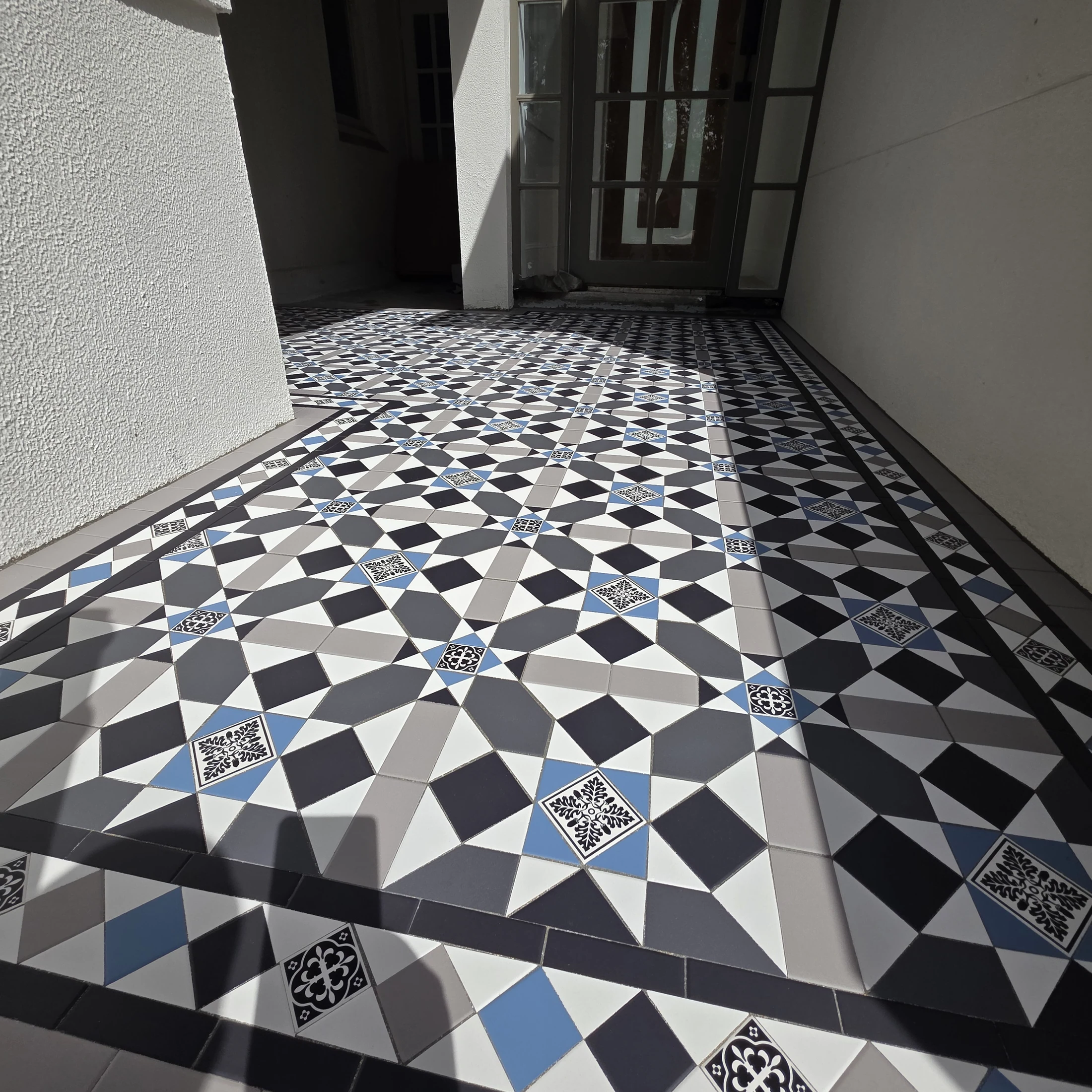
A varied Sydenham setting
Inner West Council describes Sydenham as an evolving suburb with low-density residential areas alongside industrial uses and transport infrastructure. Its local controls also identify heritage-listed buildings and a growing creative sector. Around Sydenham Station, Sydney Metro's precinct plan records a contrast between fine-grain single- or double-storey terrace houses on compact lots to the south and larger low-rise warehouses and commercial buildings to the north.
That mix makes the immediate property more useful than a generic period label when planning tiles. A residential entry, verandah or side path may call for a restrained layout that sits comfortably with the home's scale, while a more robust industrial or post-industrial setting may suit a clearer geometric treatment. These are design considerations, not a claim that every Sydenham property has the same age, style or heritage status.
Plan the layout around the property
Begin with the existing thresholds, stairs, walls and edges. On a compact terrace frontage, a border and field pattern should be checked against the available width so that cuts are deliberate and the entry remains legible. For a pathway, consider its relationship to the front door, garden or street edge, as well as changes in level and drainage. For a new work beside an older surface, matching tone and proportion may be more important than introducing a busy pattern.
Sydenham's local controls describe gently undulating ground, alluvial valleys and site considerations that include flooding. A site assessment should therefore inform levels, transitions and the proposed finish rather than assuming one substrate or installation detail applies everywhere. Where stone bullnose or edging is part of the design, its profile and junctions should be coordinated with the tile layout and surrounding masonry.
When existing fabric needs care
If original or earlier tiles remain, document their condition and pattern before removing anything. Retention, selective repair, careful matching or a new complementary section may each be appropriate, depending on what survives and what the property needs. A heritage-listed building or a property within a heritage conservation area is not established by the suburb name alone.
Inner West Council provides an interactive heritage map and property-specific information for heritage items and conservation areas. Check the relevant property record and planning pathway before work begins. AHTC's role is to discuss the tile work and coordinate an approach; it is not to imply council or heritage-authority endorsement.
Heritage conservation areas | Inner West Council4.23 Sydenham | Inner West Development Control Plan
Detailing that belongs to the setting
Good tessellated work depends on the relationship between pattern, edge and threshold. Design consultation can help test a field and border against the frontage, resolve corners and steps, and coordinate tile supply with installation. Restoration work needs a different starting point: inspect what is present, identify areas that can be retained, and agree the extent of repair before selecting a replacement or complementary treatment.
For Sydenham properties, the surrounding scale and the transition between residential, industrial and transport-influenced streets can be useful design inspiration without turning those broad precinct qualities into a prescribed style. The final selection should remain specific to the building, its exposure and the owner's brief.
Your Heritage Tiling Questions
Does every Sydenham property have heritage protection?
No. Sydenham's documented character includes heritage-listed buildings, but the suburb name does not establish that an individual property is listed or inside a heritage conservation area. Use Inner West Council's heritage map and property-specific records, then confirm the applicable planning pathway before work.
Can tessellated tiles suit a Sydenham terrace or compact frontage?
They can, provided the layout is designed to the available width and the existing thresholds, stairs, walls and edges. The Sydney Metro precinct plan identifies fine-grain single- and double-storey terrace houses on compact lots in the residential area around the station, but each property still needs its own measure-up and design response.
What should be checked before tiling a pathway or entry in Sydenham?
Check levels, transitions, drainage, the condition of the existing surface and how the proposed work meets doors, stairs and boundaries. Inner West Council identifies local flooding and airspace protection as relevant site or development considerations, so the work should not rely on a universal substrate or detail.
Can existing tiles be restored rather than replaced?
Often the first step is an assessment of what remains, including pattern, condition and areas that may be retained or selectively repaired. The appropriate scope depends on the property and existing fabric. Where a heritage item or conservation area may apply, check the relevant Inner West Council information before proceeding.
Discuss Your Heritage Tiling Project
Share your location, project details and photographs using our enquiry form, or call 0433 932 711.