
Tessellated Tiles in Cecil Hills
Cecil Hills is a south-western Sydney residential suburb with a distinct local story: the suburb was gazetted in 1992, while Cecil Hills Farm preserves an earlier colonial building and farming history. For a home, verandah or pathway, a considered tile scheme can draw on that context without treating every property as heritage-listed. We can help with design consultation, tessellated tile supply, installation, restoration and stone bullnose or edging coordination.
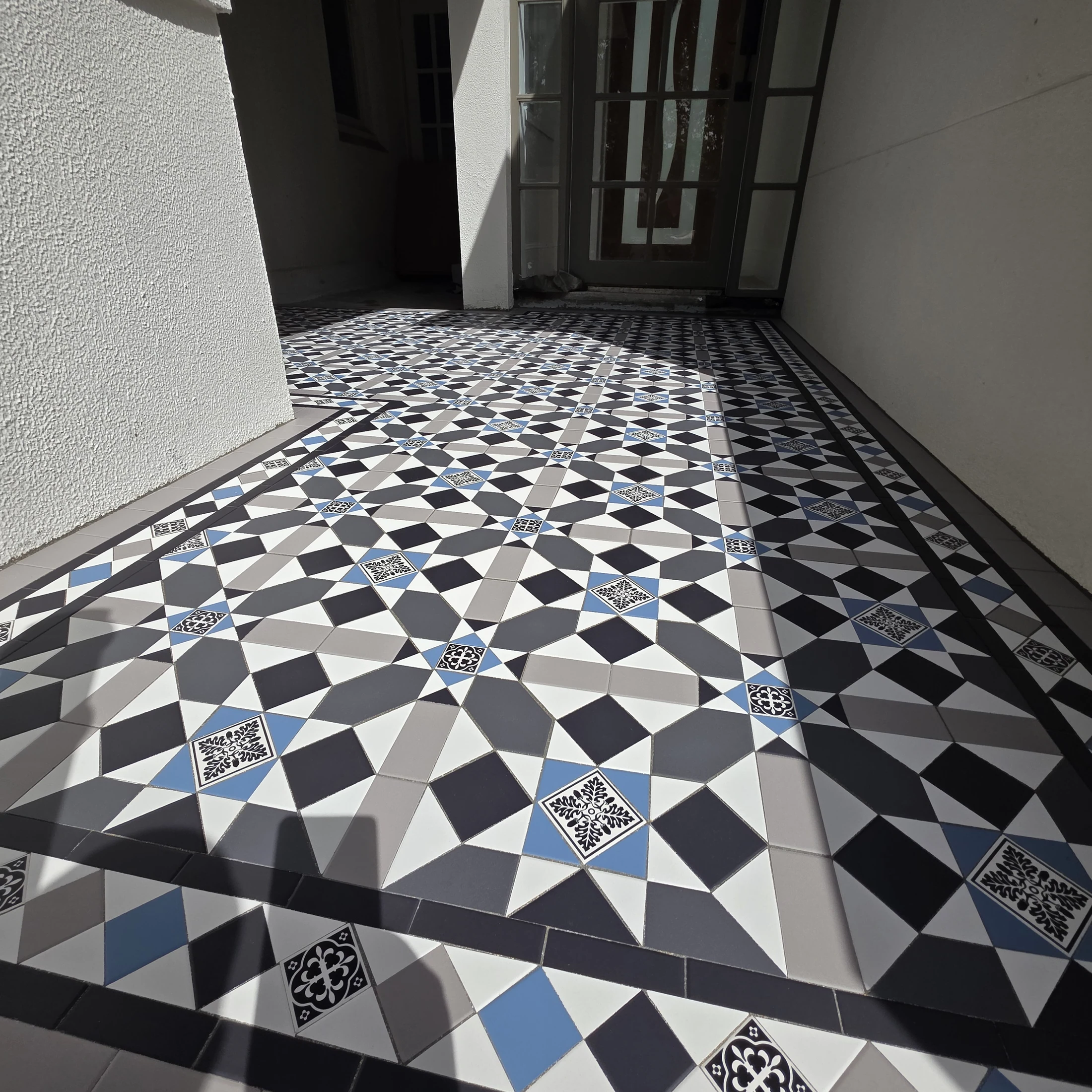
A residential setting with an earlier local landmark
Cecil Hills developed after the subdivision of Cecil Park and was officially gazetted in 1992. Its residential setting sits alongside the distinct Cecil Hills Farm heritage place, whose farmhouse dates from 1818–1824 and whose associated buildings record an earlier phase of the district's history.
That contrast is useful when planning a tiled threshold, verandah or garden path. A new installation can acknowledge proportion, restraint and the relationship between the building and its outdoor edge without copying a historic farm detail or implying that a modern home is covered by the farm's listing.
Design considerations for Cecil Hills homes
Start with the architecture already present: the entry width, verandah rhythm, garden edges and the way a path meets the front door or driveway. A restrained border, a deliberate field pattern or a small accent can give a suburban frontage clarity without making the tile work feel detached from the house.
Outdoor areas also need practical decisions about falls, drainage, movement joints, weather exposure and transitions to other paving. These are site questions rather than a universal recipe. A measured layout and sample review can help settle colour, scale and edge treatment before ordering material.
When existing fabric or a heritage place is involved
Cecil Hills Farm is a specifically listed heritage place, and NSW Planning describes restoration work there as relying on historical research, archaeological investigation and specialist heritage trades. That is a different situation from an ordinary residential tile renewal. If your property is near a recognised heritage place or includes older fabric, identify the property-specific controls before work begins.
Liverpool City Council's Development Control Plan provides planning and design guidance, but the applicable controls depend on the property and proposed development. We can help separate design and tiling decisions from the planning checks that may need to be made with Council or another relevant authority.
A practical path from idea to finished surface
For a new verandah, pathway or entry, the useful sequence is to clarify the visual brief, review the setting and dimensions, develop the layout, coordinate suitable tessellated tile supply, and plan installation with the surrounding surfaces in mind. For an existing floor, the first question is whether the original pattern and sound tiles can be retained, selectively repaired or carefully complemented.
Stone bullnose or edging can be coordinated where a robust and visually resolved edge is part of the design. The right detail depends on the exposure, adjoining materials and the character you want the finished work to have.
Your Heritage Tiling Questions
Does every property in Cecil Hills have heritage protection because of Cecil Hills Farm?
No. Cecil Hills Farm is a distinct listed heritage place. Its listing does not automatically make every home in the suburb heritage-listed. A property-specific planning and heritage check is the sensible starting point where older fabric or a nearby heritage place may be involved.
Can tessellated tiles suit a newer Cecil Hills home?
Yes. The design does not need to imitate a historic property. Pattern scale, border width, colour balance and the transition to nearby paving can be selected to suit the home's proportions and the character of its entry, verandah or path.
What should I consider for an outdoor tiled pathway in Cecil Hills?
Consider the route, falls and drainage, exposure, slip and transition details, edge treatment and how the pattern meets steps or other paving. These conditions vary from site to site, so the layout and installation approach should be reviewed against the actual area rather than assumed from a standard detail.
Can an existing tessellated floor be restored rather than replaced?
Often the first step is an assessment of the surviving tiles, pattern, bedding and edges. Depending on their condition and availability of suitable matches, a project may involve retention, selective repair, careful replacement or a new complementary section. The appropriate choice is property-specific.
Discuss Your Heritage Tiling Project
Share your location, project details and photographs using our enquiry form, or call 0433 932 711.