
Tessellated Tiles in Templestowe Lower
Templestowe Lower grew substantially as a post-war suburb during the 1950s and 1960s. That local setting includes established homes as well as documented mid-century and modernist examples, so tile choices are best made with the building's proportions, entry sequence and surviving materials in mind. AHTC can help with tessellated tile design, supply, installation, restoration and stone bullnose or edging coordination for a property-led result.
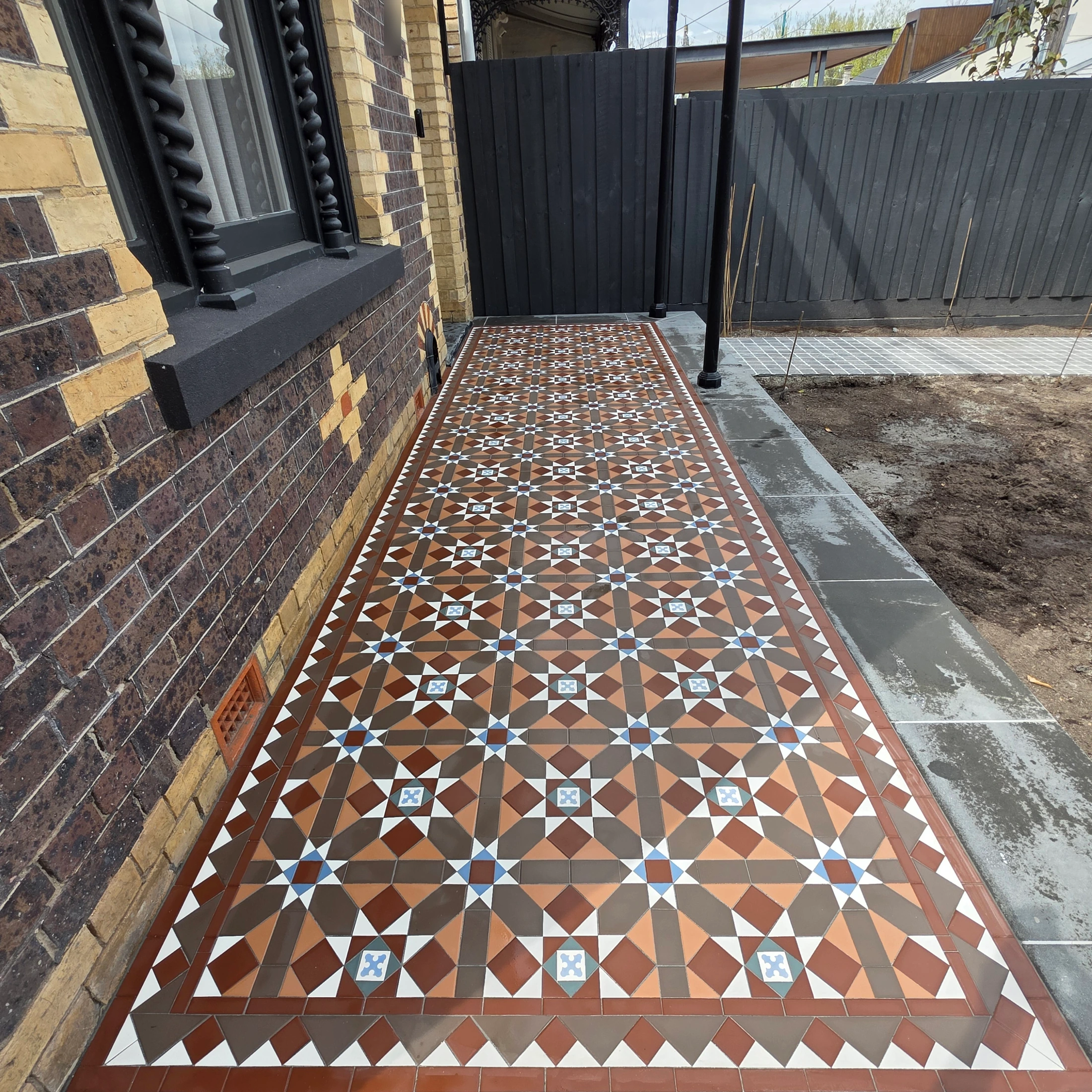
Tiling for Templestowe Lower's post-war and mid-century homes
Manningham Council describes Templestowe Lower as predominantly post-war, with substantial development in the 1950s and 1960s. In a home from this period, a new tiled entry, verandah or pathway should relate to the existing roofline, brickwork, joinery, garden setting and the scale of the front approach rather than imitate an earlier era without evidence.
The Manningham Heritage Study Review records a former Merchant Builders display-house precinct and other residential examples in Lower Templestowe. These references are useful reminders that mid-century design can have its own architectural character. They do not mean every nearby property is listed or protected.
For a renovation, begin by documenting what remains: original tile fields, border geometry, thresholds, steps, mortar condition and any later patching. AHTC can then discuss a suitable tessellated pattern, tile supply, installation approach or selective restoration around the existing fabric.
Discover our area, history and demographics — Manningham Council
Entries, verandahs and pathways
A front path or verandah in Templestowe Lower has to work as part of the arrival sequence. We can help consider border widths, turning points, step transitions and how a tessellated field sits beside brick, concrete, stone or garden edges. The right layout depends on the measured space and the way the house is used.
Where an existing tiled surface is worn or incomplete, restoration may involve careful assessment and matching rather than wholesale replacement. Where there is no surviving tilework, a new design can still be developed with a restrained relationship to the home's period and materials.
Discover our area, history and demographics — Manningham Council
Check the property before work begins
Manningham Council notes that local heritage information can cover buildings, precincts, trees, landscapes and archaeological sites. Before altering a property with suspected heritage significance, check the relevant council guidance and heritage records for that particular property. A heritage reference in the wider suburb is not proof that every home is covered by the same controls.
AHTC's role is to discuss the tile and stone work with the property context in view. Any planning or heritage assessment remains property-specific and should be confirmed with the relevant authority before work proceeds.
Your Heritage Tiling Questions
Are all Templestowe Lower homes heritage-listed?
No. Manningham's heritage study identifies particular places and a former display-house precinct, while council explains that heritage information is property-specific. Check the individual property through Manningham Council and the relevant heritage registers before assuming controls apply.
Can tessellated tiles suit a post-war home in Templestowe Lower?
They can, provided the pattern, scale, colour relationship and detailing are considered alongside the home's existing architecture. For a mid-century or modernist property, a measured and restrained design may be more appropriate than an unreferenced period imitation.
Can you restore an existing tiled entry or pathway?
Yes. Restoration starts with assessing the surviving tiles, pattern, edges, thresholds and condition. The next step may be selective repair, careful matching or a coordinated new section, depending on what remains and what the property needs.
Can you help with a new tiled verandah or front path?
Yes. Design consultation can cover the layout and relationship between the tiled field, borders, steps, stone bullnose or edging and adjoining surfaces. Supply and installation can then be coordinated around the agreed design and site conditions.
Discuss Your Heritage Tiling Project
Share your location, project details and photographs using our enquiry form, or call 0433 932 711.