
Tessellated Tiles in Seacombe Gardens
For Seacombe Gardens homes, a good tessellated tile result starts with the setting rather than a pattern chosen in isolation. We can help plan tile layouts, coordinate supply and installation, or assess existing work for careful restoration. Where a property has older fabric or sits near a recorded heritage place, the design conversation should distinguish retained work from new additions and confirm any property-specific planning requirements before work begins.
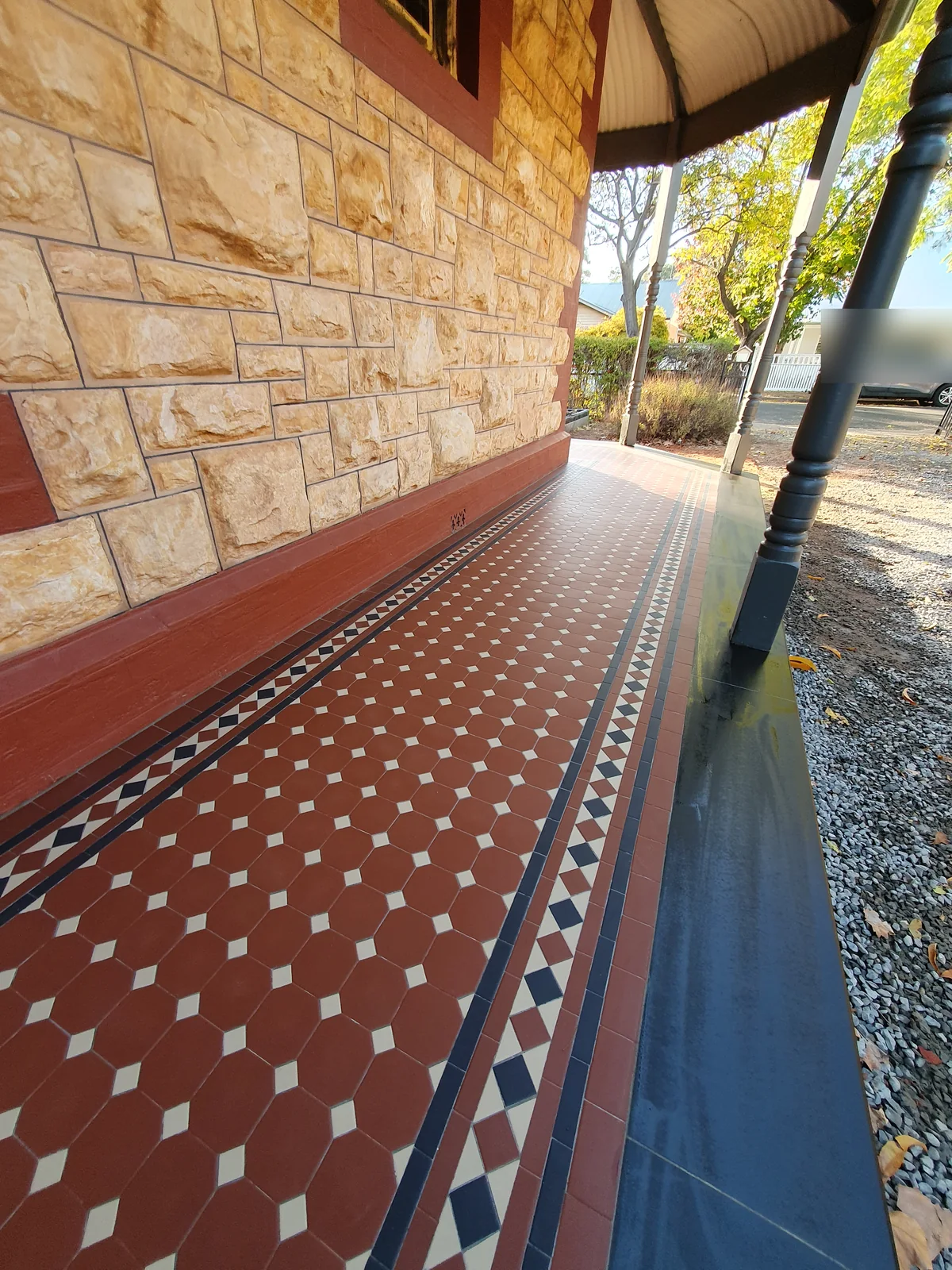
A Seacombe Gardens setting with individual historic places
Seacombe Gardens sits within the City of Marion in Adelaide's southern suburbs. Council and state records identify individual historic places in the suburb, including a locally listed dwelling associated with a former farmhouse and a cottage recorded in the Marion Heritage Survey. Those records are useful prompts for a closer look at an individual property; they do not mean every home in Seacombe Gardens is heritage listed.
For an older entrance, verandah or garden path, look first at what remains: existing border proportions, surviving colour relationships, threshold levels, steps, drainage and the way the tiled area meets masonry or garden edges. A new layout can then be designed to sit comfortably with the building without copying a period detail that the property never had.
Designing verandahs, paths and thresholds
Seacombe Gardens includes local and neighbourhood recreation spaces, so outdoor movement, garden edges and practical transitions are relevant when planning a front path or verandah. At the property itself, the layout should respond to the available width, sightlines, step geometry, exposure and how water is directed away from the building.
A consultation can compare a restrained border with a more decorative field, test how the pattern turns at corners and coordinate stone bullnose or edging where a durable edge is needed. The aim is a legible transition from public approach to entry, not a generic pattern applied without checking the house and site.
Retaining useful fabric while planning new work
Where original or early tiles survive, photograph and measure the area before lifting anything. Note loose pieces, previous repairs, level changes and any damp or drainage concern. Matching a repeat, border or edge is a design and supply exercise as well as an installation decision, so the assessment should identify what can be retained and what needs a compatible new intervention.
A state or local heritage record can affect how a proposal is considered, but the listing record and the Planning and Design Code should be checked for the specific property. A heritage-sensitive tiling consultation is not an approval, and it does not replace advice from the relevant council or South Australian planning and heritage authorities.
Planning the right tiling service
A project may need design consultation before any tiles are ordered, supply coordination for a new pattern, installation planning for a new verandah or pathway, or restoration advice where existing tessellated work is worth preserving. The appropriate sequence depends on the condition of the substrate, the extent of surviving tilework and the details of the property.
Share the approximate location, photographs and the area you want to change so the conversation can stay specific to the home. For listed or potentially sensitive properties, include any information you already have about the place and allow time for property-specific checks.
Your Heritage Tiling Questions
Does every older home in Seacombe Gardens need heritage approval for tiling?
No. The available records identify selected places, not every home in the suburb. Whether approval or additional advice is needed depends on the individual property, its controls and the proposed work. Check the relevant council and South Australian planning or heritage information before altering a recorded place.
Can existing tessellated tiles in a Seacombe Gardens verandah be restored?
Often the first step is an assessment of what remains, including loose tiles, previous repairs, levels, edges and drainage. A restoration approach can then be considered alongside compatible replacement or selective new work where needed.
What should I consider for a tessellated pathway in Seacombe Gardens?
Consider the path width, turning points, steps, threshold levels, garden edges, weather exposure and how water will move away from the building. A border and edge detail should be chosen with those site conditions in mind rather than selected as a pattern alone.
Can AHTC help with both tile supply and installation?
Yes. The project can be discussed from the design stage through tile supply coordination and installation planning, or as an assessment of existing tessellated work for restoration. The suitable scope depends on the property and the condition of the area.
Discuss Your Heritage Tiling Project
Share your location, project details and photographs using our enquiry form, or call 0433 932 711.