
Tessellated tiles in Trott Park
Trott Park is a southern Adelaide locality within the City of Marion, shaped by residential development from the 1960s and 1970s. For a home here, a good tessellated tile scheme should respond to the house, the slope and the way indoor and outdoor spaces meet. AHTC can help with design consultation, tile supply, installation, restoration and stone bullnose or edging coordination.
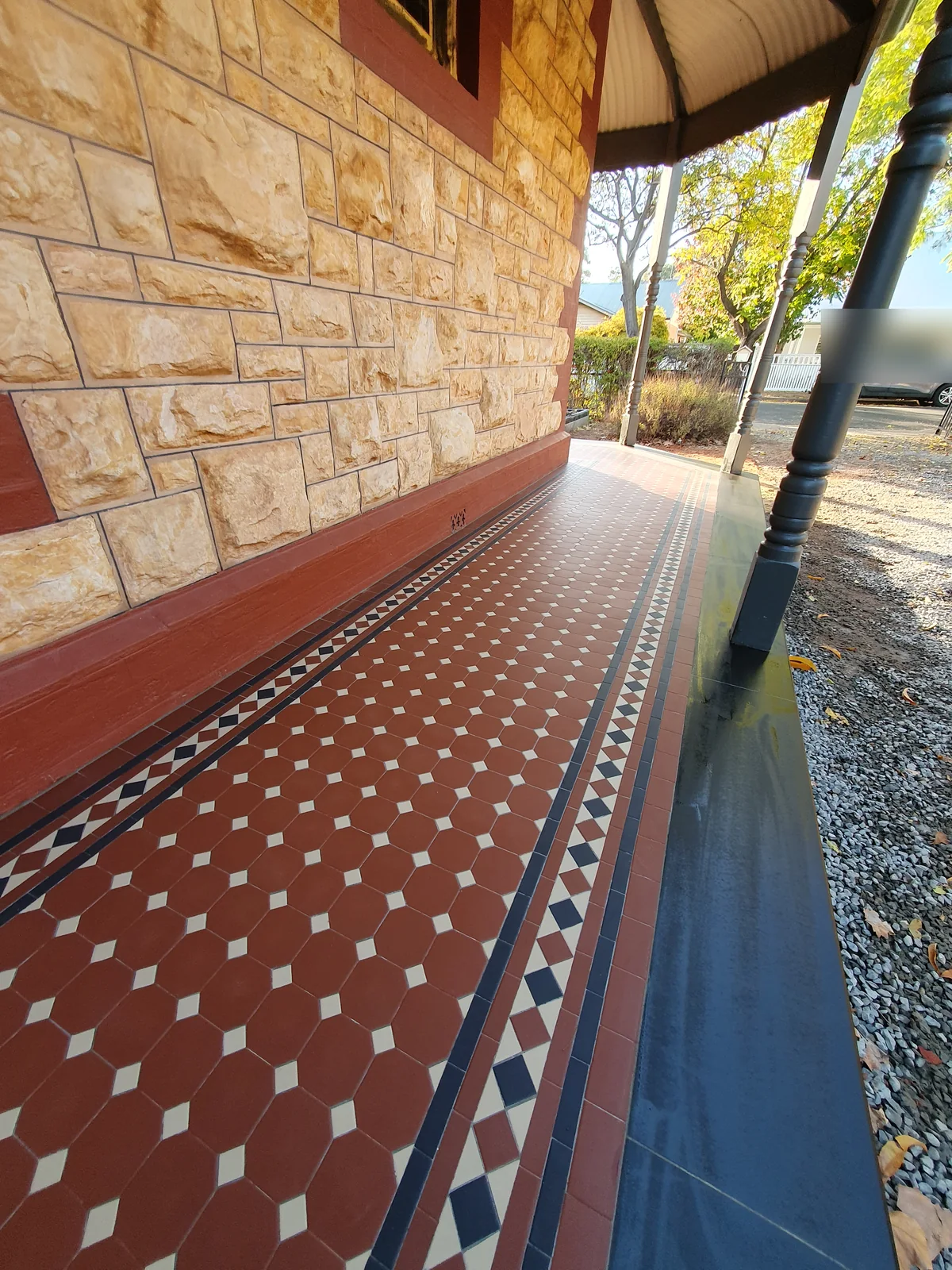
Tile design for Trott Park homes and gardens
Trott Park's housing history is comparatively recent within the City of Marion. That makes the property itself the starting point: assess the proportions, entry sequence, existing paving and garden setting before selecting a pattern. Tessellated tiles can give a porch, entry, courtyard or pathway a clear visual structure without pretending that every home belongs to an earlier heritage period.
The council's Trott Park public-art material describes a locality where streets and reserves named after Australian artists connect with walking routes, open space and native planting. That landscape-minded setting is useful design context for choosing border widths, transitions and edge details that sit comfortably beside planting and shared paths.
Plan pathways and edges around the site
The City of Marion's southern-suburbs planning work considered topography and specifically included Trott Park. On a sloping site, the practical questions are how the paved route meets thresholds, where water is directed, how steps or changes in level are handled and whether the proposed finish remains comfortable to use. These details should be assessed at the property rather than assumed from the suburb name.
For a verandah or garden path, a measured layout helps coordinate the field pattern with borders, corners, steps and any stone bullnose or edging. A site review can also identify where existing tiles should be retained, carefully repaired or replaced so the new work reads as one considered surface.
Restoration, renewal or a new tessellated surface
Not every older-looking surface needs to be removed. Where original or established tiles remain, begin with condition, bond, colour variation, thresholds and the extent of loss. Selective restoration may be appropriate when the existing layout is worth retaining; a new installation may be better where the surface is incomplete or the space is being redesigned.
AHTC's service can cover design consultation, tessellated tile supply, installation and restoration, with stone bullnose or edging coordination where the project calls for a defined perimeter. The right sequence depends on the property and the intended use, so the design should be settled before ordering materials.
Check the property before work begins
PlanSA explains that South Australian planning rules, zones and overlays are checked by property address through the Planning and Design Code and SAPPA. If a proposed verandah, pathway, retaining change or other building work forms part of the tiling project, confirm the applicable requirements before work starts. Tile selection and workmanship do not replace a planning or building assessment where one is required.
For a Trott Park consultation, useful photographs include the existing surface, thresholds, drainage points, adjoining garden levels and the route from the house to the street or outdoor area. Those details help keep the pattern, edge treatment and installation approach grounded in the actual site.
Your Heritage Tiling Questions
Are all Trott Park homes heritage properties?
No. Trott Park was developed as a southern suburb during the 1960s and 1970s, so a property's age and character need to be assessed individually. A tessellated tile design can still be appropriate for a contemporary or established home when its pattern, scale and edges suit the building and garden.
Does a sloping Trott Park site change the tile design?
It can. Slope may affect thresholds, steps, levels, drainage, pathway transitions and the way an edge is finished. The site should be measured and reviewed rather than applying a standard layout. The council's southern-suburbs planning work specifically considered topography and sloping land.
Do I need to check planning rules before tiling in Trott Park?
If the work is part of a verandah, pathway, retaining, alteration or other development proposal, check the property in the South Australian Planning and Design Code and SAPPA first. PlanSA notes that renovation and development work may require approval, and the answer depends on the individual property and proposal.
Can existing tiles be restored instead of replaced?
Often the first step is to assess what remains, including the pattern, condition, missing areas and transitions. If the existing layout has value and can be stabilised, restoration or selective repair may be suitable; if the surface is incomplete or the space is changing, a new coordinated installation may be more practical.
What should I photograph for a Trott Park tiling consultation?
Photograph the full room or outdoor route, close views of the existing tiles, thresholds, corners, steps, drainage points and adjoining garden levels. Include enough context to show how the proposed tiled area connects with the house and landscape.
Discuss Your Heritage Tiling Project
Share your location, project details and photographs using our enquiry form, or call 0433 932 711.