
Tessellated tile services in Kilsyth
Kilsyth sits within Melbourne's outer east and the City of Maroondah. For a Kilsyth home, a useful tessellated-tile scheme should respond to the building, the approach from the street and the way existing paving, gardens and levels work together. We can discuss design, tile supply, installation, restoration and stone bullnose or edging coordination for the particular area you want to renew.
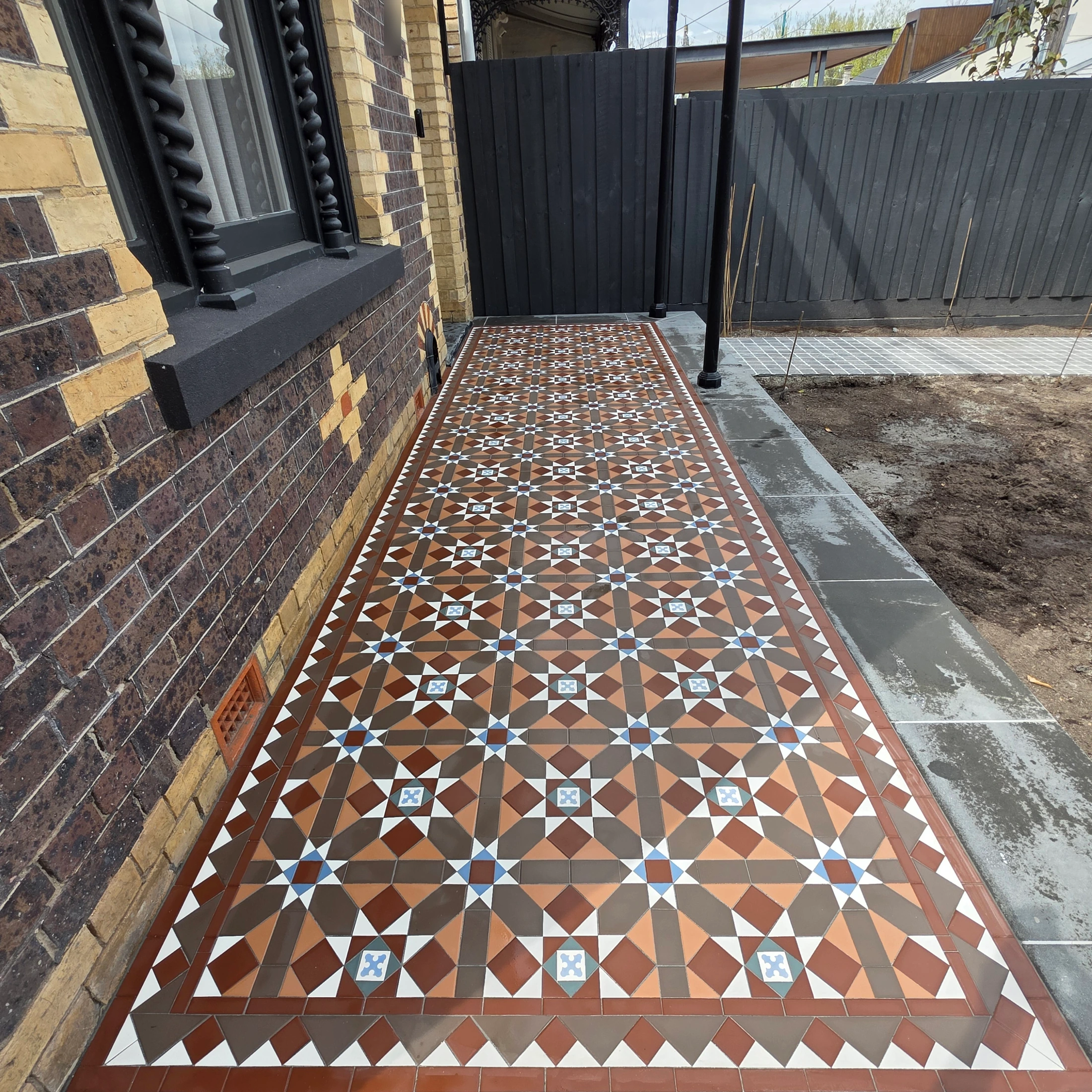
A property-led approach for Kilsyth homes
Maroondah's planning context recognises a mix of established and later residential areas, with different housing eras, street patterns, slopes, waterways and mature canopy. That broad setting is a useful starting point, but it is not a substitute for looking closely at your own frontage, verandah, entry or garden path.
Before selecting a pattern, consider the sightline from the street, the proportions of the threshold, existing brickwork or render, retained trees and the fall of the site. A restrained border or a carefully scaled field can make a new path sit comfortably with its surroundings without pretending that every Kilsyth property belongs to one architectural period.
Design, restoration and installation decisions
For a new verandah or pathway, layout decisions include the width of the route, the relationship between field and border, transitions at steps and doors, and how the finish meets garden edges or other paving. A design consultation can help resolve those choices before supply and installation are coordinated.
Where tiles already exist, restoration begins with an assessment of what can be retained and what needs careful replacement. Matching colour, scale and pattern is a property-specific exercise. The condition of the substrate, drainage, movement and junctions with adjacent surfaces also need to be considered rather than assumed from the suburb name.
Work with the site's setting
Maroondah guidance for development assessment asks applicants to understand surrounding built form, levels, trees, site access and paving. Those same observations are helpful when planning a tiled entry or path: photograph the existing approach, note changes in level and identify surfaces or planting that should remain undisturbed.
If your property has a heritage overlay or another planning control, check the applicable requirements with the relevant authority before work begins. A local setting or an older-looking home does not by itself establish heritage protection, and tile work should not be described as council-approved unless a separate approval has actually been obtained.
Your Heritage Tiling Questions
Can tessellated tiles suit a newer Kilsyth home?
They can, provided the pattern, scale, border and transitions are designed for the building rather than copied from an unrelated period. A consultation can compare a quieter layout with the home's existing materials and street presentation.
What should I consider for a sloping or garden-connected Kilsyth path?
Start with the site's levels, drainage, steps, edges, retained trees and the way the path meets doors or other paving. Maroondah planning guidance also identifies site access, trees and surrounding built form as matters that belong in a proper site description.
Can existing tessellated tiles be restored rather than replaced?
Often the right answer depends on an inspection of the existing tiles, pattern, joints, substrate and surrounding construction. Where sound original fabric can be retained, restoration and selective replacement may be considered; the suitable approach is specific to the property.
Does living in Kilsyth automatically mean my home is heritage-listed?
No. Kilsyth's locality and Maroondah's broader character do not by themselves establish heritage protection for an individual property. If you are concerned about an overlay or permit requirement, check the property-specific planning information with the relevant authority before work starts.
Discuss Your Heritage Tiling Project
Share your location, project details and photographs using our enquiry form, or call 0433 932 711.