
Tessellated tile services in McMahons Point
McMahons Point's harbour setting sits alongside a layered built history. North Sydney Council identifies McMahons Point North and McMahons Point South as local heritage conservation areas, while the locality's older cottages, terraces, apartment buildings, waterfront paths and industrial remnants create different tile and surface decisions from property to property. AHTC can help with tessellated tile design consultation, supply, installation, restoration and stone bullnose or edging coordination, with the existing fabric and the property's planning context considered at the outset.
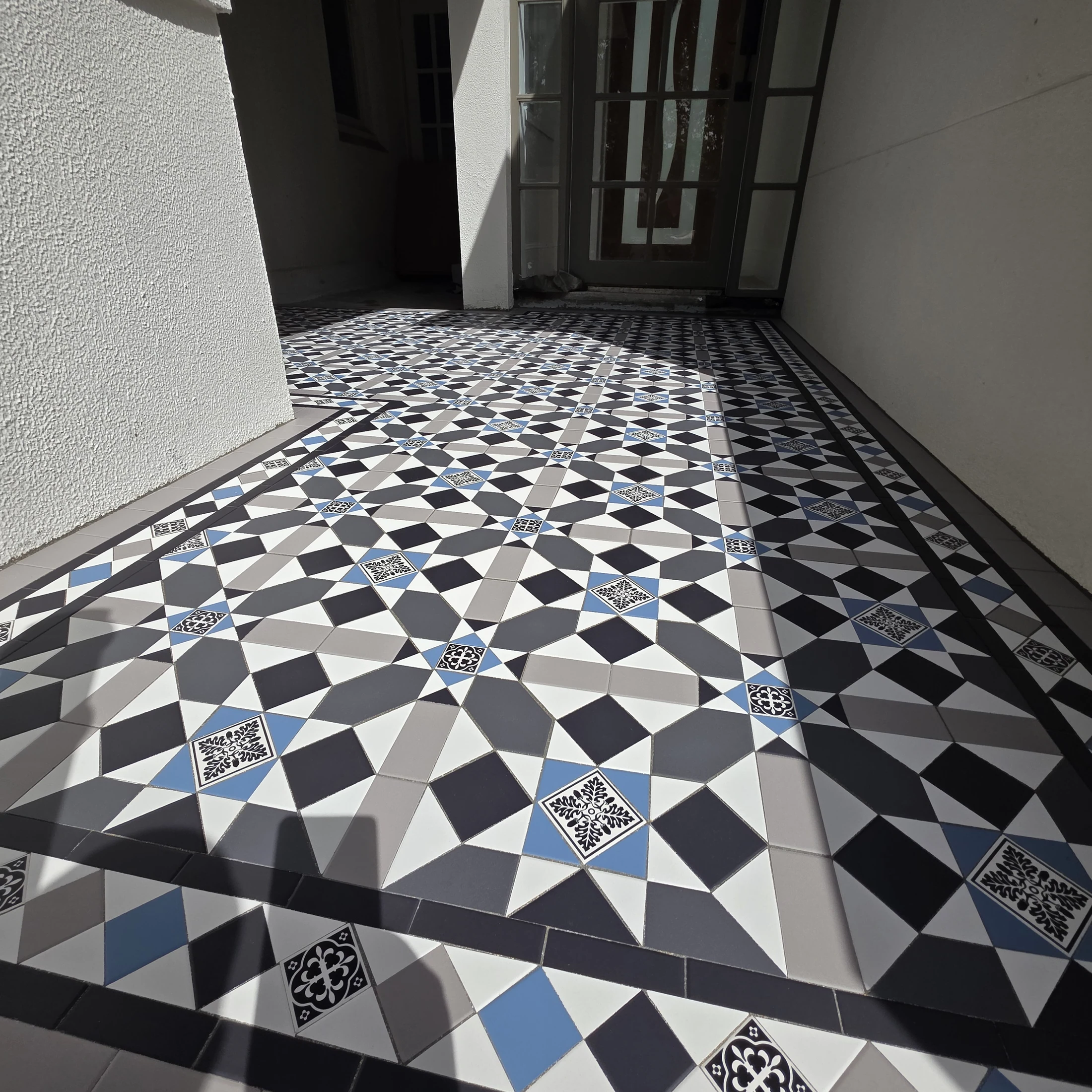
A locality of cottages, terraces, apartments and waterfront edges
McMahons Point is not a single architectural type. The Dictionary of Sydney records a former working waterfront of cottages, ferry wharves and boatbuilding yards, alongside surviving Victorian terrace houses and 1920s apartment buildings. That mix means a new tiled entry, verandah or pathway should be designed for the building and its setting rather than treated as a generic period template.
Harbour-facing paths, stepped approaches, narrow lanes and changes between private and public edges can make proportion, borders, thresholds and transitions especially important. A design consultation can work through the visual relationship between the tiled area, the dwelling or apartment building, and adjoining masonry, paving and landscape elements without assuming that every property has the same heritage status.
Check the property's heritage context before changing existing fabric
North Sydney Council's planning material lists two McMahons Point conservation areas and a McMahons Point neighbourhood locality. The LEP schedule also records individual heritage items and groups in the suburb, including waterfront places, residential buildings, commercial buildings and industrial remnants. These are different forms of heritage control and should not be read as a blanket listing of every home.
Before removing, repairing or extending an existing tiled surface, confirm the property's position in Council's mapping and the relevant planning controls. Where original or contributory fabric may be present, document what survives, assess its condition and discuss a repair or matching approach before selecting replacement work. Council or the relevant planning authority—not a tile contractor—can confirm whether an approval or exemption applies to a particular proposal.
North Sydney Development Control Plan 2025 — Section 1: Planning and Locality AreasHeritage property protection and regulations
Design inspiration and craftsmanship for a harbour-side property
For a new verandah or pathway, useful starting points include the scale of the frontage, the direction of approach, the relationship between border and field, and how the layout meets steps, thresholds and existing stone or masonry. A restrained palette can sit comfortably beside older brickwork, while a more decorative arrangement may suit a clearly defined entry or a property where the surrounding details support it. The right choice depends on the site and the intended relationship with existing fabric.
For restoration, retain as much sound original material as practical, record the pattern and edge conditions before lifting anything, and separate matching decisions from the later installation sequence. Our services include design consultation, tessellated tile supply, installation, restoration and coordination of stone bullnose or edging. The condition of the substrate, drainage, access and adjoining surfaces should be assessed at the property rather than assumed from the suburb name.
Plan the work around the existing property
A useful first step is to share photographs and a brief description of the area, including whether the work is a new pathway, verandah or floor, or the repair of an existing tiled surface. The design discussion can then consider pattern, scale, edging, transitions and the relationship with the property's architecture before supply and installation are coordinated.
If the property is within a conservation area or is individually listed, use North Sydney Council's heritage information and the NSW heritage register links to confirm the applicable controls. AHTC can provide tiling and restoration guidance, but does not provide heritage approval or replace advice from the responsible authority.
Heritage property protection and regulationsNorth Sydney Development Control Plan 2025 — Section 1: Planning and Locality Areas
Your Heritage Tiling Questions
Is every property in McMahons Point heritage-listed?
No. North Sydney Council distinguishes individual heritage items from conservation areas. McMahons Point has two named local conservation areas and a number of individually listed items, but the status of a particular property must be checked in the current LEP and Council mapping.
Does a conservation-area property automatically need heritage approval for tiling work?
Not necessarily. The applicable controls depend on the property, the conservation-area provisions and the proposed work. North Sydney Council or the responsible planning authority should confirm whether consent, an exemption or another pathway applies before work begins.
Can existing McMahons Point tessellated tiles be restored rather than replaced?
Often the first question should be whether sound original fabric can be retained. Record the existing pattern, edges and condition, then assess the substrate and adjoining surfaces before deciding between selective restoration, matching or new work. The appropriate method is property-specific.
What should a new McMahons Point pathway or verandah consider?
Consider the building's scale and character, the approach and slope, border and field proportions, thresholds and steps, drainage, access, and the relationship with existing masonry, stone and landscape. A design consultation can resolve those relationships before supply and installation are coordinated.
Discuss Your Heritage Tiling Project
Share your location, project details and photographs using our enquiry form, or call 0433 932 711.