
Tessellated Tiles in Coromandel Valley
Coromandel Valley's sloping sites, established vegetation and spacious detached homes call for tile layouts that are considered alongside the setting, not selected in isolation. Authentic Heritage Tiling Co can help with tessellated tile design, supply, installation, restoration and stone bullnose or edging coordination for verandahs, entrances, paths and other residential surfaces.
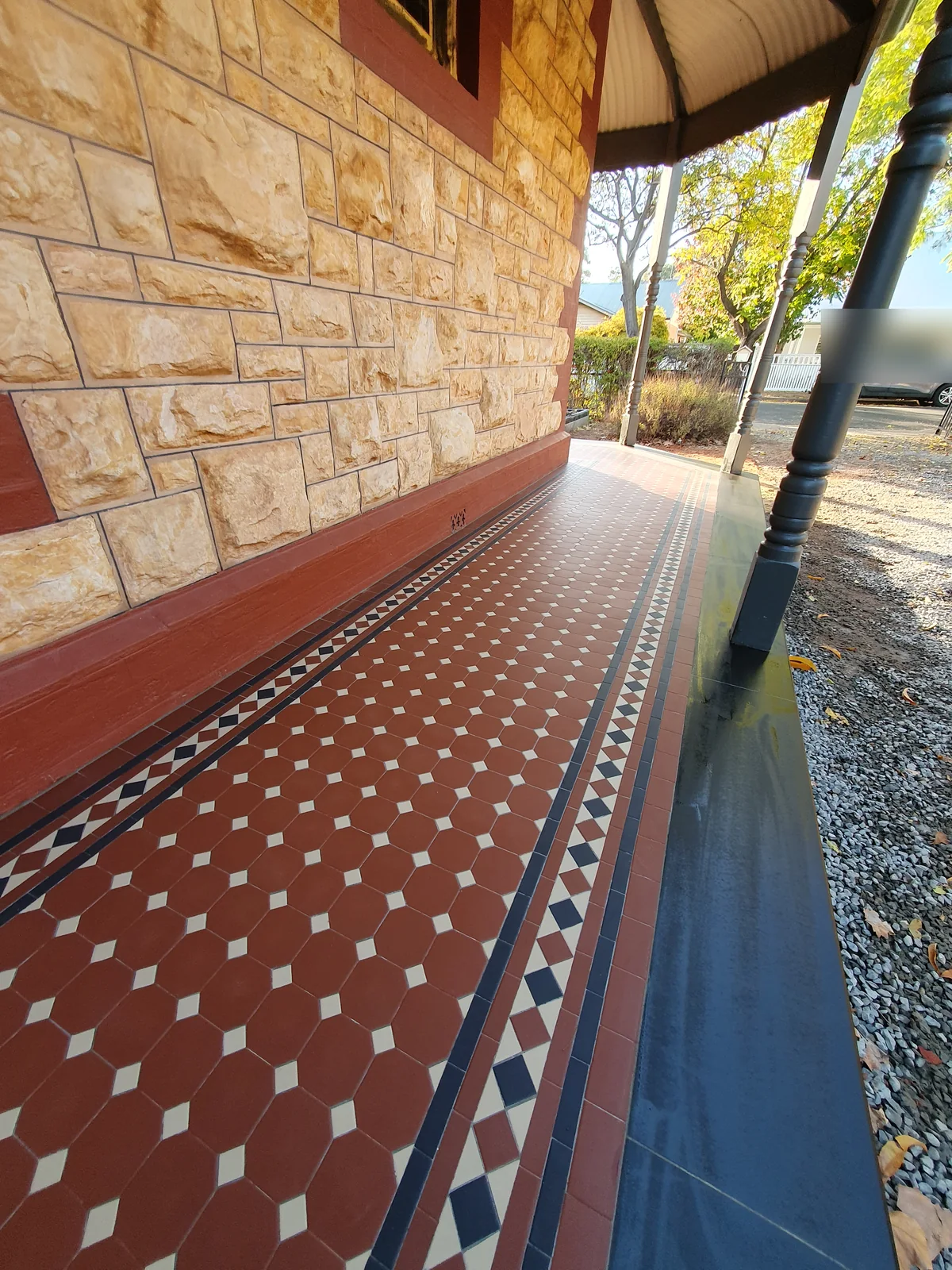
Designing for Coromandel Valley's slope and landscape
Local character guidance for Coromandel Valley describes steep or sloping land, curving roads, spacious detached homes, retained native vegetation and driveways that follow the slope. For a tile project, those conditions make transitions, levels, drainage and the visual weight of borders worth resolving early. A layout can be developed around the actual approach to the home rather than forcing a regular grid onto an irregular site.
Low-profile roofs and dark earthy materials, including brick, stone and timber, are also identified in the local character material. Tessellated patterns can be selected to sit comfortably with those tones while still giving an entrance, verandah or path its own definition. The right balance depends on the existing building, light, planting and sightlines from the street.
Where a path or verandah meets a slope, the design conversation should include thresholds, step geometry, edge treatment and how water is directed away from the tiled surface. Stone bullnose or other edging coordination may help clarify exposed edges, but the suitable detail depends on the site and the existing construction.
Respecting existing fabric and local heritage context
The South Australian Heritage Places Database records a local heritage place in Coromandel Valley at Main Road. That listing is property-specific and should not be read as evidence that every home or streetscape in Coromandel Valley is heritage listed. Before altering an older tiled surface or a property with a heritage status, the property's current listing and applicable planning controls should be checked.
For restoration, the first step is usually to understand what remains: the pattern, colour relationships, edge detail, wear, movement and any previous repairs. A design consultation can then separate conservation of sound original fabric from carefully defined new work, with supply and installation planned around the property's condition rather than an assumed universal method.
Tessellated tile services for local homes
A project may begin with pattern and colour selection, a review of an existing floor or a practical discussion about a new verandah, entrance or pathway. The work can then be coordinated through tessellated tile supply, installation or restoration, with stone bullnose and edging considered where the design needs a durable, resolved boundary.
Coromandel Valley addresses can vary substantially in slope, access, vegetation and existing construction. A site-led conversation is therefore more useful than assuming that one layout, edge detail or installation sequence suits every property. Share the intended area, what is already there and the way the surface is used so the next design decision is grounded in the home.
Your Heritage Tiling Questions
Does every Coromandel Valley home have heritage protection?
No. The South Australian Heritage Places Database records individual listed places, including one local heritage place in Coromandel Valley, but that does not make every home or streetscape heritage listed. Check the specific property and current Planning and Design Code requirements before altering an older tiled surface.
What should be considered when tiling a sloping Coromandel Valley site?
Discuss levels, thresholds, steps, drainage, access and edge conditions before settling the pattern. Local character guidance identifies sloping land and driveways that follow the slope, so the layout and transitions should respond to the actual site rather than assume a flat rectangular setting.
Can existing tessellated tiles be restored rather than replaced?
Often the appropriate choice depends on the condition and extent of the surviving fabric. A review can look at pattern, loose or damaged tiles, movement, previous repairs, edges and the intended use before deciding what can be retained and what new work is needed.
Are tessellated tiles suitable for a verandah or pathway in Coromandel Valley?
They can be considered for verandahs, entrances and pathways when the design is coordinated with the existing building, access, exposure, levels and drainage. Border proportions and stone bullnose or edging details can be resolved as part of the overall layout.
Discuss Your Heritage Tiling Project
Share your location, project details and photographs using our enquiry form, or call 0433 932 711.