
Tessellated tiles and heritage tiling in Morphett Vale
Morphett Vale's documented historic buildings include civic, religious, commercial and justice-related places, with stone, brick, rendered masonry, verandahs and later additions forming part of the local architectural story. For a new entrance, pathway or verandah, or for existing tiles that need attention, the useful starting point is the individual property: its proportions, adjoining materials, surviving details, exposure and intended use. AHTC can help with design consultation, tessellated tile supply, installation, restoration and stone bullnose or edging coordination.
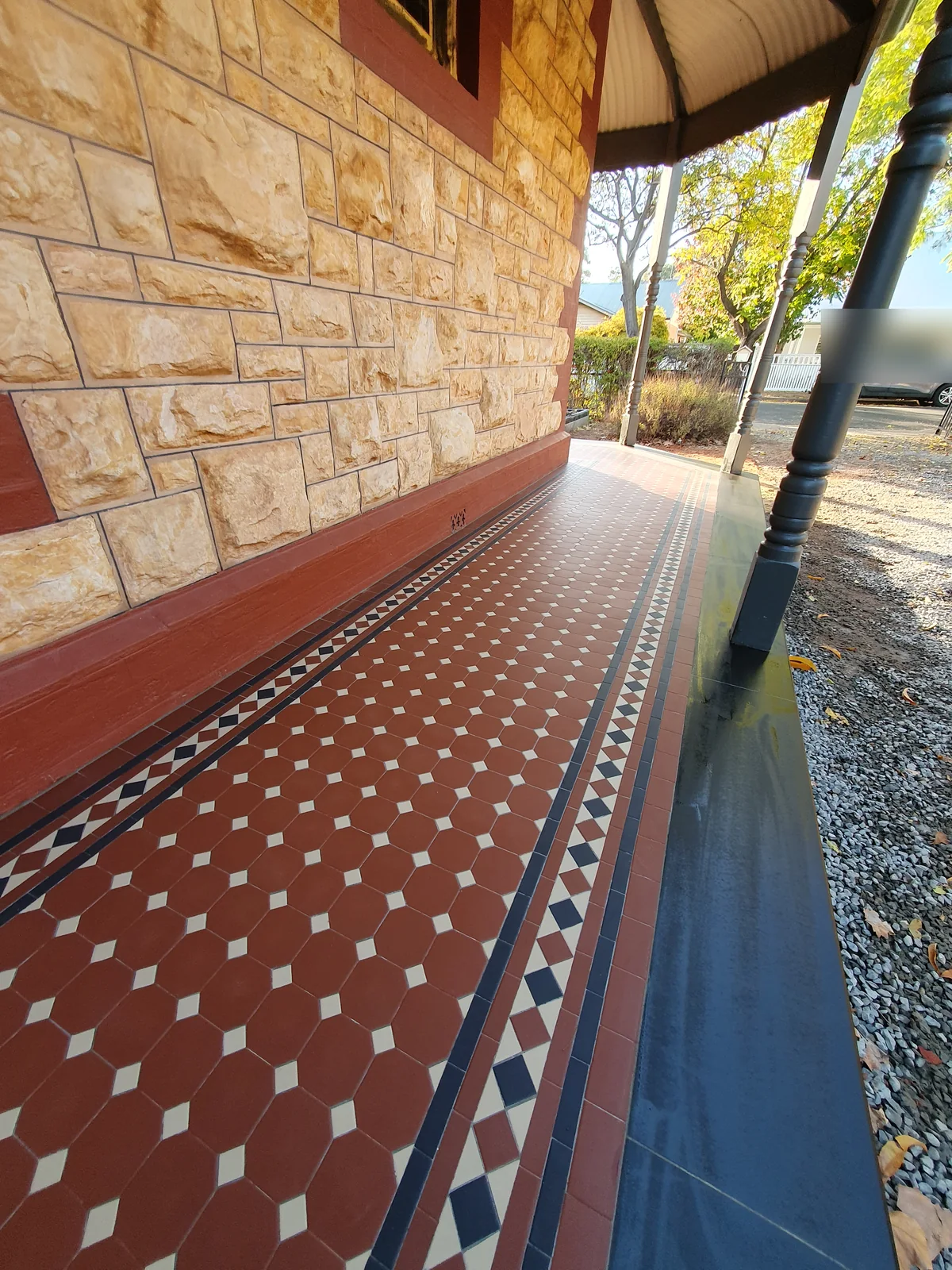
A layered historic setting
The City of Onkaparinga's records show that Morphett Vale's historic fabric is varied rather than defined by one uniform house type. The former Courthouse and Police Station, for example, is described with limestone walls, red brick quoins, corrugated iron roofing and a concave verandah, while the Emu Hotel contains early stone and brick sections alongside later additions.
Those layers are useful design cues, not a template to apply to every property. A tile layout should be considered alongside the building's scale, entrance sequence, existing masonry, fence or garden edge and the way the work will be seen from the street.
Design around thresholds, edges and material relationships
For a Morphett Vale verandah or pathway, proportions matter as much as the pattern. Design consultation can test the field, border and colour balance against the available width, steps, door threshold and adjacent walls. Existing stone, brick, render or painted joinery may suggest a restrained relationship, while a more contemporary addition may call for a clear but compatible transition.
Levels, falls, drainage and the condition of the supporting surface should be assessed at the property rather than assumed from the suburb. Where stone bullnose or edging is part of the brief, its profile and junctions should be coordinated with the tile layout and surrounding construction.
Check the individual property's heritage status
Morphett Vale includes both State and Local Heritage places, but the suburb name alone does not establish protection for every home or project site. South Australian heritage guidance provides official register and database pathways, and the council's built-heritage directory records the distinction between different types of heritage place.
If existing tiles or other original fabric remain, document their condition and pattern before removal. Depending on the property and scope, retention, selective repair, careful matching or a complementary new section may be appropriate. Heritage-sensitive tile guidance is not planning approval or an authority endorsement.
Tessellated work for entries, verandahs and pathways
A well-resolved tessellated surface is read at the threshold as well as from the street. The design stage can establish the pattern, border and colour relationship; supply and installation then need to be coordinated with the measured site and the condition of the existing work. Restoration begins differently, with an assessment of what survives and which areas can be retained or repaired.
For properties near older civic or commercial fabric, the aim is not to imitate a listed place. It is to make a new or repaired surface sit comfortably with the actual building, its edges and its surrounding landscape while keeping the scope clear and property-specific.
Your Heritage Tiling Questions
Does every Morphett Vale property have heritage protection?
No. Council records identify particular State and Local Heritage places, but the suburb name does not establish that an individual property is listed or protected. Check the current council and South Australian heritage information for the specific property before planning work.
What local architectural details can inform a Morphett Vale tile design?
The council's local records document stone, limestone, red brick quoins, rendered masonry, corrugated roofing and verandah forms across historic buildings such as the former courthouse and the Emu Hotel. These can be read as context cues, while the final pattern and colours should be selected for the actual property.
Can tessellated tiles work on a newer Morphett Vale addition?
They can be considered for a newer addition, but the design should resolve the relationship between old and new work rather than assume a period replica. Review the entry proportions, materials, steps, levels and edges, then choose a layout that belongs to the brief and the building.
Should I check heritage information before restoring tiles in Morphett Vale?
Yes, where the property may be a heritage place or affected by heritage controls. South Australia provides official heritage databases, and the City of Onkaparinga publishes property-specific built-heritage records. Confirm the relevant planning pathway before starting; tile design advice is not approval.
Can existing Morphett Vale tiles be repaired rather than replaced?
An assessment can consider the surviving pattern, condition, substrate and edges before deciding between retention, selective repair, matching or replacement. The appropriate scope depends on the individual surface and property, especially where original fabric may contribute to significance.
Discuss Your Heritage Tiling Project
Share your location, project details and photographs using our enquiry form, or call 0433 932 711.