
Tessellated Tile Services in Fairview Park
Fairview Park sits on Adelaide's north-eastern metropolitan edge within the City of Tea Tree Gully area. Its documented setting includes public reserves, community facilities, open space and views towards the Adelaide Hills and Hope Valley Reservoir. For a Fairview Park home, tessellated tiles can help connect an entry, verandah, pathway or interior floor with the way the property is used. The right design depends on the building, existing surfaces, exposure and the level of pattern you want to introduce.
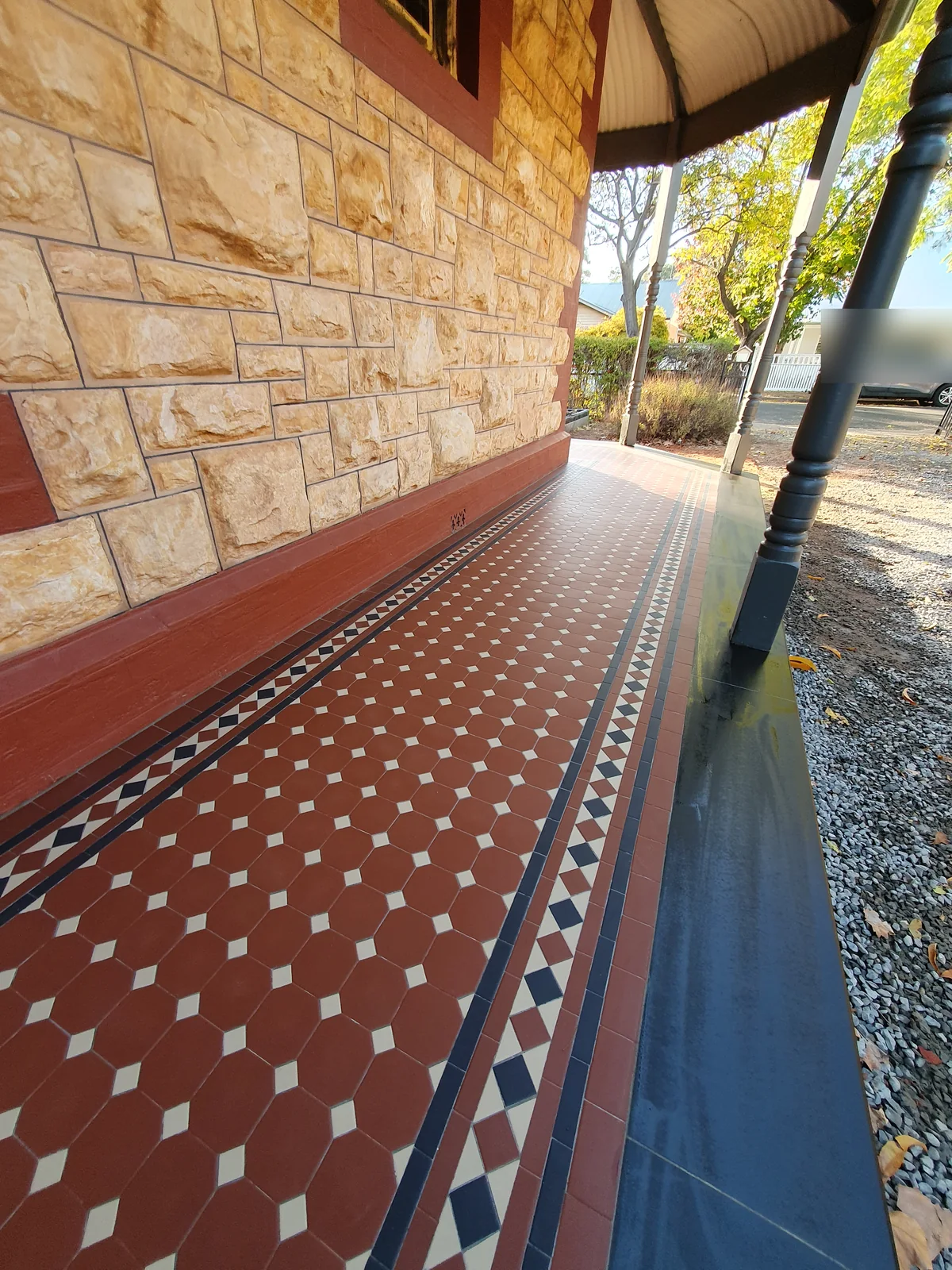
A considered tile approach for Fairview Park homes
Fairview Park is not treated as one uniform architectural style. The locality's public landscape and community facilities provide useful context, but the character of an individual home still needs to be read on site. A restrained border, a carefully scaled geometric field or a more contemporary interpretation may each be appropriate depending on the house and adjoining landscape.
For a house near open reserves or a well-used family garden, the practical brief may be as important as the pattern: clear thresholds, durable edges, safe changes in level and a surface that works with shade, weather and regular foot traffic. Design consultation can test proportions and colour relationships before supply or installation is arranged.
Verandahs, entries and pathways
A Fairview Park verandah or front path benefits from a layout that responds to its width, door openings, garden boundaries and approach to the street. Tessellated patterns can define a route without making a narrow space feel busy. Borders and corner turns should be planned with the actual footprint in mind rather than selected as a catalogue afterthought.
Where a new tiled area meets an older step, slab or threshold, the junction deserves early attention. Stone bullnose or edging coordination may help resolve the edge, but the suitable detail depends on levels, drainage, substrate condition and the materials already present.
Restoration and property-specific checks
If a Fairview Park property already has tiled steps, a verandah or an internal floor, assessment should come before replacement. Existing pieces, surviving borders and the condition of the base may guide whether the work is selective restoration, careful adaptation or a new installation alongside retained fabric.
A council or state planning check is property and proposal specific. Before changing a significant exterior, use the South Australian Planning and Design Code and SAPPA to check the relevant controls and whether approval may be needed. A tiled surface or design service does not itself confer heritage approval, and no suburb-wide heritage status is assumed.
Your Heritage Tiling Questions
Can tessellated tiles suit a newer Fairview Park home?
Yes. The pattern and border can be scaled to the building rather than copied from a period template. A simpler field, a restrained palette or a carefully framed entry may suit a newer home, while the final choice should also account for exposure, levels and the adjoining garden.
Are all Fairview Park properties heritage-listed?
No such suburb-wide conclusion is supported here. Heritage status and planning requirements need to be checked for the particular property and proposal through the relevant South Australian planning information and, where appropriate, the council.
What should be considered for a Fairview Park pathway or verandah?
Start with the footprint, entry direction, door thresholds, drainage, exposure and the relationship with steps or garden edges. A measured layout helps keep the pattern balanced and identifies where edging or a transition detail may be needed.
Can existing tiles in a Fairview Park home be restored?
Often the first step is an assessment of what remains: loose or damaged tiles, the border, the base and any moisture or movement issues. That assessment can indicate whether selective restoration or a new, compatible tiled area is the more suitable approach.
Discuss Your Heritage Tiling Project
Share your location, project details and photographs using our enquiry form, or call 0433 932 711.