
Tessellated tiles in Golden Grove
Golden Grove sits in Adelaide's north-east within the City of Tea Tree Gully. Homes and additions here can differ in age, setting, access and level, so a useful tiling plan starts with the property rather than a presumed suburb-wide style. We can help with tessellated tile design, supply, installation, restoration and stone bullnose or edging coordination for floors, verandahs and pathways.
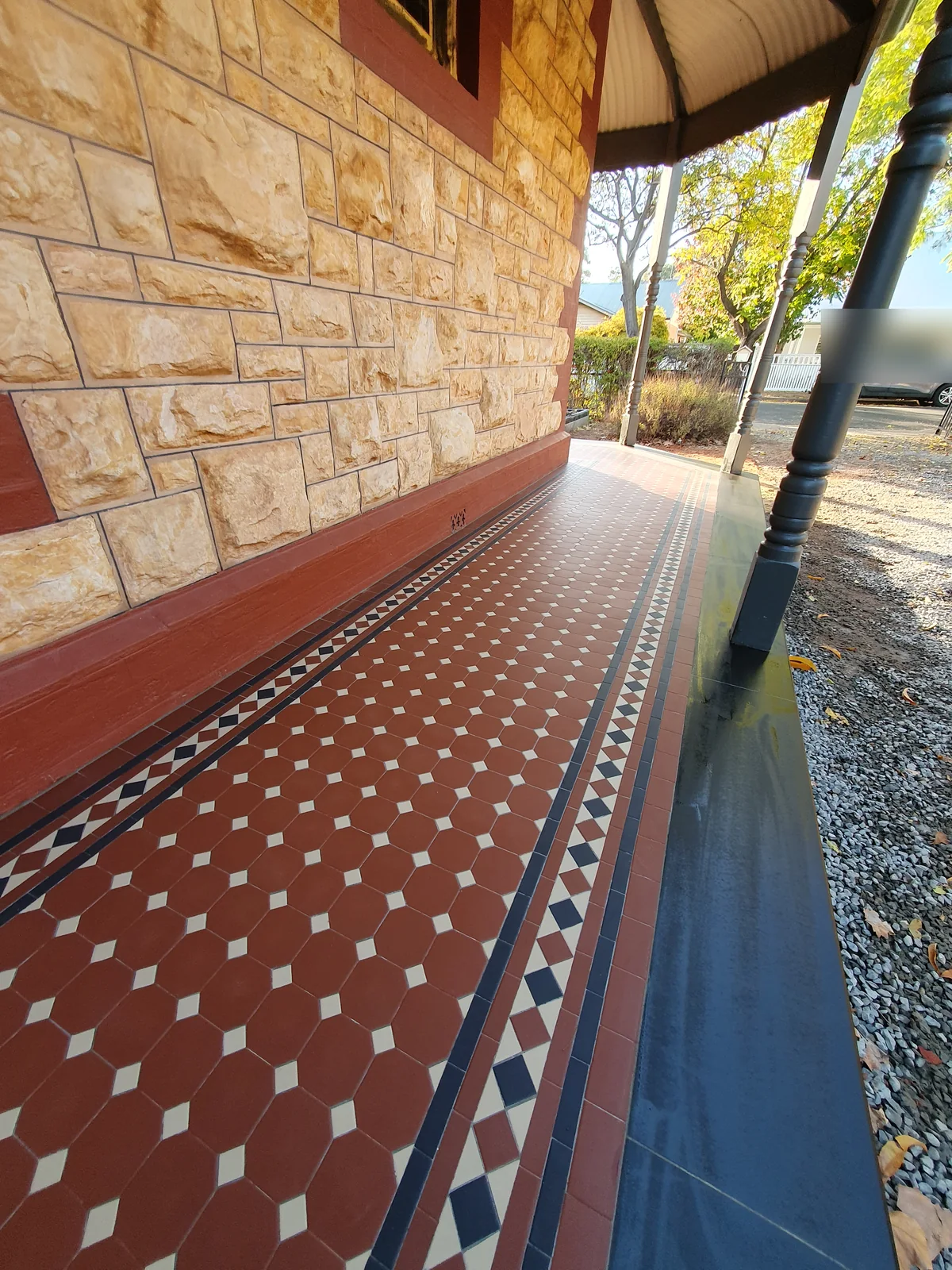
A site-led approach for Golden Grove properties
South Australian planning material for Golden Grove describes master-planned housing and employment growth alongside open space and walking and cycling connections. It also identifies slope, drainage and flooding, bushfire, regulated and significant trees, water resources and neighbouring land uses as matters that may shape development decisions in the affected area. [s2] [s3]
For a new tiled area, those conditions make the relationship between levels, thresholds, surface water and adjoining landscape important to resolve before selecting a layout. A design consultation can consider the intended use, pedestrian movement, edges and transitions so the pattern works with the building and its setting.
These planning matters do not mean that every Golden Grove home has the same construction or approval pathway. Advice about a particular property should be checked against the site, existing approvals and the relevant South Australian planning requirements.
Design, supply and installation for floors, verandahs and paths
Tessellated patterns are most successful when the geometry is considered with the room or route around it. We can work through colour relationships, borders, corner turns, thresholds and the visual scale of the pattern before supply and installation are coordinated.
For verandahs and pathways, the layout needs to meet doors, steps, garden edges and other surfaces cleanly. On a sloping or exposed site, the practical detailing of falls, drainage and transitions should be resolved as part of the broader design conversation rather than assumed from a standard detail.
Where stone bullnose or other edging is appropriate, its profile and junctions can be considered alongside the tessellated field. The final selection and installation approach remain dependent on the actual property and the condition of the area being tiled.
Restoring existing tilework with care
If an existing floor, verandah or path is being retained, begin by recording what survives: the pattern, border, dimensions, loose or missing tiles, edge conditions and changes at doorways. Matching decisions are clearer when the original arrangement is documented before repair or replacement work begins.
The Stage 2 planning fact sheet states that its affected site contains no sites of National, State or Local Heritage Significance, but that statement is limited to that site and is not a heritage determination for every Golden Grove property. If a property has a heritage listing, an overlay or another planning constraint, confirm the relevant requirements with the appropriate authority before work proceeds. [s2]
Restoration, selective repair and new installation are different decisions. A property-led assessment can help determine whether existing fabric should be retained, whether a new section should be visually connected without pretending to be old, and where a compatible border or edging treatment is suitable.
Your Heritage Tiling Questions
Can you help plan tessellated tiles for a Golden Grove verandah or pathway?
Yes. Design consultation can address the pattern, border, thresholds, steps, edges and transitions for a verandah or pathway. The site should be assessed for its actual levels, drainage, access and relationship with adjoining surfaces before installation details are settled.
Does the Golden Grove planning context affect a new tiled area?
It can. South Australian planning material identifies matters including slope, flooding, bushfire, regulated and significant trees, water resources and neighbouring land uses in the relevant growth area. Those considerations do not automatically determine the requirements for every home, so property-specific planning and building checks are important.
Can existing tessellated tiles in Golden Grove be restored rather than replaced?
Often the first step is to document the surviving pattern, borders, dimensions, edges and areas of damage. An assessment can then consider selective repair, careful matching or a new complementary section. The appropriate choice depends on the condition and significance of the particular floor or path.
Does every Golden Grove property have heritage protection?
No conclusion about every property can be drawn from a planning statement about one affected site. Heritage status and any applicable planning requirements should be checked for the specific property before work begins. A heritage-sensitive design approach can still be useful where original fabric or period character matters to the owner.
Discuss Your Heritage Tiling Project
Share your location, project details and photographs using our enquiry form, or call 0433 932 711.