
Tessellated tiles in Modbury North
Planning tessellated tiles in Modbury North is best approached from the property outward. A new verandah, garden path or entry can be designed for its proportions and exposure, while an existing tiled floor may need a more careful assessment of what can be retained, repaired or matched. We provide design consultation, tessellated tile supply, installation, restoration and coordination of stone bullnose or edging details across Adelaide's north-eastern suburbs.
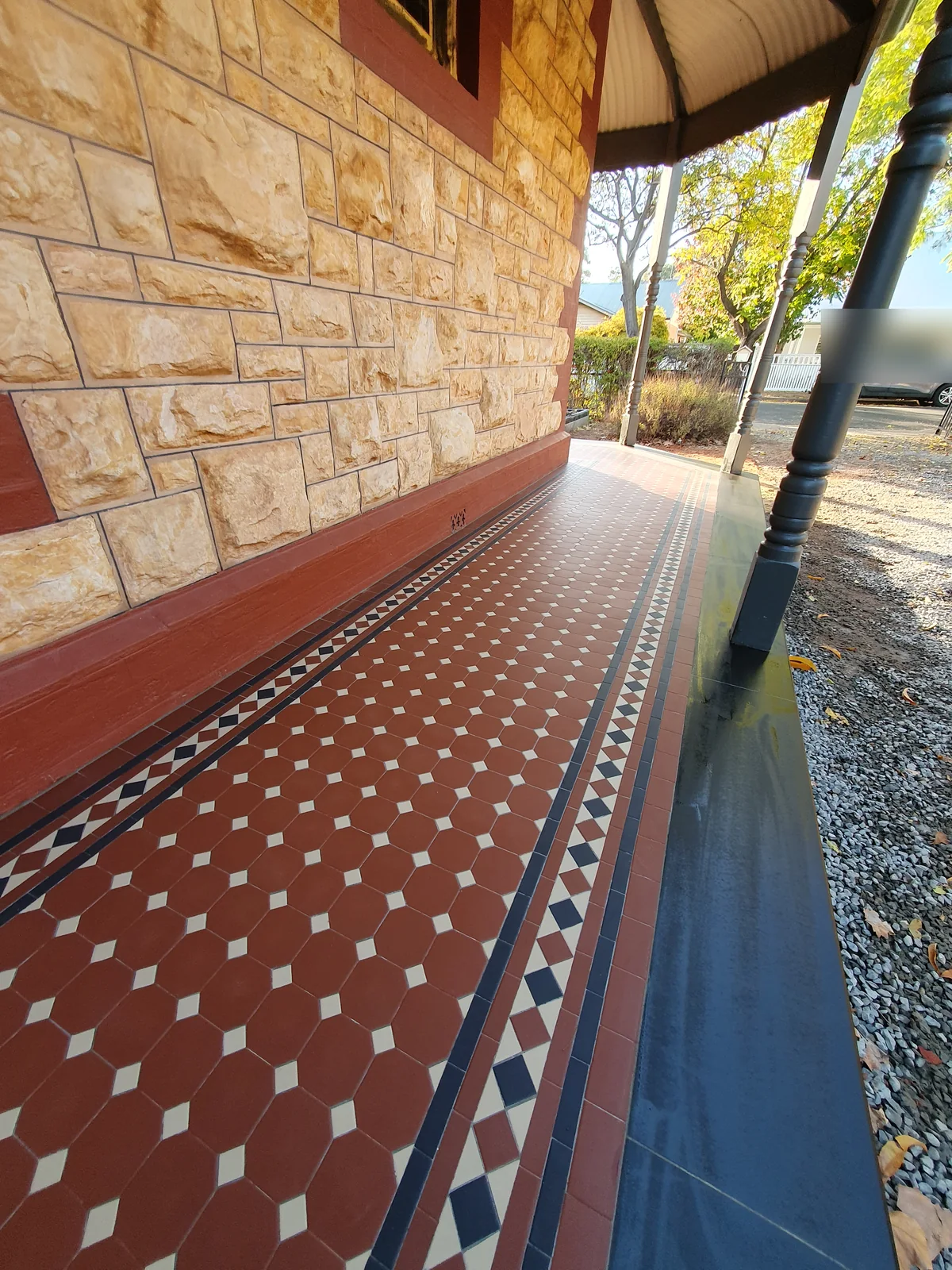
A local starting point for Modbury North properties
Modbury North is a suburb of the City of Tea Tree Gully in Adelaide's outer north-east. The council publishes an official suburb boundaries map and local suburb information, while the Greater Adelaide Regional Plan places Modbury among the Inner North centres. That metropolitan setting helps with service-area planning, but it does not by itself establish a common house style or heritage status across the suburb.
For a Modbury North project, the useful questions are specific to the property: how the entry or verandah meets the street, whether an existing pattern survives, how rain and sun affect the area, and whether the proposed work changes original fabric. Those details guide proportion, border treatment, colour relationships and the practical sequence of supply and installation.
Designing verandahs, entries and pathways
For new work, begin with the geometry of the space rather than selecting a pattern in isolation. A measured plan can establish the field, border and threshold so that cuts are deliberate and the layout sits comfortably beside steps, walls, garden edges and door openings. On a pathway, transitions and falls matter as much as the motif: the finished surface should connect cleanly with adjoining paving and manage water at the property.
Tessellated tiles can be used for a restrained contemporary interpretation or a more period-aware composition. The right choice depends on the building, surrounding materials and the level of visual contrast wanted. A consultation can also coordinate stone bullnose or edging where a step, coping or pathway edge needs a durable, resolved finish.
Restoring an existing tiled surface
Existing tiles should be documented before removal or replacement is considered. Look for loose or drummy areas, failed edges, staining, missing pieces, previous repairs and changes in level. Retaining sound original material may produce a better result than replacing an entire surface, but the appropriate approach depends on condition and on whether a close match can be sourced or made available.
A heritage label should not be assumed from age or appearance. Tea Tree Gully's heritage guidance refers to local heritage places and contributory items within a Historic Conservation Policy Area, and treats State Heritage listed properties separately. For a specific property, check the relevant listing, policy area and planning controls before altering significant fabric. PlanSA directs owners to address-specific zoning, policies and overlays through SAPPA and the Planning and Design Code.
A practical project sequence
Start with photographs, dimensions and a discussion of the intended use. We can then consider layout, tile supply, substrate condition, access, sequencing and the relationship between new and existing work. For restoration, the assessment should separate cleaning, local repair, replacement and broader rebuilding rather than treating every defect as the same problem.
If your property has a heritage listing, sits within a conservation policy area or is affected by another planning overlay, confirm the applicable requirements with the relevant authority before work begins. The planning check is property-specific; this service page does not make an approval determination.
Your Heritage Tiling Questions
Can you help design a tessellated-tile verandah in Modbury North?
Yes. We can work from the verandah's dimensions, thresholds, steps, adjoining materials and intended character to develop a layout and coordinate supply and installation. The final design should respond to the individual property rather than assume a suburb-wide style.
How should I approach an older tiled entry or path?
Begin with a condition assessment and record the existing pattern, colours, edges and areas of movement or loss. Sound original tiles may be retained, while damaged sections can be considered for selective repair or careful replacement when a suitable match is available.
Does living in Modbury North mean my home is heritage-listed?
No. Suburb location alone does not establish heritage status. Check the individual property and any relevant policy area, listing or overlay before changing significant fabric. PlanSA provides address-based zoning and overlay information, and the City of Tea Tree Gully explains its separate treatment of local heritage places, contributory items and State Heritage listed properties.
Can you coordinate stone bullnose or edging with the tiles?
Yes. Stone bullnose and edging coordination can be considered alongside the tile layout, steps, borders and adjacent paving so the edge is planned as part of the whole composition.
What should I prepare before requesting a Modbury North tile consultation?
Useful starting information includes photographs from several angles, approximate dimensions, the intended use of the area, and any known history of repairs or movement. If the property may be heritage-listed or affected by an overlay, include that information so the discussion can remain appropriately property-specific.
Discuss Your Heritage Tiling Project
Share your location, project details and photographs using our enquiry form, or call 0433 932 711.