
Tessellated tiles in Middle Cove
Middle Cove's setting on a Middle Harbour peninsula brings a useful property-led perspective to tile work. A home may sit beside a slope, rock outcrop or established vegetation, while the house itself may reflect a later twentieth-century design period. We can help you consider tessellated tile patterns, verandahs, pathways, edging and restoration in relation to the existing building and site.
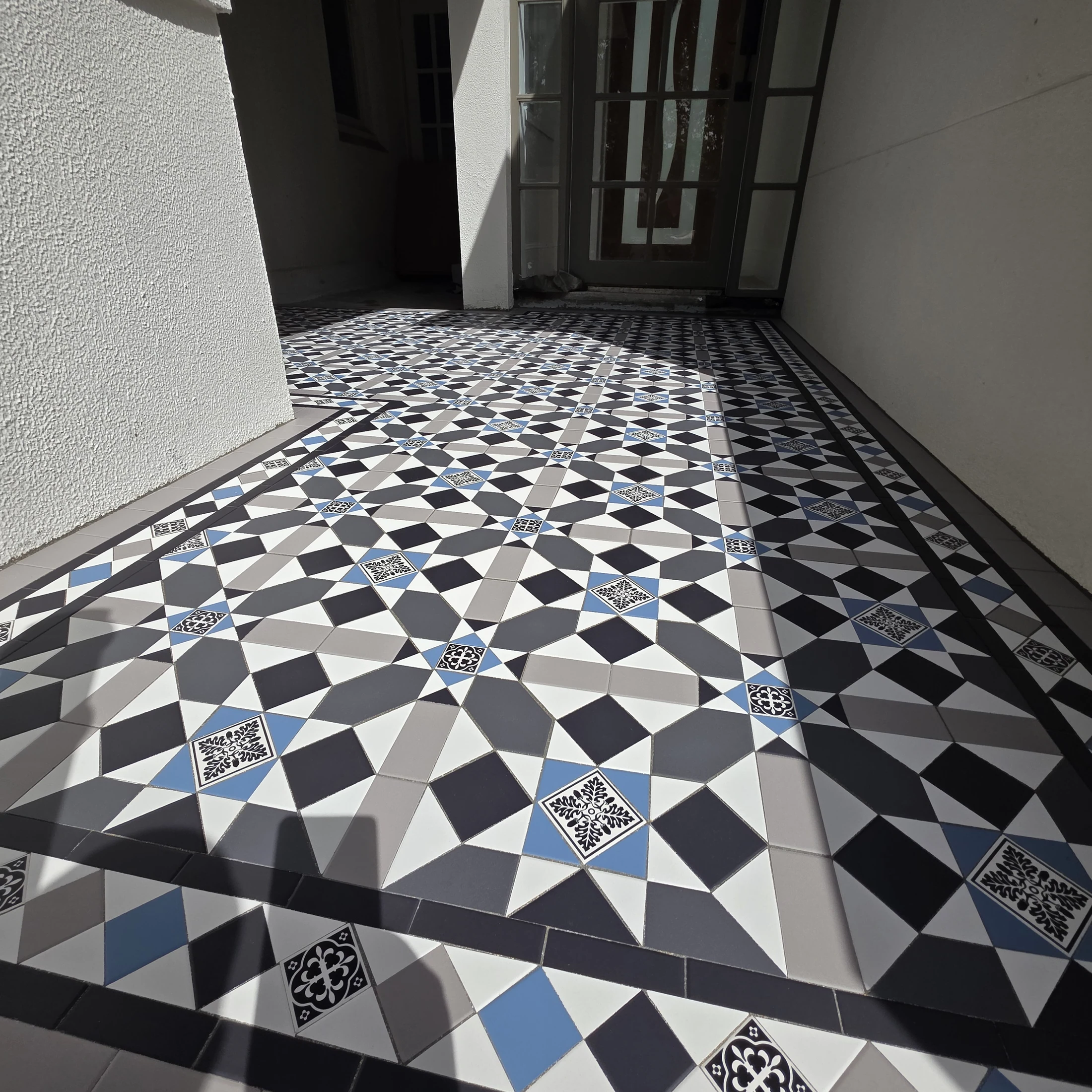
A Middle Harbour setting with varied sites
Middle Cove is described in the local historical record as the smallest of the Middle Harbour peninsulas, fronting Sugarloaf Bay from a recessed westerly position. Its recognisable residential development dates mainly from the late 1960s and early 1970s, so a Middle Cove address is not automatically a Federation or Victorian property.
Council's natural-heritage register records steep slopes, rock outcrops and remnant native vegetation in parts of Middle Cove. For a tile project, that makes the relationship between the building, entry route, verandah or terrace and the surrounding ground important to examine before selecting a layout or detailing transitions.
The Development of Castle Cove and Middle Harbour | Willoughby City LibraryWilloughby Natural Heritage Register — Middle Cove database
Let the existing architecture lead
A restrained geometric layout can suit a later twentieth-century home, while a more traditional border and colour arrangement may be appropriate where an older entry, verandah or pathway has surviving character. The right choice depends on the proportions, sightlines, thresholds and existing materials at the property rather than on the suburb name alone.
For a sloping or terraced site, discuss how the proposed tiled area meets steps, garden edges, drainage points and other surfaces. A design consultation can help coordinate the pattern, border, tile supply and installation sequence around the actual access and levels.
Willoughby Natural Heritage Register — Middle Cove databaseThe Development of Castle Cove and Middle Harbour | Willoughby City Library
When heritage checks matter
Willoughby has both local environmental-plan heritage items and heritage conservation areas, with additional provisions in Development Control Plan Part H. A Willoughby heritage review also identified an individually significant Modernist residence in Middle Cove. These records show why a property-specific check is worthwhile; they do not mean that every Middle Cove home is heritage listed or that tile work automatically requires heritage approval.
Before changing original fabric or working on a listed property or within a mapped conservation area, confirm the current planning position with Willoughby City Council or the relevant authority. Our role is to help with design, tessellated tile supply, installation and restoration planning, not to provide statutory approval.
Heritage Items | Willoughby City CouncilHeritage Conservation Areas | Willoughby City CouncilWilloughby City Council Heritage Study Review, August 2018
Craftsmanship for entries, verandahs and pathways
Small details have a large effect on a tiled entrance. Border proportions, centre alignment, colour rhythm and the meeting between tile and stone edging should be considered together. On an exposed or elevated site, the design discussion should also account for how water moves across the approach and how the tiled work joins adjacent surfaces.
Where older tiles remain, restoration begins with looking carefully at what is present: pattern, dimensions, condition, previous repairs and the areas that should be retained. If replacement is needed, matching should be approached as a design and material exercise rather than assuming a generic pattern will suit the property.
Willoughby Natural Heritage Register — Middle Cove databaseHeritage Items | Willoughby City Council
Your Heritage Tiling Questions
Are all Middle Cove homes heritage listed?
No. Willoughby's heritage guidance distinguishes individual heritage items and conservation areas from other properties. The current planning maps and instruments need to be checked for the particular address; the suburb's natural-heritage records and a heritage-study entry do not make every home heritage listed.
What should I consider for tessellated tiles on a Middle Cove slope?
Start with the existing levels, steps, drainage, garden edges and transitions to other surfaces. Middle Cove records include steep slopes and rock outcrops in parts of the locality, so the pattern and installation planning should be developed around the actual site rather than using a one-size-fits-all layout.
Can a later twentieth-century Middle Cove home use tessellated tiles?
Yes, where the design is chosen to work with the home's architecture. The local historical record notes that much of Middle Cove's residential development became established from the late 1960s and early 1970s, so a contemporary geometric approach, carefully proportioned border or restrained pathway design may be more suitable than imitating an earlier period without evidence.
How do I approach restoration if my existing tiles are damaged?
Document the surviving pattern, tile sizes, colours, borders and previous repairs first. A restoration assessment can then consider what can be retained, what needs selective repair and how any replacement work should relate to the original fabric and the property's current use.
Discuss Your Heritage Tiling Project
Share your location, project details and photographs using our enquiry form, or call 0433 932 711.