
Tessellated tiles in Rosanna
Rosanna has a varied residential story, from established garden-suburb homes to the architecturally significant Elliston Estate and Rosanna Parklands. For a new verandah, path or interior floor, tile scale, border design and transitions should respond to the building and site. Where existing tiles or other original fabric remain, the first step is a careful condition and design assessment rather than assuming replacement is the best outcome.
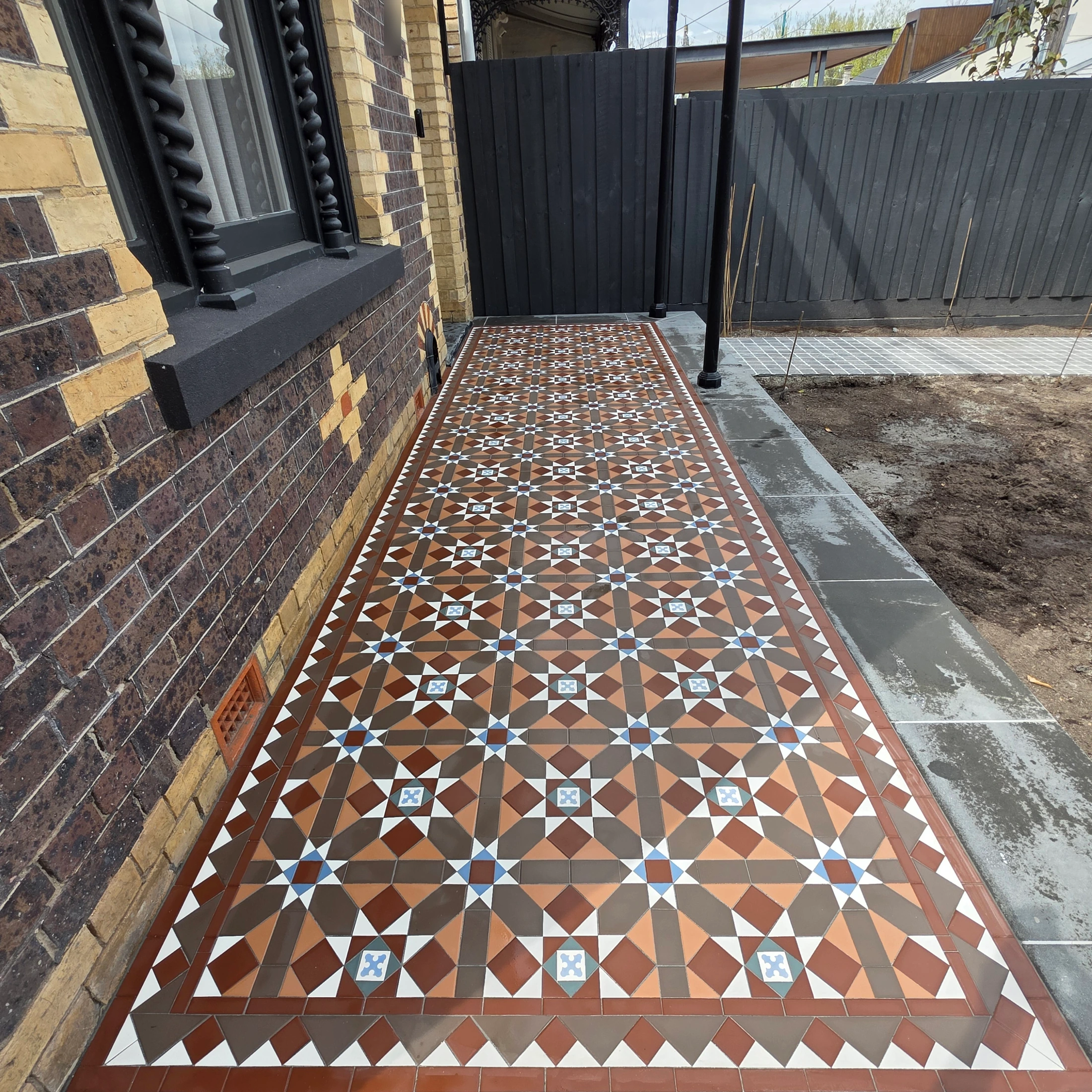
Designing for Rosanna homes and gardens
Rosanna sits within Banyule, a metropolitan municipality known for its parks, river-valley landscapes and diverse twentieth-century built history. That context makes a site-led approach useful: the right tessellated layout for a compact entrance may not be right for a broad verandah, garden path or a later extension.
A design review can consider the building lines, approach to the front door, existing colours and the relationship between paving, garden and façade. Borders, corner details, thresholds and stone bullnose or edging coordination can be resolved together so the finished work reads as part of the property rather than an isolated pattern.
A distinct post-war design context
The state-listed Elliston Estate and Rosanna Parklands are recognised for the way late-1960s and early-1970s residences were planned with landscape and shared open space. The listing describes Modernist homes, natural material palettes, native planting and a considered relationship between private and public areas.
That history is useful context, not a template for every Rosanna property. If a home is within a listed place or affected by a planning control, tile selection, repairs and new work should be checked against the relevant place information and current council requirements. A specialist tiling discussion can support design and condition decisions, but it does not replace planning or heritage advice.
Restoration, replacement and new installation
For an older tiled entry, verandah or pathway, an assessment can separate loose or damaged areas from sound original work and identify whether matching, selective restoration or a new complementary layout is the more suitable direction. Colour variation, perimeter details and the meeting point with steps or garden edges can be important to the result.
For new work, the practical brief includes the intended use, exposure, falls and drainage, access, substrate condition and how the tiles meet doors, walls and landscape edges. Supply, installation, restoration and design consultation can be coordinated around that property-specific brief.
Your Heritage Tiling Questions
Does every Rosanna home have heritage protection?
No. Heritage recognition and planning controls apply to identified places and precincts. A Rosanna address should be checked against the current Banyule Planning Scheme and relevant heritage records before assuming that controls apply or do not apply.
What is special about the Elliston Estate in Rosanna?
The state-listed Elliston Estate and Rosanna Parklands are recognised as a late-1960s and early-1970s post-war project-housing and landscape place. Its significance includes the relationship between Modernist residences, naturalistic planting, parkland and shared open space.
Can tessellated tiles suit a post-war or Modernist home?
They can, but the design should be tested against the home’s proportions, materials, entry sequence and landscape rather than assuming a period match. A restrained layout, carefully considered border and compatible edging may be more appropriate than copying an unrelated historic pattern.
Should existing Rosanna tiles be removed before an assessment?
Not necessarily. Keeping sound original fabric may be preferable, while damaged or unstable areas may need selective repair or replacement. Condition, drainage, substrate and the relationship to adjoining work should be assessed before deciding on removal.
Discuss Your Heritage Tiling Project
Share your location, project details and photographs using our enquiry form, or call 0433 932 711.