
Banyule heritage tiling area directory
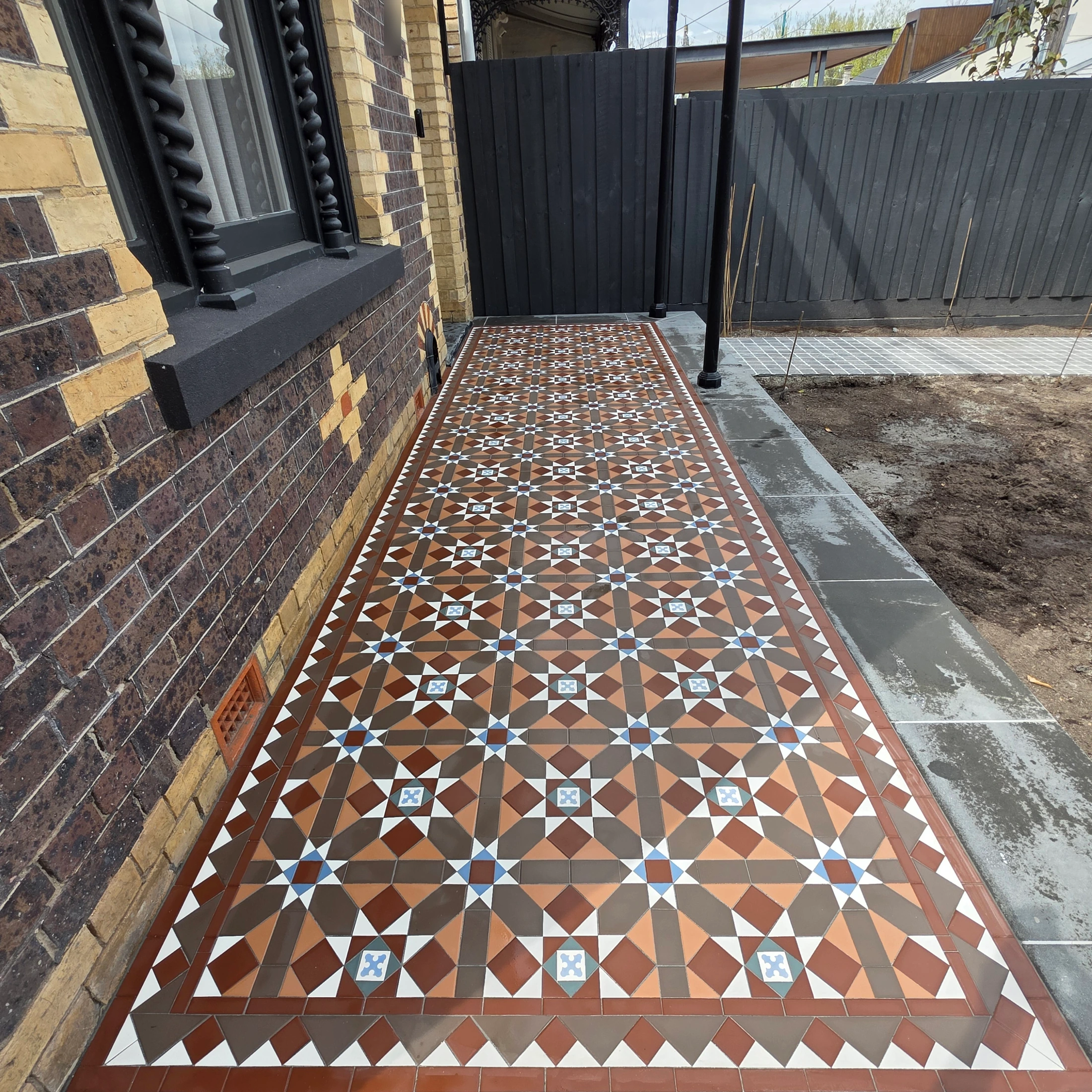
Use this Banyule area directory to find locality-specific heritage tiling guidance. Banyule's established residential neighbourhoods include places where heritage character is expressed through individual buildings, streetscapes and precincts. From Ivanhoe, Heidelberg and Eaglemont through to Rosanna, Montmorency and Greensborough, a tessellated tile scheme can contribute to the way a verandah, entry or pathway meets the architecture around it. Authentic Heritage Tiling Co can help with design consultation, tessellated tile supply, installation, restoration and stone bullnose or edging coordination, with the work planned around the property rather than a generic period label.
A broad Banyule setting with distinct local character
Banyule is in Melbourne's north-east and is an established residential municipality. Council's South Precinct groups Eaglemont, Ivanhoe and Ivanhoe East around shopping precincts, heritage buildings, green spaces, Darebin Creek and the Yarra River. That setting makes the relationship between a tiled threshold, a garden edge and the surrounding streetscape an important design consideration, while not implying that every property has the same heritage status.
Banyule's heritage research records early Warringal and Heidelberg places, buildings in Ivanhoe and Eaglemont, and later residential and commercial development. The Ivanhoe activity-centre study also discusses inter-war residential development and inter-war commercial buildings. These are useful contextual leads for design conversations, not a claim that every Banyule home belongs to one architectural period.
Demographic Profile | Banyule and PrecinctsBanyule Futures - South PrecinctBanyule Heritage ReviewIvanhoe Activity Centre Heritage Items & Precincts
Designing a tiled verandah, entry or pathway
Start with the building and the space that the tiles need to serve. A front verandah may call for a restrained field with a border that sits comfortably beside existing brickwork, joinery and garden planting. A pathway may need a clear transition at the gate, a considered edge and proportions that work with the approach to the house. For a period property, matching or complementing surviving details is usually more useful than selecting a pattern from a catalogue without first assessing the setting.
A design consultation can consider the intended use, the visual connection between indoor and outdoor thresholds, the relationship to steps and drainage, and whether stone bullnose or edging coordination is appropriate. New work should be described as new work; restoration or careful matching should be considered separately when existing tiles or fabric are present.
Check the property before altering existing fabric
Banyule's heritage material distinguishes individual places and precincts, and Council's Heritage Overlay guidance is property-specific. If a property is affected by a Heritage Overlay or another planning control, check the current planning information before demolition, alteration, addition or external works. Council states that applications are assessed case by case and that routine maintenance which does not change the external appearance may be treated differently.
For an existing tiled surface, begin with a condition assessment and record what survives before choosing repair, selective replacement or a new installation. The appropriate approach can depend on the significance of the place, the condition of the substrate and tiles, access, weather exposure and the desired relationship between original fabric and new work.
Banyule Heritage Study & Planning Scheme Amendment C165Banyule Heritage Strategy 2024-2034
Banyule area directory
Your Heritage Tiling Questions
Are all homes in Banyule heritage-listed?
No. Banyule's heritage studies identify particular places and precincts, and Council's Heritage Overlay information is property-specific. A home's age or location near a heritage area does not by itself establish the same controls for every property. Check the current planning information for the address before making heritage-related assumptions.
What should I consider when planning tessellated tiles for a Banyule verandah?
Consider the existing architecture, the scale of the verandah, the approach from the garden or footpath, steps and transitions, exposure and drainage, and whether the work is new installation or restoration of surviving fabric. A design consultation can help connect the pattern, border and edging to the property rather than treating the tile layout as an isolated surface.
Could a Heritage Overlay affect tile or paving work in Banyule?
It can, depending on the property and the proposed work. Banyule Council states that a Heritage Overlay may trigger permit requirements for demolition, construction, alterations, additions and some repairs or maintenance that change appearance. Council also explains that routine maintenance which does not change the external appearance may not require a permit. Confirm the current requirements with Council for the specific property.
Can existing tessellated tiles be restored rather than replaced?
Often the first step is to assess what remains, including the tile condition, layout, edges and underlying surface. The decision between restoration, selective replacement and new work should follow that assessment and the property's significance and practical requirements. Existing fabric should not be assumed to be disposable or automatically original without inspection.
Which Banyule areas can I explore for local context?
The directory includes Ivanhoe, Ivanhoe East, Heidelberg, Heidelberg Heights, Eaglemont, Rosanna, Viewbank, Yallambie, Greensborough, Montmorency, Eltham, Watsonia and Bundoora. Council's published heritage material gives particularly useful context for Ivanhoe, Eaglemont, Heidelberg, Rosanna, Montmorency and Greensborough, while each property still needs its own assessment.
Discuss Your Heritage Tiling Project
Share your location, project details and photographs using our enquiry form, or call 0433 932 711.