
Tessellated tiles and heritage tiling in Blaxland
Blaxland's compact town centre is shaped by the Great Western Highway, the railway corridor and a fine-grain line of shopfronts, while the wider locality sits on a ridge bordered by bushland. That combination makes the building, entry and landscape context important when planning a tiled verandah, pathway, shopfront or interior floor. We can help with design consultation, tessellated tile supply, installation, restoration and stone bullnose or edging coordination for Blaxland properties, subject to the individual site's condition and requirements.
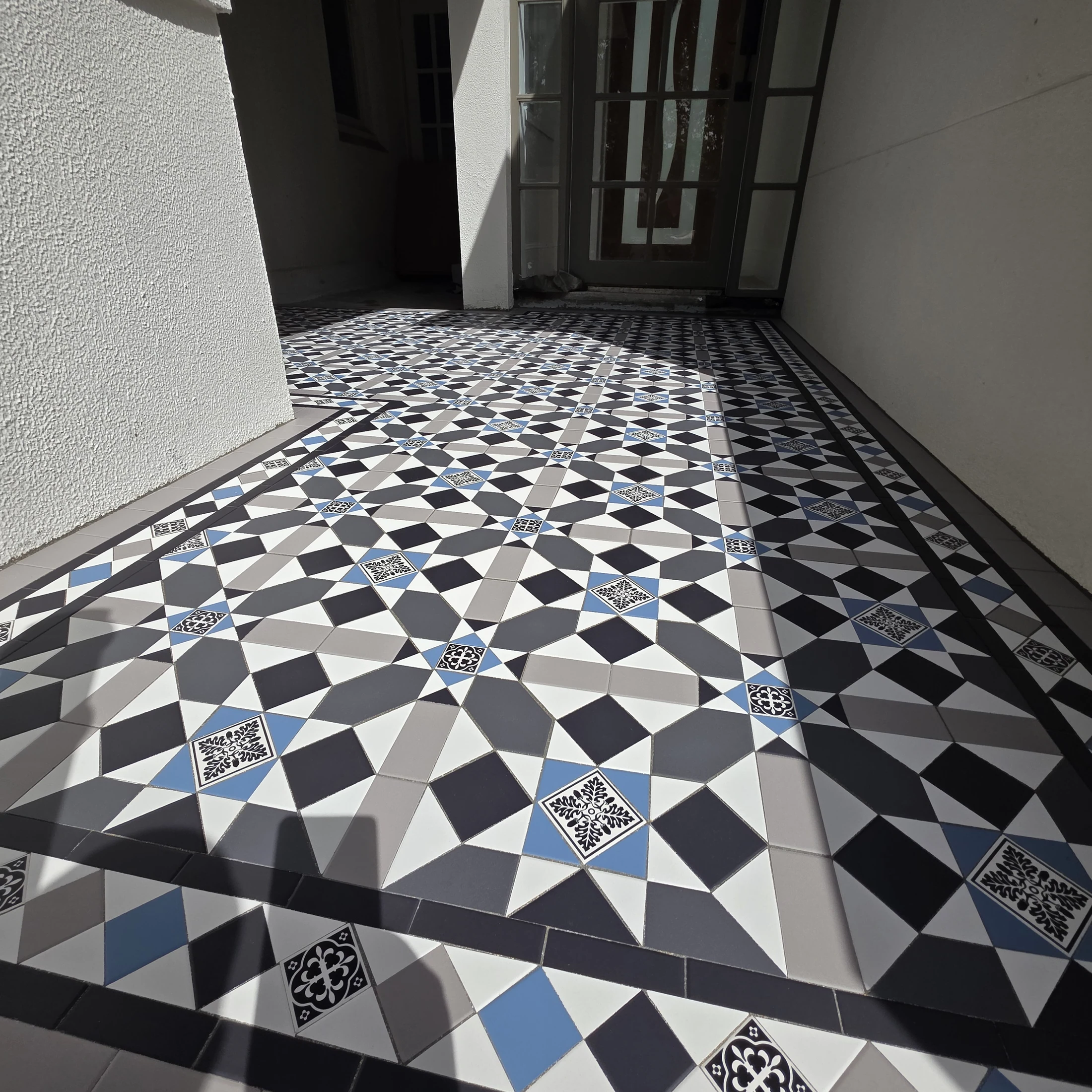
A transport-led town centre with a bushland setting
Blue Mountains City Council's Blaxland Town Centre Masterplan describes a compact centre around the Great Western Highway, Hope Street, View Street and the railway station. Traditional highway-frontage shops and a secondary Hope Street frontage give the centre a clear pedestrian and commercial rhythm, while the road and rail corridor strongly influences its form.
The same masterplan describes the broader town as occupying a major ridge bordered by bushland. For a tiled entrance or pathway, that means the design should be read at more than one scale: the immediate relationship to doors, steps, shopfronts and kerbs, and the way the finished edge sits within the property's slope, planting and surrounding streetscape.
Proportion and transitions for homes, shops and paths
The masterplan records largely 1970s infill and an assortment of built scale, form, facades and setbacks, alongside individual shopfronts that create a fine-grain texture. That mix calls for a property-led approach rather than an assumption that one period pattern or border suits every Blaxland address.
Design consultation can consider the frontage width, threshold levels, existing paving, steps, drainage, fence line and the way the tessellated field meets adjoining surfaces. A restrained border or carefully scaled repeat may help a new surface connect with an older facade, a contemporary addition or a small commercial frontage without competing with it. Stone bullnose or edging coordination should be resolved with the site's levels and material palette.
Check the individual property before changing older work
Council identifies the Blaxland station buildings as heritage listed and notes that the town centre has relatively few heritage-listed buildings. That distinction matters: a heritage reference in the town centre does not mean every Blaxland home, shop or pathway is listed or subject to the same controls.
Before removing or covering older tiles, record the surviving layout, borders, thresholds, steps and adjoining masonry. Check the property's current planning and heritage information with the relevant authority. NSW guidance recommends an informed reading of landform, scale, materials, details and views where heritage context applies; the appropriate repair, retention or replacement path depends on the actual place and proposed work.
From site review to a considered tiled surface
A practical starting point is a review of what exists and how the surface is used. For a verandah or path, that includes the approach from the street, levels at doors and steps, water movement, edges and connections to paving or garden. For a shopfront or interior, it also includes circulation, visual scale and the relationship between the tile layout and the building's facade or room proportions.
We provide design consultation, tessellated tile supply, installation and restoration, with stone bullnose or edging coordination where appropriate. The selected pattern, colours and construction response should follow the property's evidence and site conditions rather than a universal recipe.
Your Heritage Tiling Questions
Is every Blaxland property heritage listed?
No. Blue Mountains City Council identifies heritage items through planning instruments and heritage registers, and the Blaxland Town Centre Masterplan specifically notes that the centre has few heritage-listed buildings. Check the individual property and proposed work with the relevant authority rather than relying on the locality name alone.
What should I consider when choosing tessellated tiles for a Blaxland verandah or path?
Consider the property's frontage, steps, thresholds, existing paving, drainage, edge details and relationship to the street and landscape. Blaxland's mix of highway-frontage shops, later infill and ridge-and-bushland settings makes a site-specific pattern scale and transition more useful than a one-size-fits-all period treatment.
Can older Blaxland tiles be repaired rather than replaced?
That depends on what survives and the condition of the tiles, substrate, edges and adjoining construction. Document the existing work first, then assess whether retention, selective repair or replacement is appropriate in light of the property's planning and heritage context.
Does the heritage-listed Blaxland station mean nearby tile work needs approval?
Not automatically. The station's heritage status does not establish the status of every nearby property or every type of tile work. Confirm the particular site's controls and any approval requirements with the relevant authority before starting work.
Discuss Your Heritage Tiling Project
Share your location, project details and photographs using our enquiry form, or call 0433 932 711.