
Blue Mountains heritage tiling area directory
Use this Blue Mountains area directory to find locality-specific heritage tiling guidance. The Blue Mountains is a regional landscape of towns and villages with layered built character, from Victorian and Federation streetscapes to later twentieth-century homes. For a verandah, entry, pathway or interior floor, tessellated tiles can be planned as a considered part of the property rather than as an isolated surface. Authentic Heritage Tiling Co provides design consultation, tessellated tile supply, installation, restoration and stone bullnose or edging coordination across the Blue Mountains service area.
A regional setting with varied local character
Blue Mountains City Council describes 27 towns and villages spread across 100 kilometres of mountainous terrain. Council also notes that many towns and villages contain layered streetscapes shaped by Victorian, Federation, Edwardian, Inter-War and Post-War buildings, together with mature street planting and established gardens. That variety makes a property-led design conversation more useful than assuming one tile pattern suits the whole area.
Council's heritage information identifies conservation areas in particular places including Katoomba, Leura, Wentworth Falls, Lawson, Hazelbrook, Springwood, Glenbrook, Blackheath and Mount Victoria. A conservation-area reference is not a statement that every house in a town is listed. Check the individual property's mapping and planning context before finalising work.
Blue Mountains City Council geographic contextBlue Mountains City Council geographic context
Plan the pattern around the property
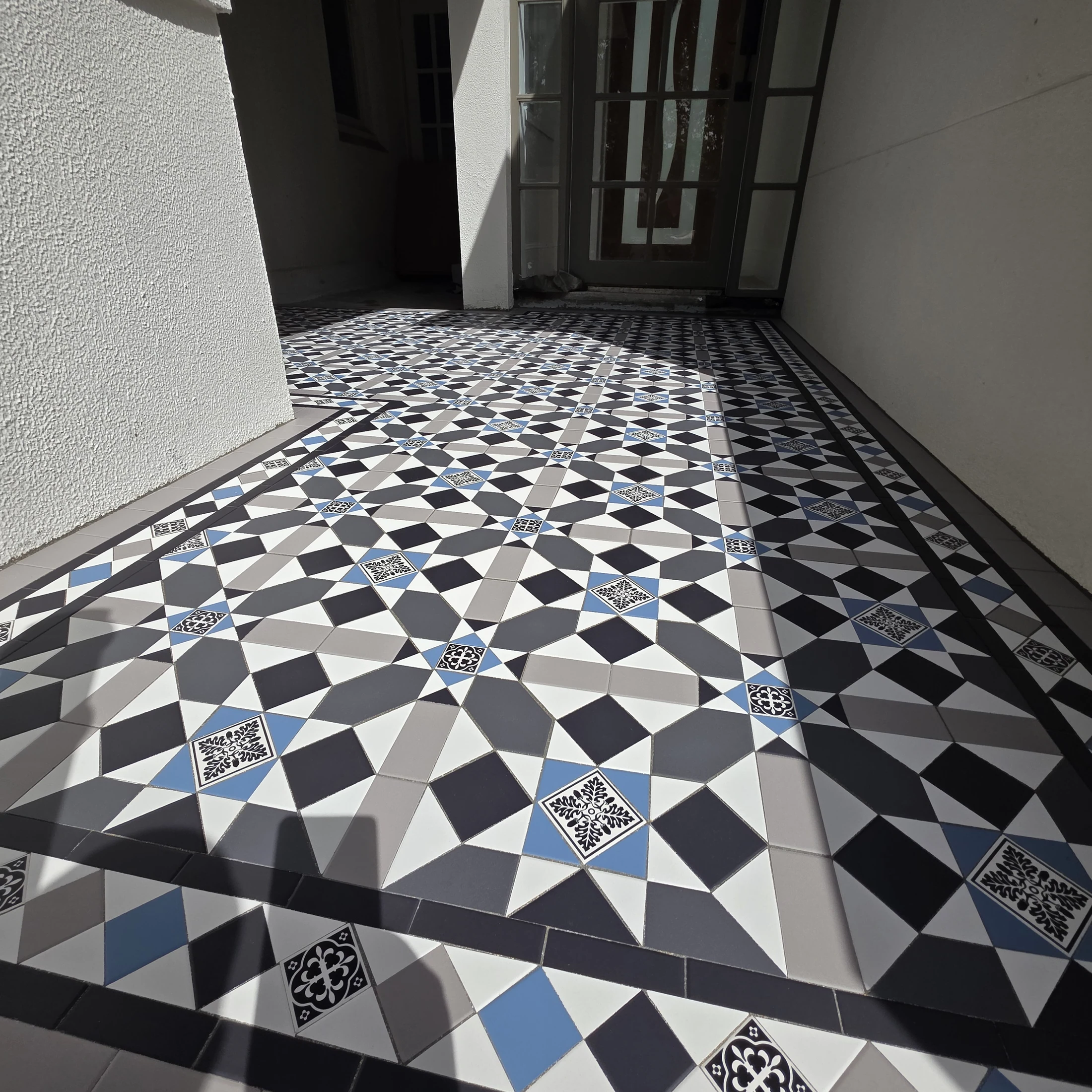
For a period home, the most convincing result often begins with the existing proportions: the width of a verandah, the rhythm of posts and openings, the relationship between the front path and entry, and the way a border frames the main field. A restrained geometric layout can sit comfortably beside older fabric, while a more decorative arrangement may suit a property where the floor is intended to be a focal point.
On a sloping or exposed site, discuss falls, thresholds, edge treatment and transitions early. Stone bullnose or other edging coordination can help resolve the meeting between a tiled surface, garden edge, step or adjoining paving. These decisions are site-specific and should follow inspection and design consultation rather than a universal detail.
Blue Mountains City Council geographic contextBlue Mountains City Council geographic context
Check the heritage setting before work begins
Blue Mountains heritage controls are property and place specific. Council says that LEP 2015 and the Development Control Plan guide development affecting heritage, and that Clause 5.10(2) identifies circumstances in which consent may be required for work affecting a heritage item, Aboriginal place or object, heritage conservation area or archaeological site.
Before removing surviving tiles or changing a visible frontage, identify whether the property appears on the relevant heritage mapping or sits within a mapped conservation area. Council's heritage specialists provide general conservation and development-related advice, including assistance connected with heritage impact statements and heritage management documents. A tiling consultation can then consider what should be retained, matched, repaired or newly introduced without assuming that approval is automatic or unnecessary.
Heritage and Development | Blue Mountains City CouncilHeritage Advice | Blue Mountains City CouncilBlue Mountains City Council geographic context
Tessellated tile supply, installation and restoration
The service can be shaped around a new design, a careful replacement of missing areas or the repair and restoration of an existing tessellated floor. Early discussion is useful for recording the current pattern, colour balance, border and edge conditions, then deciding whether the priority is faithful continuity, a complementary new layout or a practical transition between old and new work.
Design consultation, tessellated tile supply, installation, restoration and stone bullnose or edging coordination are available as connected parts of the planning conversation. The appropriate sequence depends on the property, access, existing fabric and intended use.
Blue Mountains City Council geographic contextHeritage and Development | Blue Mountains City Council
Blue Mountains area directory
Your Heritage Tiling Questions
Are all Blue Mountains homes heritage listed?
No. Council identifies particular heritage items and mapped heritage conservation areas, with boundaries and inclusions set out through the relevant maps and inventory sheets. Check the individual property rather than assuming that a town-wide label applies to every home.
Could approval be needed for tessellated tile work?
It depends on the property and the proposed work. Council says LEP 2015 Clause 5.10(2) identifies circumstances where development consent may be required for work affecting a heritage item, Aboriginal place or object, heritage conservation area or archaeological site. Confirm the relevant planning position before work begins.
How should I approach tiles for an older verandah?
Start with the verandah's proportions, surviving fabric, entry relationship and edge conditions. Record what remains before choosing a matching or complementary layout, and discuss thresholds, falls and edging where the verandah meets steps, garden or adjoining paving.
Where can I check whether a property is in a heritage conservation area?
Blue Mountains City Council directs property owners to its interactive property mapping and the LEP 2015 Heritage layer. Council also advises that property searches are informational and that formal advice should be obtained before making a decision to purchase or develop.
Can existing tessellated tiles be restored instead of replaced?
Restoration can be considered when existing fabric survives and its condition, pattern and edges can be assessed. A site review helps determine whether selective repair, careful replacement or a new complementary area is the most appropriate approach.
Discuss Your Heritage Tiling Project
Share your location, project details and photographs using our enquiry form, or call 0433 932 711.