
Tessellated tiles in Panania
Panania is a south-western Sydney residential suburb whose story includes early orchards and poultry farms, railway-led growth after 1931 and continued post-war development. That layered history makes the property itself the right starting point for a tessellated tile scheme: consider the home's proportions, surviving details, thresholds and outdoor connections before choosing a new pattern or repairing an existing floor.
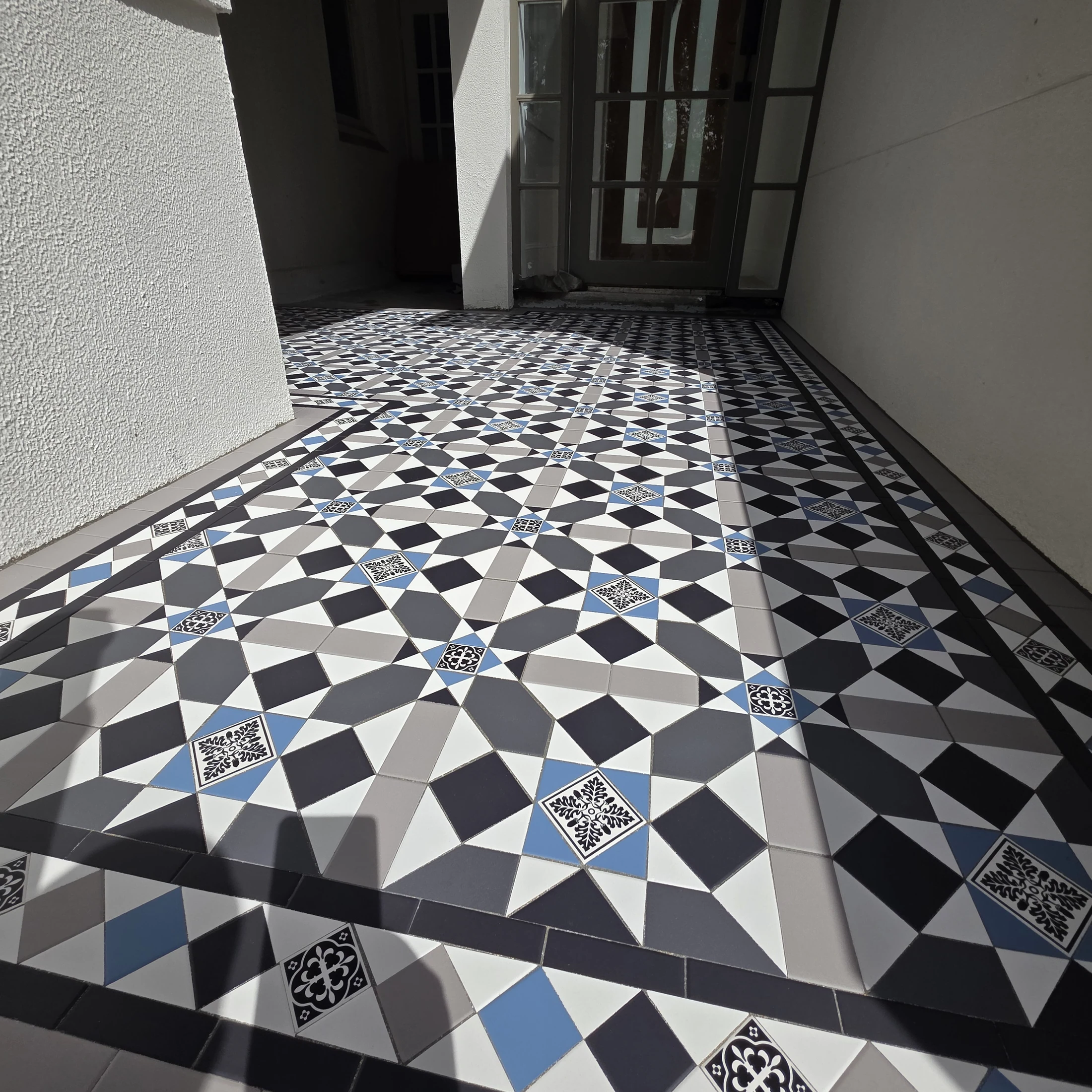
A property-led approach for Panania homes
Panania's documented development spans the period before the railway station opened and the residential growth that followed it. The history does not establish one suburb-wide architectural style, so a considered tile design should respond to the individual home rather than assume that every property is heritage-listed or belongs to the same period.
For an older entry, verandah or pathway, begin by recording the existing layout, border rhythm, colour relationships and transitions into adjoining rooms. Where original fabric survives, careful assessment can help distinguish repair and selective replacement from a wholly new installation. Where the work is new, proportions and junctions can still be designed to sit comfortably with the house and its street presentation.
Design details that reward close planning
Tessellated layouts are read at the edges as much as in the field. For a Panania verandah, porch or pathway, consider the approach to the front door, the width of borders, the relationship between steps and paving, and how the pattern turns at corners. A measured design consultation can help coordinate tile selection with the available footprint and the home's existing details.
Craftsmanship is also visible in the less obvious decisions: a clean transition at a threshold, a consistent border return, sound preparation and a repair that respects the surrounding pattern. Supply, installation and restoration should be planned as related but property-specific stages, not as a universal recipe for every Panania house.
Heritage | City of Canterbury BankstownPanania Station Upgrade — Flora and Fauna Assessment
Check the property before heritage-sensitive work
The City of Canterbury Bankstown explains that heritage items and conservation areas are protected through its Local Environmental Plan, and that heritage status is assessed for the significance of a particular place. Before changing an older floor, verandah or pathway, check the council's planning maps and heritage resources for the property rather than relying on age or appearance alone.
The NSW State Heritage Inventory and the NSW Planning Portal provide additional property-search tools. If a listing, conservation area or other planning control may apply, obtain the relevant advice before work proceeds. Heritage-sensitive design is about understanding the place and making compatible choices; it is not a claim that a tiling project has council or heritage approval.
Heritage | City of Canterbury BankstownPlanning maps — City of Canterbury BankstownState Heritage Inventory — NSW GovernmentPlanning — NSW Government
Tessellated tile services for Panania properties
A Panania project can begin with design consultation and proceed to tessellated tile supply, installation, restoration or stone bullnose and edging coordination, depending on the condition and purpose of the space. Existing floors benefit from an assessment of what can be retained, matched or repaired before any replacement decisions are made.
For broader locality navigation, the Canterbury-Bankstown service area provides the surrounding context for Panania. The useful next step is to share the property's location, photographs and aims so the design and technical questions can be considered together.
Your Council | City of Canterbury BankstownHeritage | City of Canterbury Bankstown
Your Heritage Tiling Questions
Does every older Panania home need heritage approval for tessellated tiling?
No general assumption should be made from age or suburb alone. Canterbury-Bankstown Council explains that heritage protection depends on assessed significance and statutory listing or a conservation area. Check the individual property through council's planning and heritage resources and seek the relevant advice before changing a heritage-sensitive place.
How can a tessellated pattern suit a Panania verandah or pathway?
Start with the home's proportions and the path to the entry. Review the border width, pattern scale, corner returns, steps and threshold transitions together so the layout reads as one composition. The right design depends on the measured space and the existing details rather than on a suburb-wide style assumption.
Can an existing tessellated floor be restored instead of replaced?
That depends on the condition of the existing tiles, the substrate and the extent of missing or damaged areas. An assessment can identify what may be retained, repaired or matched and whether restoration is appropriate for the space.
Where can I check Panania planning and heritage controls?
Canterbury-Bankstown Council provides detailed planning maps and heritage resources. The NSW Planning Portal Spatial Viewer can also be used to search an address for zoning and planning controls, while the NSW State Heritage Inventory provides a heritage-listed-item search and map. Confirm current requirements with the relevant authority for the property.
Discuss Your Heritage Tiling Project
Share your location, project details and photographs using our enquiry form, or call 0433 932 711.