
Canterbury-Bankstown heritage tiling area directory
Use this Canterbury-Bankstown area directory to find locality-specific heritage tiling guidance. Canterbury-Bankstown brings together established residential streets, commercial places and historic landscapes across Sydney's South District. Canterbury's Cooks River setting has an industrial past, while Earlwood grew into a closely settled residential suburb with early twentieth-century tram development. For a verandah, pathway or interior floor, the most useful starting point is the property itself: identify what remains, understand the proportions and character of the setting, then choose whether careful restoration, sympathetic repair or new tessellated tile work is appropriate.
A metropolitan area with varied local context
Canterbury-Bankstown sits within Greater Sydney's South District. It is a broad council area rather than one uniform architectural precinct, so a design that suits a Canterbury property beside the Cooks River may not be the right response for a later home in Bankstown, Revesby or Panania.
Canterbury's nineteenth-century Cooks River industry and Earlwood's transition from rural uses to close residential settlement provide useful historical context, but they are not a basis for assuming that every home is heritage listed or that every street shares the same period character.
Start with the property and its existing fabric
Before selecting a pattern, look at the entry sequence, verandah or pathway proportions, the relationship between the floor and adjoining masonry, and any surviving tile edges or borders. Matching existing work is a different task from introducing a new tiled surface, and an inspection should separate loose or damaged tiles from movement, moisture or drainage issues that may affect the finished result.
Canterbury-Bankstown Council identifies heritage items and heritage conservation areas through its planning controls. A property-specific check is important before work begins, particularly where a place is listed or lies within a conservation area. Council states that compatible change can be possible, while consent or written advice may be required depending on the work.
Heritage | City of Canterbury BankstownCanterbury Local Environmental Plan 2012 | NSW Planning Portal
Design inspiration for verandahs, paths and floors
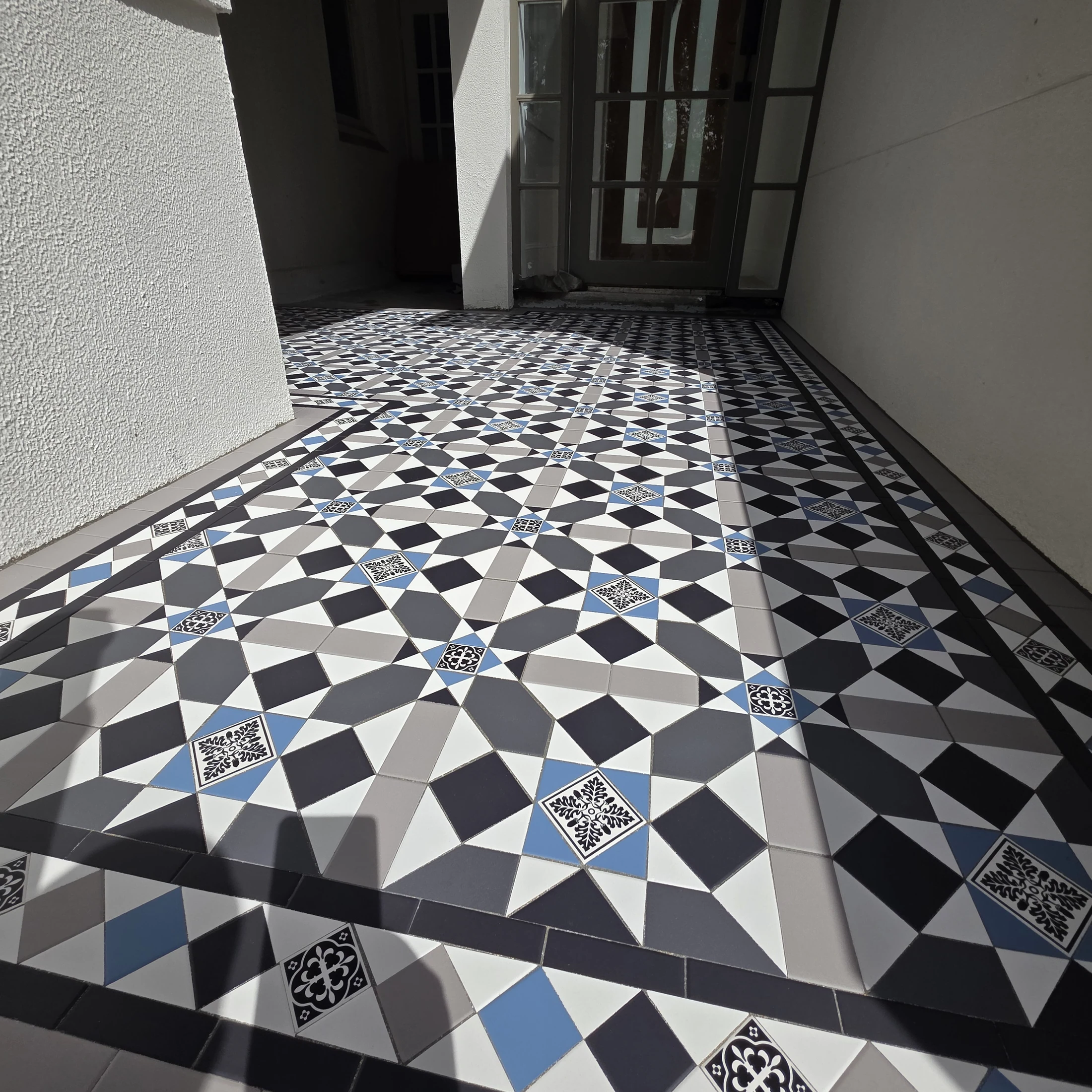
Use the building's scale and approach to guide the layout. A restrained border can clarify a narrow path, while a more detailed centre-and-border composition may suit a wider entry where the pattern can be read without awkward cuts. Colour relationships should be considered alongside brick, render, timber and stone rather than chosen in isolation.
Craftsmanship is most visible in the preparation of the layout, the alignment of borders and transitions, and the way edges meet steps, thresholds and other materials. Where a historic surface survives, the aim may be to retain as much sound original fabric as practical and make new work legible as a careful response rather than an unsupported imitation.
Plan the right tiling service
AHTC can help with design consultation, tessellated tile supply, installation, restoration and coordination of stone bullnose or edging details. The appropriate scope depends on the condition of the existing surface, the intended use and the property's context. Restoration is centred on assessing and retaining existing work; new installation is centred on layout, material selection, access and a suitable sequence for the site.
For heritage-related questions, Canterbury-Bankstown Council provides heritage resources and an advisory service. The council's own guidance should be checked for the specific property before works are scheduled.
Canterbury-Bankstown area directory
Your Heritage Tiling Questions
Are all older homes in Canterbury-Bankstown heritage listed?
No. Council describes a diverse range of heritage items and areas, but listing is property- or area-specific. Age alone is not enough to assume that a home is listed or lies within a heritage conservation area. Check the current planning information for the property before relying on heritage controls.
Can I change tiles at a heritage property in Canterbury-Bankstown?
Council says heritage listing does not prevent changes, but new work should be compatible with or complement the heritage place and normally requires development consent. The exact pathway depends on the property and proposed work, so seek property-specific council guidance before starting.
Can minor tile maintenance be exempt from development consent?
Some minor works and maintenance may be allowed without development consent where they do not adversely affect heritage significance. Canterbury-Bankstown Council says owners should submit details and obtain written advice before proceeding under its minor works process.
Should existing tessellated tiles be removed or restored?
That depends on what remains and why it is failing. An assessment can distinguish sound original fabric from isolated damage and identify whether careful restoration, selective repair or a new installation is the more suitable response. Property context, access, drainage and transitions should be considered before a layout is finalised.
Does the Canterbury-Bankstown service area have one uniform architectural style?
No. The council area is geographically broad and contains varied places and development histories. Canterbury's Cooks River industrial history and Earlwood's early twentieth-century residential growth illustrate why the building and street context should guide each tiling decision rather than a single area-wide style assumption.
Discuss Your Heritage Tiling Project
Share your location, project details and photographs using our enquiry form, or call 0433 932 711.