
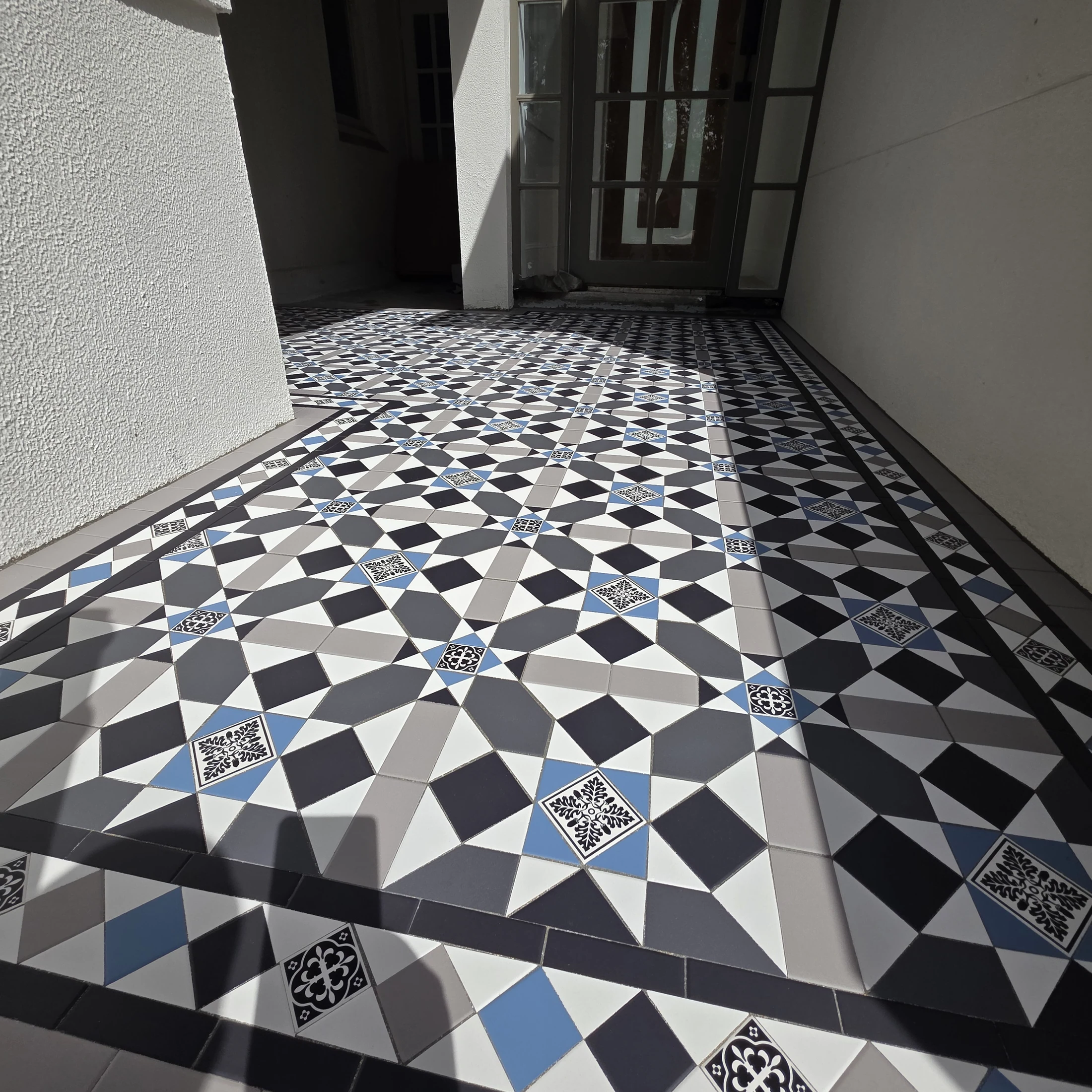
Tessellated tiles in Auburn, NSW
Auburn's built story is closely connected to its railway station, station-side commercial streets, Duck River and the industrial growth that followed. The local heritage record also describes early timber workers' cottages and later brick or timber homes with tiled roofs and timber detailing. For an Auburn verandah, pathway or interior floor, tile proportions, border treatment, colour and transitions should be considered alongside the building's surviving fabric and the character of its setting.
Auburn's railway and industrial setting
Auburn developed as a suburb after the railway station opened in 1877 and the Township of Auburn subdivision was released in 1878. Cumberland City Council records the commercial district forming beside the station, with residential areas extending beyond it. The area later became an industrial centre beside the main Western railway line and Duck River.
That layered history is useful design context rather than a claim that every Auburn property is heritage listed. A new tiled surface can acknowledge the scale, entry sequence and material cues of a particular home without copying a pattern that is not supported by its fabric or setting.
History of Auburn City Council — Cumberland City CouncilAuburn listing sheets — Cumberland City Council Heritage Inventory
Design considerations for Auburn homes
For a period-influenced Auburn property, begin by looking at the entrance, verandah or pathway as a connected composition. Consider how a geometric field, border and threshold meet the existing masonry, timber details, steps and garden edges. Where original material remains, matching its scale and visual rhythm may be more appropriate than introducing a disconnected pattern.
Auburn's documented residential history includes modest timber cottages as well as brick or timber homes with tiled roofs and timber detailing. Those broad types call for an on-site design response: confirm levels, drainage, access, substrate condition and the relationship between new work and retained fabric before selecting a layout or installation sequence.
Auburn listing sheets — Cumberland City Council Heritage InventoryHistory of Auburn City Council — Cumberland City Council
Supply, installation and careful restoration
Auburn's history of pottery and brickmaking gives local material history a useful place in the design conversation, but it does not identify a universal tile type or prove that a particular property used locally made tiles. Selection should follow the property's surviving evidence, the intended use and the practical conditions of the site.
Where an existing tessellated floor or pathway survives, document its pattern, edges, thresholds and areas of loss before deciding between repair, selective replacement or a new compatible section. For new work, design consultation can coordinate tile supply, installation and stone bullnose or edging details around the building rather than treating the floor as an isolated surface.
Auburn listing sheets — Cumberland City Council Heritage Inventory
Check the property's heritage status first
Cumberland City Council distinguishes heritage items from heritage conservation areas and notes that contributory and non-contributory properties can be treated differently. Before external or internal alterations, check the property's status in Schedule 5 of the Cumberland LEP 2021 and the NSW Planning Portal Spatial Viewer or State Heritage Inventory, then confirm the planning pathway for the proposed scope.
A heritage-sensitive tile design is not the same as heritage approval, and tile work does not automatically require the same process on every property. Council's guidance says that approval requirements depend on the work and the property's significance, so property-specific advice should be obtained where relevant.
Your Heritage Tiling Questions
Are all Auburn homes heritage listed?
No. Auburn has formally listed heritage items and conservation areas, but the heritage record does not make every home heritage listed. Check the individual property through Schedule 5 of the Cumberland LEP 2021, the NSW Planning Portal Spatial Viewer or the State Heritage Inventory.
What should I consider when choosing tessellated tiles for an Auburn verandah?
Start with the building and its setting: existing fabric, entry proportions, steps, thresholds, garden edges, drainage and the scale of any surviving pattern. Auburn's documented residential history includes different building types, so a site-led design is more reliable than assuming one pattern suits the whole suburb.
Can existing tessellated tiles in Auburn be restored rather than replaced?
Often the first step is to document what remains, including the field, borders, thresholds and areas of loss, then assess whether repair, selective replacement or a compatible new section is appropriate. The suitable approach depends on the condition and significance of the particular floor or pathway.
Do I need approval for tile work on an Auburn heritage property?
It depends on the property's classification and the scope of work. Cumberland City Council advises owners to check the relevant heritage controls and determine whether an approval, development application, complying development certificate or another pathway applies before work begins.
Discuss Your Heritage Tiling Project
Share your location, project details and photographs using our enquiry form, or call 0433 932 711.