
Tessellated tiles in Guildford, NSW
Guildford sits in Western Sydney's Cumberland Plain, where the suburb's residential story developed around the railway and late-nineteenth-century subdivision. For a Guildford verandah, entry path or interior floor, a good tile scheme should respond to the property's proportions and existing details rather than impose a generic period look. AHTC can help with tessellated tile design, supply, installation and restoration, including coordination of stone bullnose or edging where it suits the project.
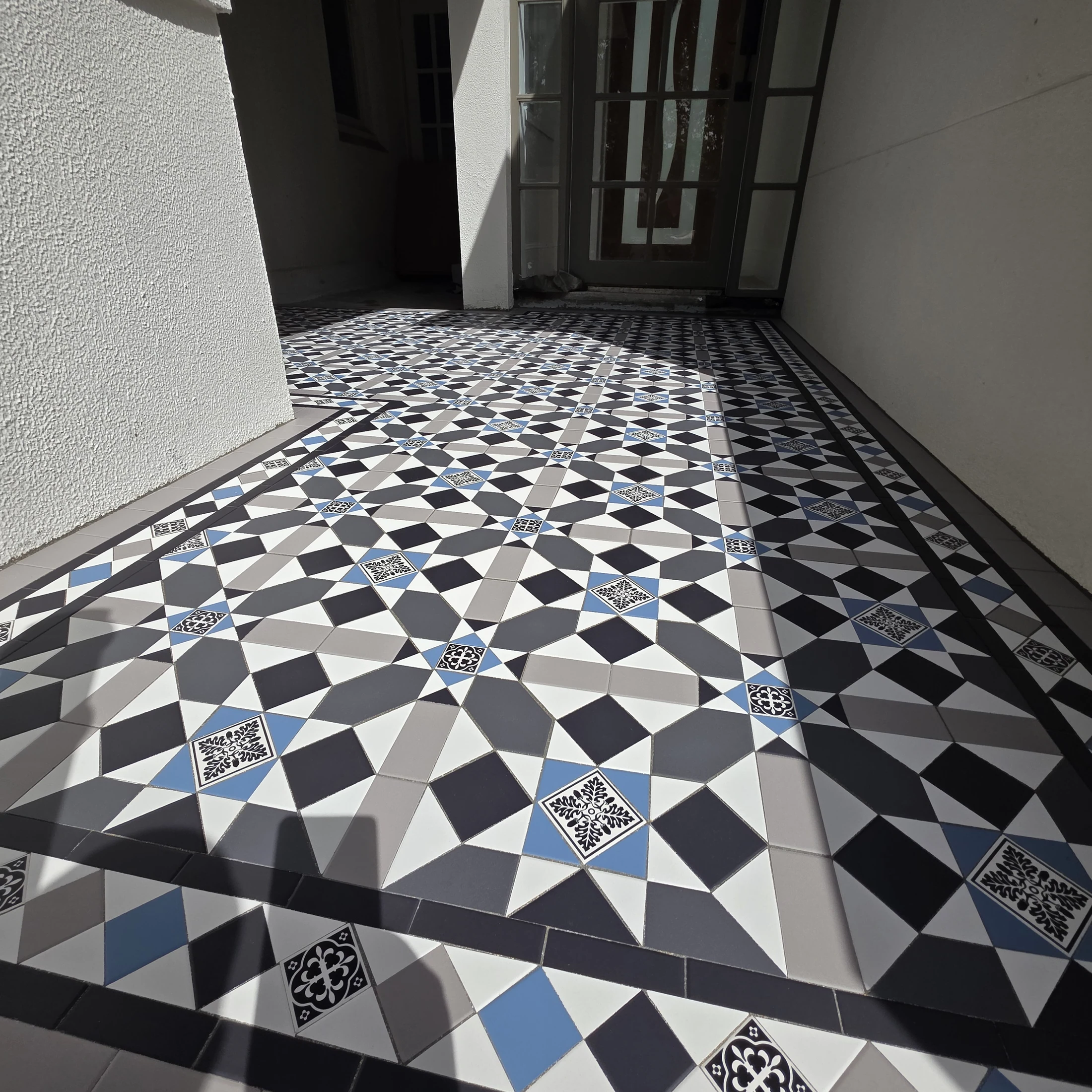
A Guildford context shaped by railway-era growth
Cumberland City Council records that Guildford Railway Station opened in 1876 and that Henry Whitaker's Estate was subdivided in 1888–89. That sequence helps explain why Guildford contains a mix of established residential streets and later layers of development, rather than one uniform architectural character.
The local history also records heritage-listed places in Guildford, including Linwood House and the McCredie Memorial Presbyterian Church. These landmarks provide useful context, but a nearby historic place does not by itself establish that another home is listed or subject to the same controls.
History of the City of HolroydHeritage Items in Cumberland City
Start with the property, not a catalogue pattern
For an older Guildford property, begin by recording the existing entry sequence, verandah width, thresholds, wall lines and any surviving tile fragments. A border, field and step arrangement can then be selected to sit comfortably with the home's scale and joinery. Where original fabric survives, matching its colour relationships and geometry may be more appropriate than replacing it with a new decorative treatment.
The Cumberland Guildford inventory shows why this needs to be site-led: its assessments discuss original fabric, setting, form, scale, bulk, setback, height, materiality and landscape elements for identified heritage places. Those are useful design questions, not a universal specification for every Guildford house.
Guildford listing sheet | Cumberland City Council Heritage InventoryHeritage Items in Cumberland City
Verandahs, steps and pathways need a joined-up layout
Guildford tile planning can extend from the front threshold across a verandah or pathway, so the pattern should be considered with step positions, door swings, drainage falls and adjoining paving. Narrow paths often benefit from a clear border and a calm field, while a broader verandah can support a more deliberate central layout if its proportions allow it.
Existing steps, edges and damp-prone junctions should be inspected before installation or restoration is specified. Stone bullnose or other edging coordination may help define a transition, but the appropriate detail depends on the measured site and the adjoining materials.
Guildford listing sheet | Cumberland City Council Heritage InventoryOur local environment | Cumberland City Council
Check the heritage position before changing an identified place
Cumberland Council publishes heritage inventory sheets and points owners to Schedule 5 of the Cumberland LEP 2021 when checking whether a place is formally listed or within a heritage conservation area. If your Guildford property appears in those records, use the listing and its mapped extent to inform the brief before choosing a restoration or new-work approach.
A tile consultation can help document the visible fabric and develop a sympathetic scheme, but it is not a heritage approval. Any planning or heritage pathway should be confirmed for the specific property with the relevant authority before work begins.
Heritage Items in Cumberland CityCumberland Local Environmental Plan 2021Guildford listing sheet | Cumberland City Council Heritage Inventory
Your Heritage Tiling Questions
Does every older Guildford home have heritage controls?
No. Cumberland Council's heritage controls and inventory material concern identified heritage items and heritage conservation areas. Check the current Cumberland LEP 2021 Schedule 5 and the Council's inventory for the specific property rather than assuming that age or location alone determines listing status.
What should be reviewed before restoring existing Guildford tessellated tiles?
Record the surviving pattern, colours, borders, thresholds and adjoining surfaces, then assess movement, cracked or loose tiles, edge conditions and moisture at steps or walls. The right response depends on what remains and on the property's setting; a listed place should also be considered against its relevant inventory sheet.
Can new tessellated tiles work on a Guildford verandah or pathway?
Yes, a new scheme can be planned for a verandah or pathway, but its proportions, border, step transitions, drainage and relationship to the building should be resolved together. Existing details and any identified heritage significance should guide the design rather than a generic pattern choice.
Where can I check whether a Guildford property is listed?
Cumberland Council's Heritage Items in Cumberland City page links to the Council's inventory sheets and to the Cumberland LEP 2021. Use those official resources to check the property-specific listing and any applicable conservation-area information.
Discuss Your Heritage Tiling Project
Share your location, project details and photographs using our enquiry form, or call 0433 932 711.