
Tessellated Tiles in Regents Park, NSW
Tessellated tile work in Regents Park benefits from a careful reading of the property and its setting. Cumberland's Regents Park Town Centre plan describes a fine-grain centre around Amy Street and records the Regents Park Train Station Group and a property on Amy Street as heritage items in the Cumberland portion of the centre. For a home, verandah, path or commercial frontage, design choices should respond to the existing building, the intended use and the condition of the surface rather than assume one pattern suits every site.
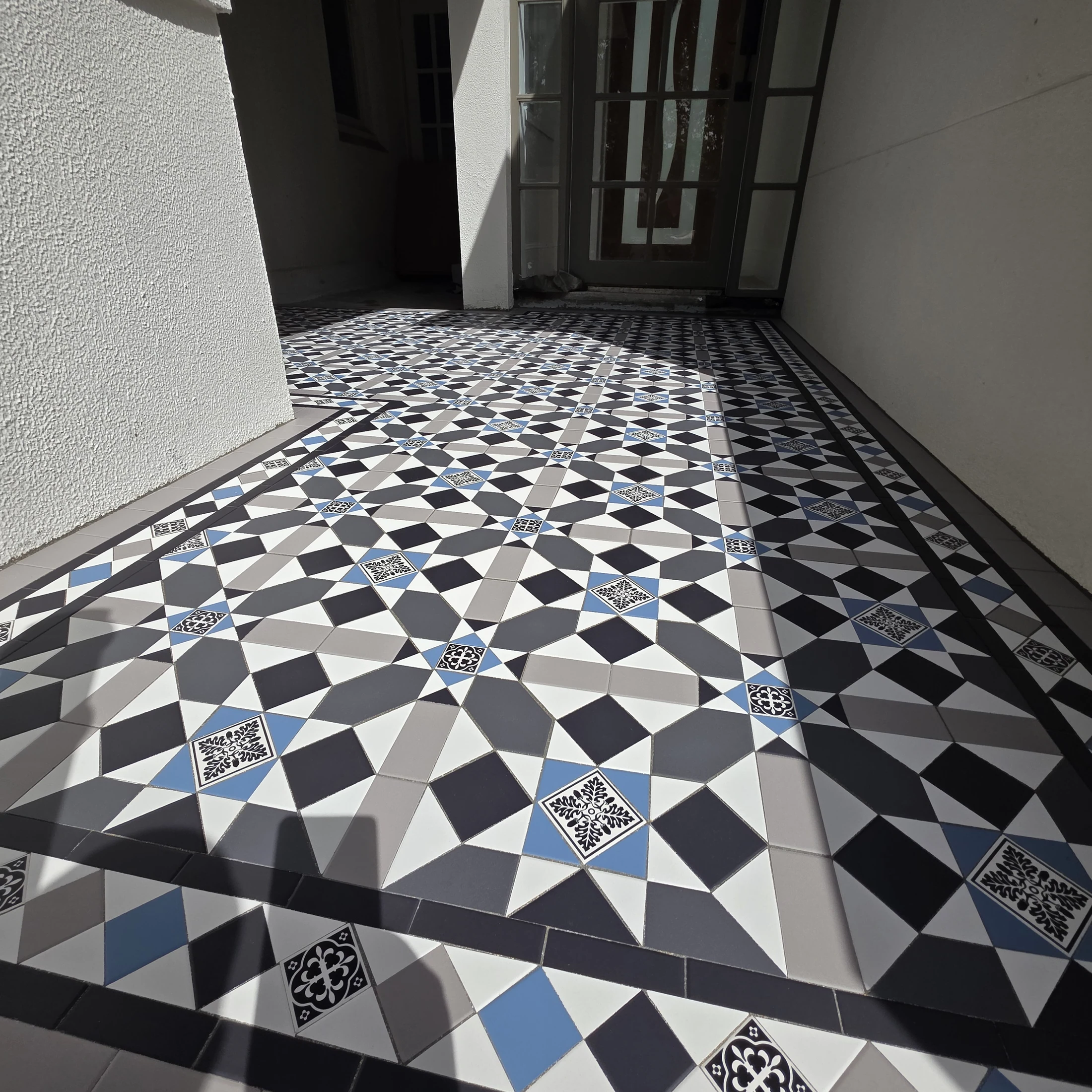
A fine-grain town-centre setting
The council's town-centre plan describes Amy Street as the centre of a fine-grain street pattern with active frontages. That is a useful design cue when considering a visible entry, verandah or pathway: proportion, edge treatment and the transition from public frontage to private threshold deserve as much attention as the tile pattern itself.
The plan also records that Regents Park crosses two local government areas, divided by the Sydney Water Pipeline. The Cumberland service route is therefore a practical starting point for local enquiries, not a statement that the whole suburb shares one planning authority.
Design with the building and its setting
For a period-influenced property, a tessellated layout can be developed by looking at the scale of the frontage, the rhythm of openings, existing thresholds and any surviving floor or path fabric. A restrained border, a clear central field or a carefully proportioned transition may be more appropriate than adding detail without a relationship to the building.
The Regents Park plan identifies the station group and a property on Amy Street as heritage items in the Cumberland part of the town centre. That does not make every nearby property heritage listed, and it does not determine the controls for a particular address. Before altering an identified item or a property in a conservation area, check the applicable planning controls and approval pathway for that site.
Regents Park Town Centre Public Domain PlanHeritage in CumberlandCumberland Local Environmental Plan 2021, Schedule 5
Plan the detail before installation or restoration
A useful consultation should establish whether the work is new tiling, repair of an existing tessellated surface, or a combination of both. It should also consider how the pattern meets doors, steps, walls and drainage edges, and how the finish will read from the street and from inside the property.
Where original or earlier fabric remains, documenting what is present before removal helps separate retention, repair and replacement decisions. For new work, the design can draw on the discipline of a fine-grain frontage without suggesting that a modern property is a heritage item. AHTC can coordinate design consultation, tessellated tile supply, installation, restoration and stone bullnose or edging requirements for the site being considered.
Regents Park Town Centre Public Domain PlanHeritage in Cumberland
Check the property before changing significant fabric
Cumberland City Council advises checking Schedule 5 of the Cumberland Local Environmental Plan 2021, the NSW Planning Portal Spatial Viewer and the State Heritage Inventory when determining whether a property has heritage significance. Because the suburb spans a council boundary, the relevant authority and controls should be confirmed for the actual site rather than inferred from the suburb name or service directory.
If the site is a listed heritage item, in a heritage conservation area or affected by another heritage control, the council says the scope of work determines whether an approval, development application, complying development certificate or other pathway is required. A tile consultation can help define the proposed work, but it is not heritage approval or planning advice.
Heritage in CumberlandRegents Park Town Centre Public Domain PlanCumberland Local Environmental Plan 2021, Schedule 5
Your Heritage Tiling Questions
Is every property in Regents Park heritage listed?
No. The council plan identifies particular heritage items in the Cumberland portion of the town centre, including the Regents Park Train Station Group and a property on Amy Street. A property's status must be checked individually against the applicable planning controls and heritage registers.
Which council should I check for a Regents Park tiling project?
Regents Park spans two local government areas, with the boundary described by Cumberland's town-centre plan as the Sydney Water Pipeline. Confirm the actual property's authority and controls before work begins; the Cumberland locality route is a service-directory path and is not a statutory boundary map.
Can existing tessellated tiles be restored rather than replaced?
That depends on the condition, extent and significance of the surviving surface. Begin by documenting the existing layout, edge conditions and damaged areas, then compare a repair-and-retain approach with selective replacement or new work. If the property has heritage significance, check the relevant controls before disturbing the fabric.
What should be considered for a new verandah or pathway in Regents Park?
Consider the building frontage, the scale of the entry, pattern proportions, borders, thresholds, steps, drainage and the way the finished surface meets the street. The council's description of a fine-grain Amy Street frontage provides local context, but the final layout should be designed for the individual property.
Does a tile consultation provide heritage approval?
No. Cumberland City Council explains that approval requirements depend on the property's status and the scope of work, and that development applications are individually assessed. Confirm the planning pathway with the relevant authority before commencing work.
Discuss Your Heritage Tiling Project
Share your location, project details and photographs using our enquiry form, or call 0433 932 711.