
Tessellated tiles and heritage-sensitive tiling in Ivanhoe East
Ivanhoe East has a documented architectural story that includes post-war modernist houses and churches as well as older residential settings. For a verandah, entry path or interior floor, the useful starting point is the individual property's proportions, materials and existing fabric—not an assumption that every home has the same heritage status. We can help with design consultation, tessellated tile supply, installation, restoration and stone bullnose or edging coordination for the work your property actually needs.
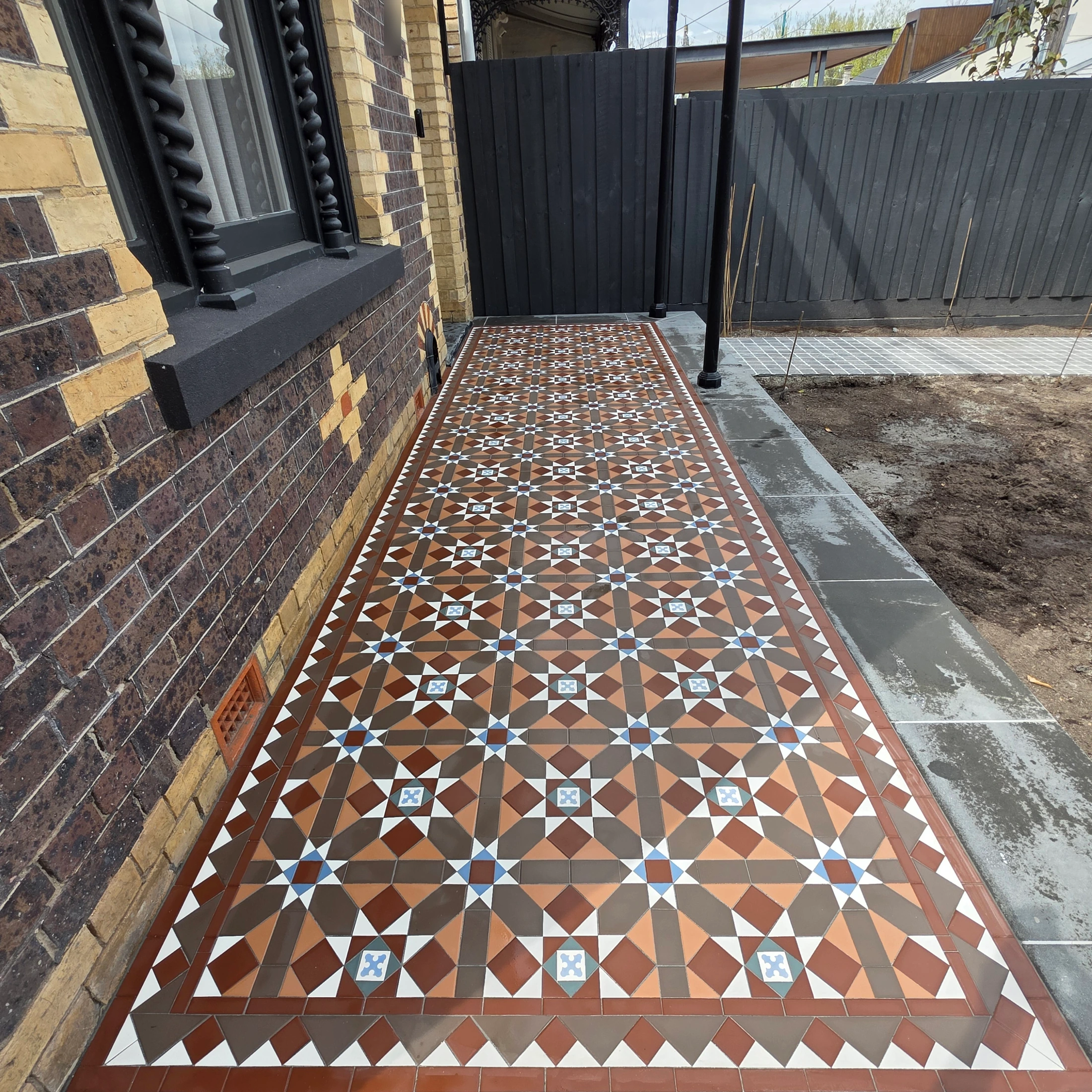
Let the architecture guide the tile design
Banyule's Heritage Study describes distinct enclaves of modernist design culture in Ivanhoe East by the early 1960s. It identifies examples such as Yann House, Crittenden House and Hilliard House, along with St George Peace Memorial Church and Mother of God Church. These places show why a local brief should respond to the actual façade, entry sequence, masonry, garden setting and period of the property rather than apply a generic historic pattern.
A tessellated layout can be quiet and finely scaled on a compact porch, or use a clearer field and border where the approach is longer. At a modernist property, restraint, alignment and transitions may matter more than reproducing a decorative scheme. At an older verandah, matching surviving details and preserving the relationship between threshold, path and garden can be the better starting point.
Plan verandahs, paths and floors around the site
For an Ivanhoe East verandah or front path, review the door, steps, gate, garden edge and public approach before choosing the module or border. Levels, drainage, movement, access and edge protection should be considered alongside the visual pattern. A site assessment helps separate a new installation from selective repair or restoration of an existing surface.
Indoors, a tessellated floor can acknowledge the geometry and materials of an entry or adjoining room without claiming an unverified original scheme. Where old tiles remain, record what is intact and what has changed before deciding whether to retain, match, repair or replace. Stone bullnose or edging coordination can then be considered as part of the overall transition rather than added as an afterthought.
Check the actual property before changing heritage fabric
Banyule's official heritage material lists particular Ivanhoe East houses and churches for heritage consideration, and the planning scheme schedule records individual Ivanhoe East places. That evidence does not make every home protected. Before altering an older façade, porch, path or floor, check the planning information for the actual site and obtain property-specific advice where a Heritage Overlay or other control may apply.
A useful project brief records the existing fabric, proposed new work, pattern scale, edge treatment and installation sequence. This supports a careful conversation about tessellated tile supply, restoration, installation and edging without turning the method used at one property into a universal rule.
Your Heritage Tiling Questions
Does every Ivanhoe East home have heritage protection?
No. Banyule's records identify particular houses, churches and other places, and the Heritage Overlay schedule is property-specific. Ivanhoe East's architectural character is useful design context, but it does not establish that an individual home is protected. Check the planning information for the actual property before changing an older façade, verandah, path or floor.
What tile approach can suit an Ivanhoe East modernist home?
There is no single suburb-wide answer. Banyule's study identifies several modernist properties in Ivanhoe East, so the design should respond to the home's own lines, masonry, entry proportions, garden setting and surviving details. A restrained field, carefully aligned border or simpler transition may be more appropriate than an assumed period pattern.
Can tessellated tiles work on an Ivanhoe East verandah or pathway?
They can, subject to the site's construction and condition. Review the relationship between the door, porch, steps, garden gate and footpath, then consider levels, drainage, movement, access and edge treatment. If the property is individually listed or within a Heritage Overlay, obtain the relevant property-specific advice before work begins.
Is a damaged original tessellated floor restored or replaced?
That depends on what survives and why it is failing. Begin with a condition review, document the existing pattern and identify movement, moisture or edge issues. Selective repair and matching may be preferable where original fabric remains, while a new installation may suit a different brief. The decision should follow the property and the floor's condition rather than a generic suburb rule.
What should I prepare before discussing tile work?
Useful information includes clear photographs, approximate dimensions, the areas to retain or change, any known movement or drainage issue, and whether the work is on a verandah, path or interior floor. For an older or architect-designed Ivanhoe East property, include views of the façade, porch, garden edge and existing transitions so the design can be considered in context.
Discuss Your Heritage Tiling Project
Share your location, project details and photographs using our enquiry form, or call 0433 932 711.