
Tessellated tiles in Caulfield North
Caulfield North brings together Victorian and Federation residences, interwar infill and later homes across a varied Melbourne streetscape. For a verandah, entry, pathway or interior floor, a useful tile scheme starts with the building's proportions, surviving details and the way the work will meet the street. We can help with tessellated tile design consultation, supply, installation, restoration and stone bullnose or edging coordination.
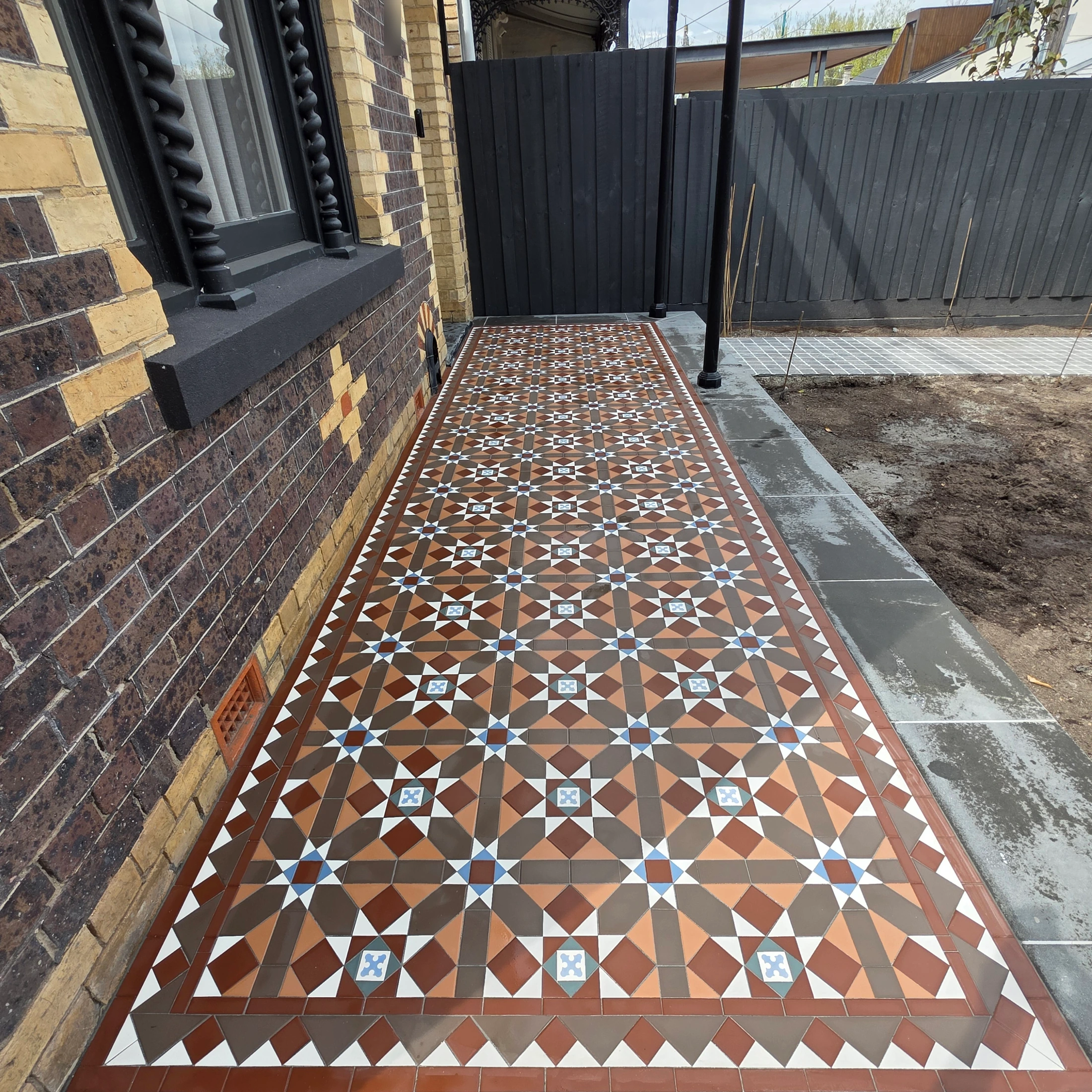
A varied local architectural setting
Glen Eira's Caulfield North Heritage Review describes a substantial residential precinct of Victorian and Federation houses, with interwar development that includes Georgian Revival, Old English, Arts and Craft and Streamline Moderne influences. It also records recurring streetscape cues such as hipped and gabled roofs, verandahs, chimneys, sash windows, low front fences and consistent setbacks. Those observations can inform a tile layout, but they are not a template for every house.
A front path or verandah can be designed to sit comfortably with the existing rhythm without copying historic details. Border width, field scale, threshold transitions and the relationship to steps or edging are best considered from the actual frontage and the way the tiles meet adjoining materials.
Plan around the property, not just the suburb name
Some Caulfield North places and precincts are covered by heritage controls, while others are not. Glen Eira distinguishes individually significant, contributory and non-contributory places, so a site check matters before external works are specified. Where original paving, a verandah edge or an early threshold remains, record its condition and relationship to the façade before deciding what to retain, repair or replace.
For a property in a Heritage Overlay, Council and Victorian planning guidance may affect external alterations, works, repairs, fences, verandahs or other visible changes. Check the mapped overlay, the applicable schedule and VicPlan, and obtain project-specific planning advice where required. Tile consultation can support design decisions, but it is not planning approval.
Tessellated tile design for paths, verandahs and floors
A considered scheme may use a restrained border, a geometric field or a carefully matched repair, depending on the room or approach and the evidence available from the property. We can coordinate tile supply and installation, discuss restoration where existing tessellated work survives, and plan stone bullnose or edging details where a path or step needs a durable, resolved finish.
Glen Eira's design guidance recommends attention to setbacks, roof and façade relationships, verandah proportions, front fencing, materials, colours and finishes. For tile work, that translates into checking levels, drainage, thresholds, sightlines and the visual weight of the pattern before installation. Existing fabric should be assessed on its condition rather than assumed to require complete removal.
Your Heritage Tiling Questions
Does every Caulfield North home have heritage protection?
No. Glen Eira identifies places as individually significant, contributory or non-contributory, and heritage controls apply according to the mapped property and the relevant planning schedule. Check the Council heritage map and VicPlan for the specific site before planning external works.
What should I check before replacing a front path or verandah tiles?
First record the existing pattern, edge, threshold, levels and condition. Then check whether the property is in a Heritage Overlay and whether the proposed work changes visible fabric or requires planning advice. A site-led design can then address the path proportions, drainage, adjoining materials and an appropriate tile scheme.
Can new tessellated tiles suit a Victorian or Federation frontage without looking like a replica?
Yes. A new scheme can respond to the frontage through scale, rhythm, border proportions and compatible materials while remaining identifiable as new work. Glen Eira's guidance discourages false historic appearances and encourages careful consideration of the streetscape rather than literal imitation.
Can existing tessellated tiles be restored rather than replaced?
Often the first step is a condition and layout assessment. Surviving tiles, borders and edges can be considered for retention or selective restoration where their condition and the property's design support it; the appropriate approach depends on what is actually present and how the work will perform.
Discuss Your Heritage Tiling Project
Share your location, project details and photographs using our enquiry form, or call 0433 932 711.