
Tessellated Tiles in Boronia
Boronia brings together a low-rise activity centre, leafy residential streets and ongoing change around services and transport. For a verandah, pathway or entrance, the right tessellated tile layout depends on the property's proportions, existing fabric, edges and practical site conditions. We can help with design consultation, tessellated tile supply, installation, restoration and stone bullnose or edging coordination.
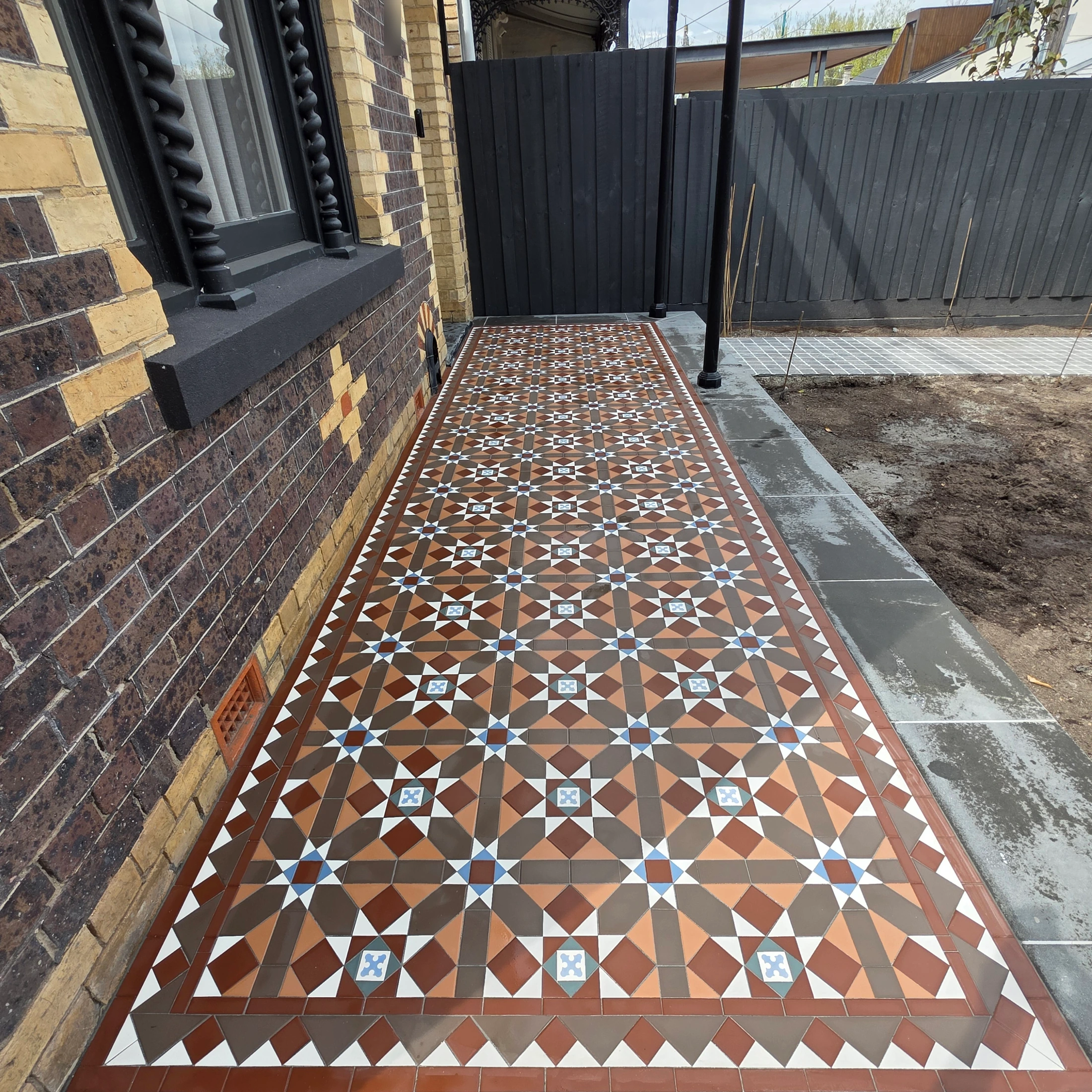
A local setting for considered tile design
Knox's Boronia Renewal Strategy describes the Major Activity Centre as predominantly low-rise, with original commercial buildings reflecting both its initial township development and later car-oriented suburbanisation. It also records the Dandenong Ranges as a valued backdrop and describes leafy streetscapes and landscaped front gardens in the residential neighbourhoods. For a local tiling brief, those observations are useful context rather than a template: the design still needs to respond to the individual frontage, building form and surrounding landscape.
Boronia is also changing. The strategy records townhouse development and expects further activity-centre change near services and public transport while seeking to maintain the character of more sensitive residential areas. A new tiled entry or pathway may therefore sit beside an older house, a substantially altered dwelling or a newer townhouse. Scale, border width, colour balance and the way the pattern meets steps or garden edges should be selected for the actual property rather than assumed from its suburb.
The strategy's centre-specific discussion notes limited landmark buildings and no identified heritage buildings in the Boronia Major Activity Centre. That does not mean heritage questions can be dismissed at a particular site, nor does it make every older-looking property protected. Where a planning or heritage control may apply, check the current status of the individual property with the relevant authority before works begin. Tiling guidance is not heritage approval.
Plan the field, borders and transitions together
A Boronia verandah or front path should be measured as a complete composition. Record the usable footprint, steps, thresholds, drainage direction, door clearances and any existing stone or tile edges before settling on a pattern. A border can align the design with posts, walls or a garden edge, while the main field needs enough room for its geometry to read cleanly without awkward slivers at the perimeter.
External areas need practical decisions as well as visual ones. Levels, falls, exposure and the relationship between the tiled surface and adjoining paving or planting should be considered at the design stage. These conditions vary from site to site, so installation preparation should be confirmed after the area is assessed rather than treated as a universal recipe.
If older tiles remain, begin by documenting their pattern, colour sequence, borders, condition and junctions with steps or thresholds. An assessment can then distinguish sound fabric from damaged areas and consider selective restoration, matching supply or a new layout that meets the existing surface appropriately.
Local tessellated tile services
A Boronia project can start with design consultation for a new geometric floor, a review of an existing verandah or pathway, or an assessment of missing and damaged tiles. The service scope can include tessellated tile supply, installation, restoration and coordination of stone bullnose or edging details, with the final approach shaped by the property's measurements and brief.
When comparing restoration with replacement, photographs of the whole area and close views of borders, steps, thresholds and damaged sections are useful starting information. For an older property, keep any planning or heritage check with the relevant authority and treat the tiling discussion as one part of the wider project decisions.
Local heritage protection — Planning VictoriaKnow Your Council – Knox City Council
Your Heritage Tiling Questions
Is Boronia a metropolitan Melbourne suburb?
Boronia is a locality within Knox City Council, which the Victorian Government describes as being in Melbourne's outer eastern metropolitan area. The local service route can therefore use metropolitan Melbourne context, while still describing Boronia's own setting accurately.
Does every Boronia property have heritage protection?
No. Boronia's suburb name or an older appearance does not establish a Heritage Overlay or state heritage registration. Victorian guidance explains that local controls operate through the relevant planning scheme and that state-significant places are dealt with through the Victorian Heritage Register system. Check the specific property before work begins.
Can tessellated tiles suit a Boronia verandah or pathway?
They can, provided the layout suits the actual footprint and transitions. Boronia's documented mix of low-rise buildings, leafy residential streets and ongoing activity-centre change makes it especially important to choose the pattern, border and edging in relation to the individual property's frontage rather than applying one suburb-wide style.
Should existing Boronia tessellated tiles be restored or replaced?
That depends on their condition, extent, stability and whether a suitable match can be made. Start with photographs and an assessment of the field, borders, edges and junctions. The options may include retaining sound areas, selectively repairing damaged sections, sourcing matching tiles or designing a new surface that meets the existing work carefully.
What information helps plan a Boronia tiling project?
Useful starting details include the property's suburb, photographs of the full area and close tile or edge details, approximate dimensions, steps and access constraints, and whether the brief is a new verandah or pathway, restoration or replacement. Those details help frame a practical design and installation conversation.
Discuss Your Heritage Tiling Project
Share your location, project details and photographs using our enquiry form, or call 0433 932 711.