
Tessellated tile services in Lysterfield
Lysterfield sits in Melbourne's eastern foothills, where suburban homes, rural-transition properties and green landscape settings can meet. A considered tessellated-tile scheme starts with the property: the existing entry, verandah or pathway, the way the ground drains, the scale of surrounding planting and buildings, and whether original tilework is being retained or a new pattern is being designed. AHTC can help with design consultation, tessellated tile supply, installation, restoration and stone bullnose or edging coordination.
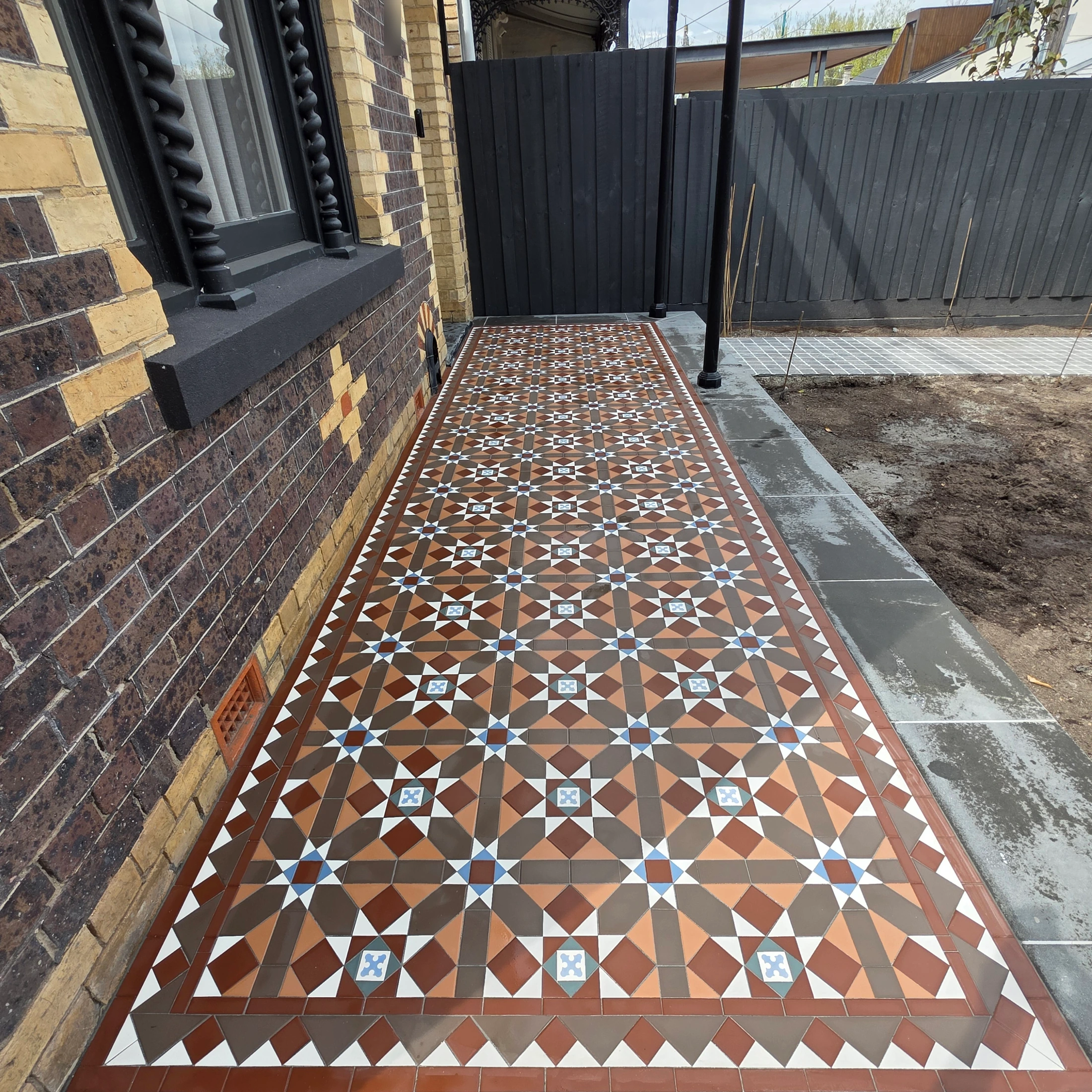
Designing for Lysterfield's foothill setting
Planning Victoria places Lysterfield among the suburbs in the foothills of the Dandenong Ranges within Melbourne's Eastern Metro region. Knox planning guidance also identifies Lysterfield Valley, Lysterfield Hills and the Dandenong Foothills as landscape-sensitive settings. For a tiled entrance, verandah or path, that makes the relationship between hard surface, garden, canopy and views especially important rather than treating the tile pattern as an isolated graphic.
On a sloping or exposed site, the design discussion should include levels, transitions, drainage and the way the finished work meets existing paving or garden edges. These are property-specific design questions, not a universal construction recipe. A site assessment can help establish the appropriate detailing before tile quantities and borders are finalised.
Pattern and material choices for rural-transition properties
The Lysterfield Valley record describes a pastoral landscape with a clear visual transition between metropolitan suburbia and the Dandenong Ranges. On properties that share that open or garden-led character, a border, scale and colour arrangement can be selected to sit comfortably with the architecture and landscape rather than overpowering either. The right balance depends on the building's proportions, the path or verandah width and the amount of pattern visible from the approach.
For a new scheme, consultation can cover tessellation, edging and the relationship with steps or thresholds. For existing work, the first question is whether sound original fabric can be retained and where selective repair, matching or carefully separated new work is more appropriate.
Check the property, not just the suburb name
Knox's rural strategy identifies particular Lysterfield landscapes and places for further heritage assessment, while the Victorian Heritage Database records Lysterfield Valley as a local-level cultural landscape spanning Knox City and Yarra Ranges Shire. Those records are useful context, but they do not mean every home in Lysterfield is heritage-listed or subject to the same controls.
Before altering older tilework or changing a frontage, the property owner should check the applicable planning scheme, overlays and any property-specific heritage information with the relevant authority. AHTC's role is to help assess the design and tiling brief; it is not to provide heritage or planning approval.
Restoration, supply and installation for local projects
If a Lysterfield verandah or pathway has loose, cracked or missing tessellated tiles, a measured assessment can distinguish repairable areas from later alterations and help determine a suitable matching approach. Where the project is new, design consultation can coordinate pattern, supply, installation and stone bullnose or edging details around the actual access, levels and surrounding finishes.
The same careful process applies whether the home is suburban, garden-oriented or part of a rural-transition setting: confirm the brief, document the existing conditions and resolve the layout before work proceeds.
Your Heritage Tiling Questions
Is every Lysterfield property heritage-listed?
No. The Lysterfield Valley is recorded as a local-level cultural landscape, and Knox strategy documents identify particular places and landscapes for assessment. That does not make every home or tile installation heritage-listed. Check the individual property, overlays and current planning requirements before altering existing work.
What should be considered when tiling a sloping Lysterfield site?
Start with the actual levels, drainage, thresholds, steps, surrounding vegetation and the way the new surface meets existing paving. Knox planning guidance calls for site analysis that considers views, open space, vegetation and drainage; the final construction detail remains specific to the property.
Can existing tessellated tiles be restored rather than replaced?
Often the first step is an assessment of the existing fabric. It can identify sound areas to retain, damaged sections to repair and locations where matching or separated new work may be needed. The appropriate approach depends on condition, availability of matching tiles and the property's design brief.
Can a new pattern work with a garden or rural-transition setting?
Yes, when the pattern is proportioned to the entry, verandah or path and considered alongside the building, planting, edges and views. Lysterfield's foothill and pastoral-transition context makes the overall relationship between hard surface and landscape an important part of the design discussion.
Discuss Your Heritage Tiling Project
Share your location, project details and photographs using our enquiry form, or call 0433 932 711.