
The Hills heritage tiling area directory
Use this The Hills area directory to find locality-specific heritage tiling guidance. The Hills brings together established urban neighbourhoods, growing centres, village settings and rural landscapes in north-western Greater Sydney. That variety can shape the way a tessellated tile project is planned: an existing verandah, garden path or entry may carry useful evidence of a property's history, while a newer home may call for a carefully proportioned interpretation of a traditional geometric floor. Authentic Heritage Tiling Co can help with design consultation, tessellated tile supply, installation, restoration and stone bullnose or edging coordination across the area.
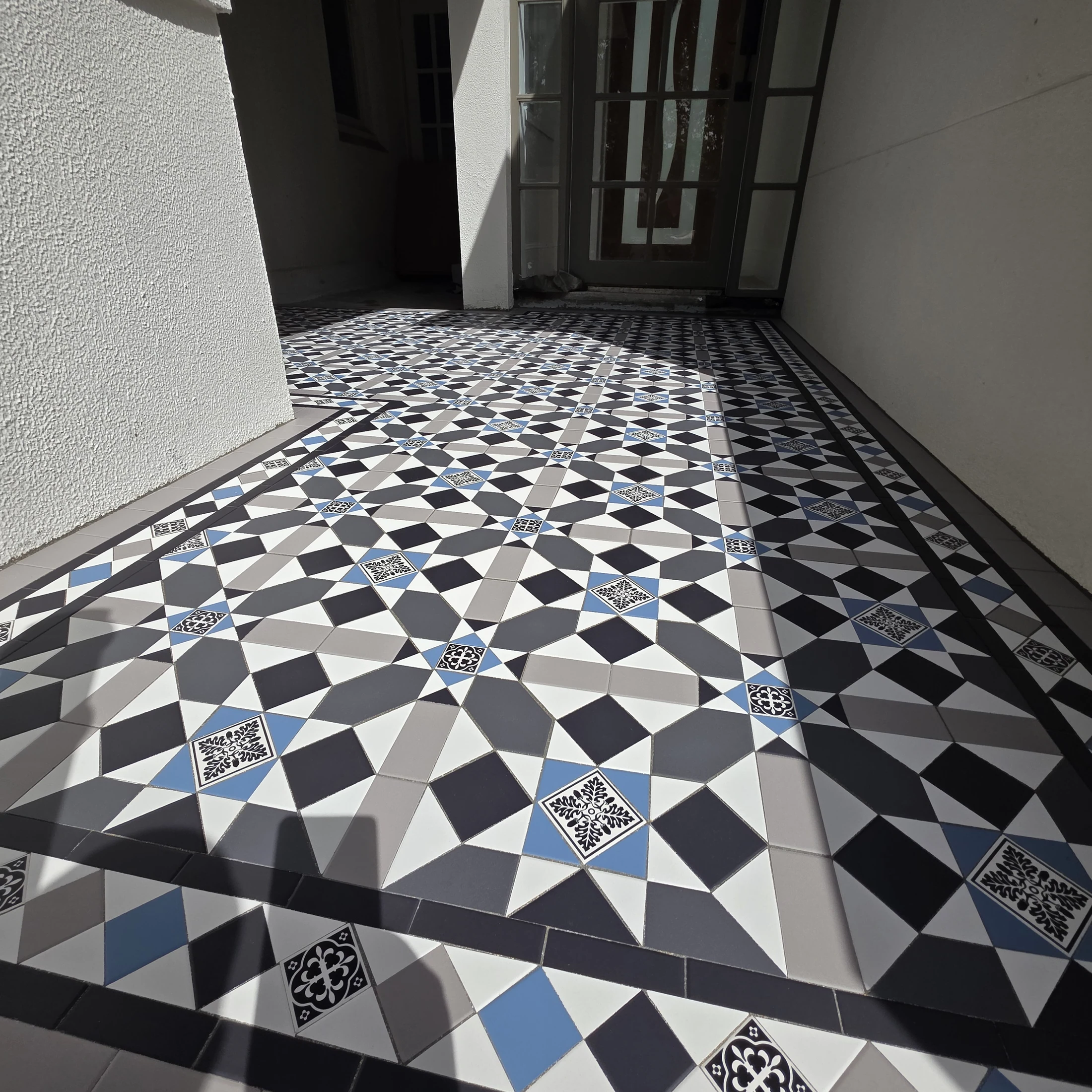
A mixed Hills setting calls for a property-led approach
Council's history of The Hills describes a place shaped by Dharug Country, early roads, farming, orchards, country retreats and successive urban development. The result is not one uniform architectural character. Castle Hill, Baulkham Hills, Norwest, Kellyville and Rouse Hill include established and changing urban environments, while Dural, Glenhaven, Kenthurst and Annangrove connect with larger-lot, village and rural settings.
For a tile project, the useful starting point is the property itself. Consider the building's scale, the approach from the street, the relationship between verandah and garden, and whether existing paving or edging survives. A new pattern can be designed with a traditional rhythm without pretending that every property belongs to the same historic period.
A Brief History of the Shire — The Hills Shire CouncilHills Future 2036 — Local Strategic Planning StatementResearching Your Home's Heritage — The Hills Shire Council
Check heritage status before altering existing fabric
The Hills Council identifies heritage items and conservation areas in planning instruments, and its guidance makes clear that significance is specific to the listed place and its setting. A property is not heritage-listed simply because it is old, and a broad locality label does not establish heritage status.
Before replacing an older verandah floor, pathway or associated edging, check the current planning information for the property and ask Council whether consent or supporting heritage information is required. Where original fabric or a significant setting may be involved, document what is present before work begins and obtain appropriate heritage advice.
Protecting Our Heritage — The Hills Shire CouncilWhat Does Heritage Listing Mean? — The Hills Shire CouncilState Heritage Inventory — NSW Government
Design details that suit Hills homes and gardens
Tessellated layouts can be developed around the proportions of an entry, verandah or pathway rather than applied as a generic repeat. Border width, transitions at thresholds, the direction of movement and the relationship with steps or stone edging all affect how the finished work reads from the garden and street.
Where an older property retains clues in its fabric, photographs, joinery, garden layout, fencing and existing paving can help inform a sympathetic design. Where the work is new, a restrained palette and clear geometry can reference the character of a period home while remaining honest about what has been added. Installation planning should also account for access, exposure and the way the tiled area meets adjoining surfaces.
What Does Heritage Listing Mean? — The Hills Shire CouncilResearching Your Home's Heritage — The Hills Shire Council
From first inspection to finished surface
A project can begin with a review of the existing space, the intended use and the design relationship between tiles, steps, pathways and edging. From there, design consultation can guide pattern and proportion, supply can be coordinated with the selected layout, and installation or restoration can be planned around the property's existing conditions.
For surviving tiled areas, restoration decisions should start with condition and significance rather than an assumption that every surface should be replaced. For new work, the aim is a durable, carefully set result that belongs to the property and its approach.
Protecting Our Heritage — The Hills Shire CouncilWhat Does Heritage Listing Mean? — The Hills Shire CouncilResearching Your Home's Heritage — The Hills Shire Council
The Hills area directory
Your Heritage Tiling Questions
Are all older homes in The Hills heritage-listed?
No. Council distinguishes individual heritage items and conservation areas from properties that are simply old or locally characteristic. Check the applicable planning information for the specific property before assuming that heritage controls apply.
Can tessellated tiles work in a newer Hills home?
Yes. A new installation can use tessellated geometry as a deliberate design reference without presenting the work as original historic fabric. Pattern scale, border treatment, transitions and the relationship with the home's entry or garden should be considered together.
What should I check before replacing an old verandah or pathway floor?
Record the existing surface and surrounding details, then check the current planning and heritage information for the property. Council guidance indicates that verandahs, pathways, gardens, fencing and other fabric can help reveal a property's history, and some work affecting a listed item or conservation area may require consent or supporting information.
Can a heritage-listed property be changed?
Heritage listing does not automatically prevent change. The proposed work should be considered against the significance of the item or area, with the current LEP, DCP and any property-specific advice checked before work proceeds.
Discuss Your Heritage Tiling Project
Share your location, project details and photographs using our enquiry form, or call 0433 932 711.